
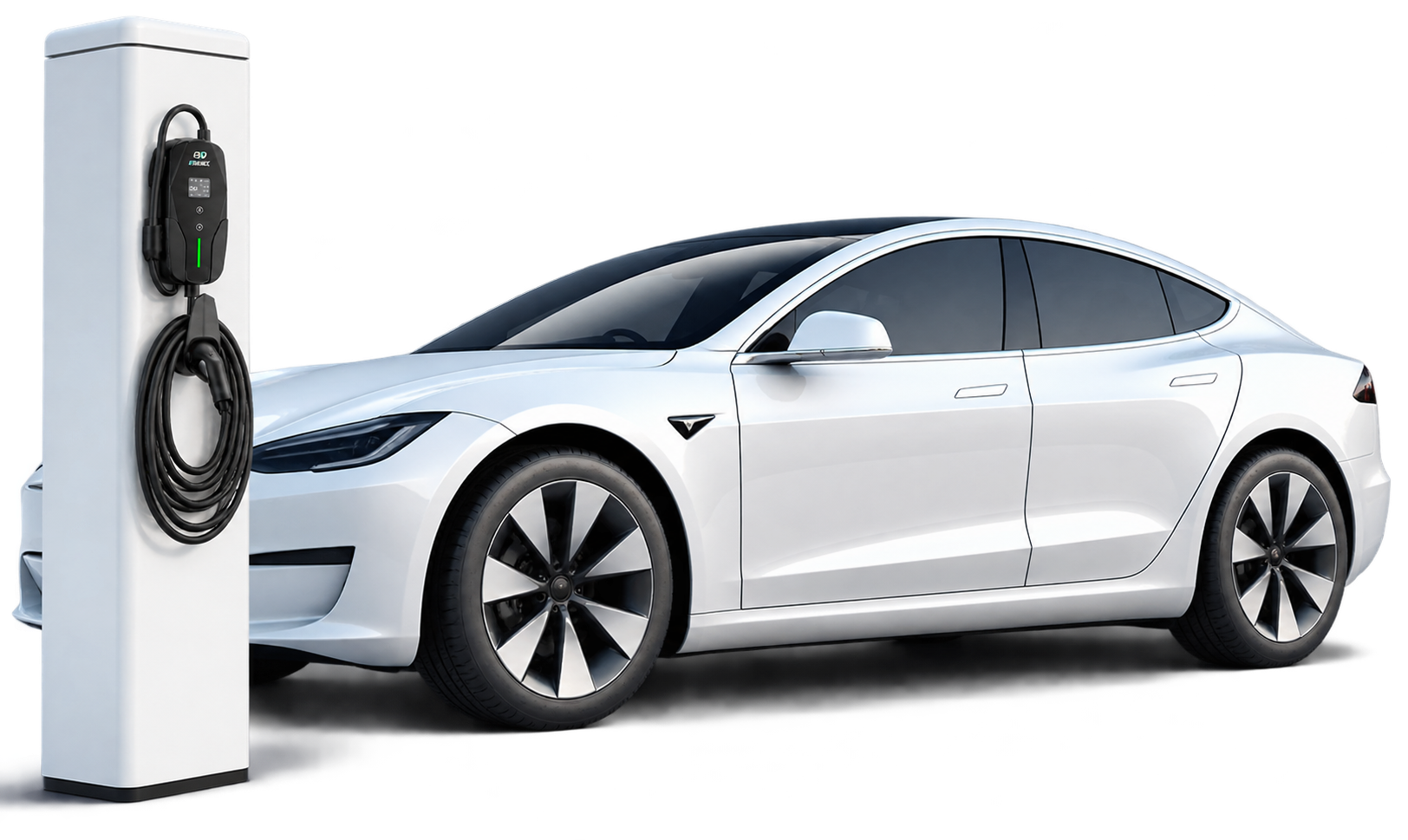
No. A home EV charger has no battery inside it. It is a controlled, safety-checked connection to your home’s electricity supply: power flows through it, from the grid to the car, and the car’s battery is what stores the energy. When the grid stops, the charger stops — it holds nothing back.
Key Takeaways
- Home and most public chargers contain no battery — they pass grid power through to the car.
- The car’s battery is the only storage in a normal charging setup.
- Battery-buffered fast chargers exist, but the battery is site equipment, not part of the plug.
- Home batteries and bidirectional charging add storage as separate systems, by design.

What Is Inside a Home Charger Instead
If there is no battery, what fills the box? Three jobs, none of them storage:
- Switching. Contactors open and close the power path only when the car is properly connected, which is why a charger clicks when a session starts.
- Safety checks. The unit monitors for faults such as ground faults and overheating, and cuts power if something is wrong.
- Communication and metering. The charger tells the car how much current is available, and smart models measure the energy delivered and report it to an app.
Our explainer on how home EV chargers work walks through that sequence step by step. On AC charging the conversion to battery-ready DC happens in the car’s on-board charger — again, in the car, not in the box on your wall.
Where the Energy Actually Sits
| Device | Stores energy? | Its role |
|---|---|---|
| Home wallbox or portable charger | No | Passes grid power to the car under safety control |
| The car’s traction battery | Yes | The only storage in a normal charging setup |
| Public DC fast charger | Usually no | Converts grid AC to DC and delivers it directly |
| Battery-buffered fast charger | Yes — a site battery | Stores energy between sessions to support high-power delivery |
| Home battery system | Yes | Separate equipment that stores solar or off-peak energy for the house |
One small sign of the pass-through design: chargers sip a little power on standby for their lights and electronics. ENERGY STAR notes that certified chargers use 40% less energy in standby than conventional models — a trickle for the control board, not a store of energy for the car.
The Exception: Battery-Buffered Fast Chargers
Some DC fast charging sites add a stationary battery next to the charger. It charges slowly from the grid between cars, then helps deliver a short, high-power burst when a car plugs in. That lets a site offer fast charging where the local grid connection alone is too small, and it smooths the site’s demand peaks.
Two things are worth keeping straight. The battery belongs to the site, not to the charger you plug into, and most fast chargers have no battery at all — they convert and deliver grid power in real time. Whether a given station is buffered is invisible from the driver’s seat and changes nothing about how you use it.
Do Not Confuse the Charger With a Home Battery
Storage enters home charging only as separate equipment. A home battery paired with solar panels can hold sunshine for the evening, as our solar and EV charging guide explains, and some EVs can send power back through a bidirectional charger, covered in our bidirectional charging explainer. In both cases the battery doing the storing is the home battery or the car’s — never a battery hidden in an ordinary charger.
For normal home use, choose a charger for its power, cable and safety listing, not for storage it does not have. The EVDANCE EV-ACT5006T 48A wall charger is a pass-through Level 2 unit, hard-wired or NEMA 14-50P, and for sites the EV-RHDC30K-L compact DC charger delivers 22 kW directly from the supply. Backup power is a separate home-battery conversation with your installer.
Frequently Asked Questions
Can my charger keep charging the car during a power cut?
No. With no battery inside, a standard charger has nothing to deliver when the grid goes down, and the session stops. Charging through an outage requires a home battery system designed for backup — separate equipment.
Why does my charger have lights, a screen and an app if it has no battery?
Those are control electronics, powered by the grid like the rest of the unit. They manage the session, show status and record energy use. They consume a small amount of standby power but store no energy for charging.
Can I charge an EV from a portable power station instead?
A large portable power station is itself a battery with outlets, and it can add a small amount of range — we cover what to expect in our guide to charging an EV with a portable battery. It is an emergency top-up, not a substitute for a charger connected to the grid.
Related Reading
- How Do Home EV Chargers Work?
- Solar Panels and EV Chargers: How to Charge With Sunshine
- Bidirectional Charging Explained: V2L, V2H and V2G
- Can You Charge an EV With a Portable Battery?

