
It can be — workplace EV charging has no special tax rule of its own. Its treatment follows your country’s general rules for employer-provided benefits, and it turns on how the charging is provided: free at work, reimbursed at home, or in a company car. In the United States, employer perks are generally taxable wages unless a specific exclusion covers them, so free charging is not something to assume either way. Your payroll team or a tax adviser gives the answer for your case.
Key Takeaways
- Workplace charging has no EV-specific tax rule; general benefit rules in your country decide.
- The setup — free at work, company car, reimbursement, employer-fitted home charger — changes the answer.
- The employer’s 30C credit covers the hardware, not your benefit treatment.
- Metered session records and a written policy are what make the question answerable — ask payroll early.
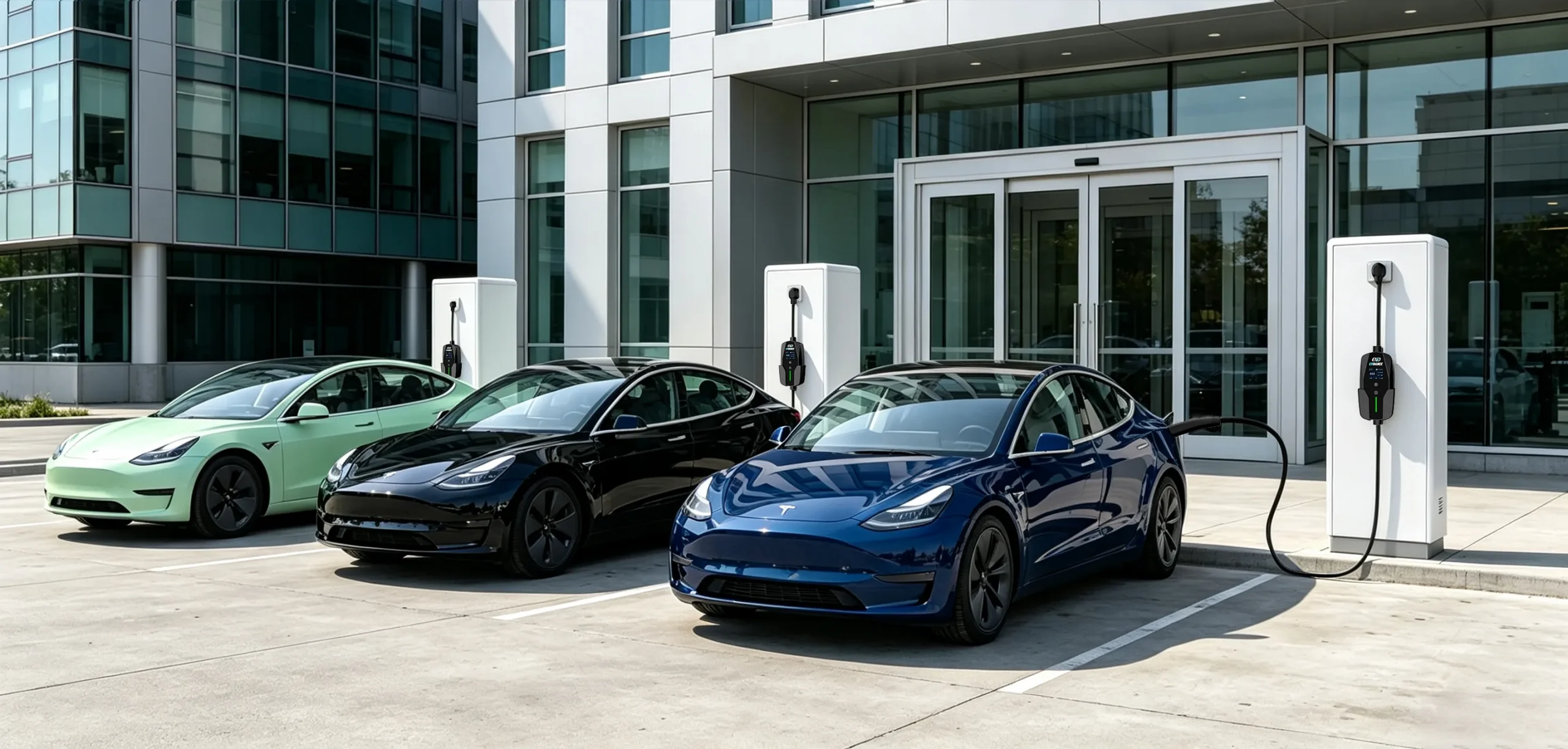
The Four Setups, and What Decides Each
| Setup | What the benefit is | What usually decides the treatment |
|---|---|---|
| Free charging at work, your own car | Free energy from your employer | Your country’s benefit rules and whether payroll reports it as one |
| Charging a company car at work | Fuel for a business vehicle | The company-car policy and how business and private use are separated |
| Employer reimburses your home charging | Cash towards your electricity bill | Whether the payment is structured as an expense reimbursement or as pay, and the records behind it |
| Employer pays for a charger at your home | Equipment, and possibly installation | Who owns the unit and what the installation was for — a business tool or a personal perk |
Two drivers in the same car park can therefore get different answers: one charging a company car on a fleet policy, the other topping up a private car as a perk. UK readers will meet the same question under a different name — “benefit in kind” — with its own rules and reporting. Wherever you are, the written policy behind the scheme is the document that matters, which is why our workplace EV charging program guide treats policy as part of the installation.
The Employer’s Side Has Its Own Tax Piece
Do not confuse the employee’s benefit question with the employer’s credit for the hardware. Under the U.S. IRS Section 30C credit, a business that installs charging property — including workplace chargers — in an eligible census tract may claim 30% of the cost, up to $100,000 per item, when prevailing wage and apprenticeship requirements are met, or 6% otherwise. Those amounts apply to property placed in service between January 1, 2023 and June 30, 2026. The credit belongs to the employer and concerns the property; it says nothing about whether your charging is taxed. Our explainer on whether EV charger installation is tax deductible covers the related deduction questions, and the IRS page for the 30C credit is the primary source.

Records Are What Make It Answerable
- Metered sessions. Workplace chargers identify each driver by RFID card or app account and record the kWh per user — how RFID cards work for EV charging explains the mechanism. Those records are what any benefit figure would be built from.
- The written policy. Free, at-cost or flat-fee — get the scheme in writing, including what happens when you leave.
- Your payslip. If charging is being treated as a benefit, it normally shows there first. Ask payroll before the first session, not at tax time.
- State programs. Some states add their own incentives or rules for workplace charging; the DSIRE database tracks them.
Hardware That Keeps Users Separate
Per-user metering is what makes any of this administrable. The EVDANCE EV-AC03201T dual-connector AC station offers two Type 2 connectors, up to 43 kW shared, OCPP 1.6J and RFID, so each session is attributed to a driver. EVDANCE’s commercial EV charging solutions cover larger workplace sites. EVDANCE is a Shenzhen manufacturer founded in 2011 and exports to 30+ countries.
Frequently Asked Questions
My employer offers free charging. Will it appear on my payslip?
That depends on how your employer treats it under your country’s rules — which is exactly why you should ask payroll directly. If it is reported as a benefit, the payslip or year-end statement is where it will show.
Is reimbursed home charging taxed the same as free workplace charging?
Not necessarily. A reimbursement is money paid to you against your own electricity costs; free workplace charging is energy supplied at work. The two setups are analysed differently in most tax systems, so do not carry an answer from one to the other.
Does the 30C credit make my workplace charging tax-free?
No. The 30C credit is the employer’s credit for installing the charging property. Whether the energy you take is a taxable benefit is a separate question with its own rules.
Related Reading
- How to Plan a Workplace EV Charging Program
- Is EV Charger Installation Tax Deductible?
- What Is an RFID Card for EV Charging?
- How Much Do EV Charging Stations Charge? Pricing Models Explained

