
Usually, yes. In an older home the charger itself is rarely the obstacle — the electrician’s first job is to check what decades-old electrical work can safely carry: the size of the service, the state of the panel, and any wiring from an earlier era on the route the charger will use. Many older homes end up charging at a lower current rather than not charging at all.
Key Takeaways
- Older homes can usually charge — the charger’s size and the preparatory work are what vary.
- The checks that matter are the service size, the panel, and any earlier-era wiring on the charger’s route.
- A continuous load exposes weak connections, so the assessment comes before the charger, not after.
- Adjustable-current chargers and load management often avoid major work entirely.

What “Older” Usually Means Electrically
Homes wired decades ago were designed for far fewer large loads — often no air conditioning, no electric dryer or range, and sometimes a much smaller service than today’s norm. Three findings come up again and again:
| What the electrician finds | Why it matters for a charger | The usual route |
|---|---|---|
| A small service and a panel that is already full on paper | The load calculation leaves no room for a full-size charger circuit | A lower-current charger, load management, or a service upgrade |
| An elderly fuse box or early breaker panel | Parts, breakers and capacity may no longer suit a new continuous load | Panel replacement, often combined with the charger circuit in one job |
| Wiring from an earlier era — for example aluminium branch wiring or, in the oldest homes, knob-and-tube | Connections and insulation from another era need assessing before they carry hours of steady current | The electrician advises what must be renewed on the charger’s route |
None of these is an automatic “no”. They change the size of charger you can run and the work that comes first. Our guide to panel capacity and charger size explains the load calculation your electrician will run.
Why a Charger Raises the Bar on Old Wiring
Most household loads switch on and off. An EV charger does not: the National Electrical Code treats EV charging as a continuous load, so the breaker is sized at 125% of the charger’s current — 32 A of charging needs a 40 A breaker, 40 A needs 50 A, and 48 A needs 60 A. Hours of unbroken current find weak points: a tired connection that copes with a kettle can run warm under a charger. That is why the checks concentrate on the circuit the charger will actually use.
The Routes That Avoid Major Work
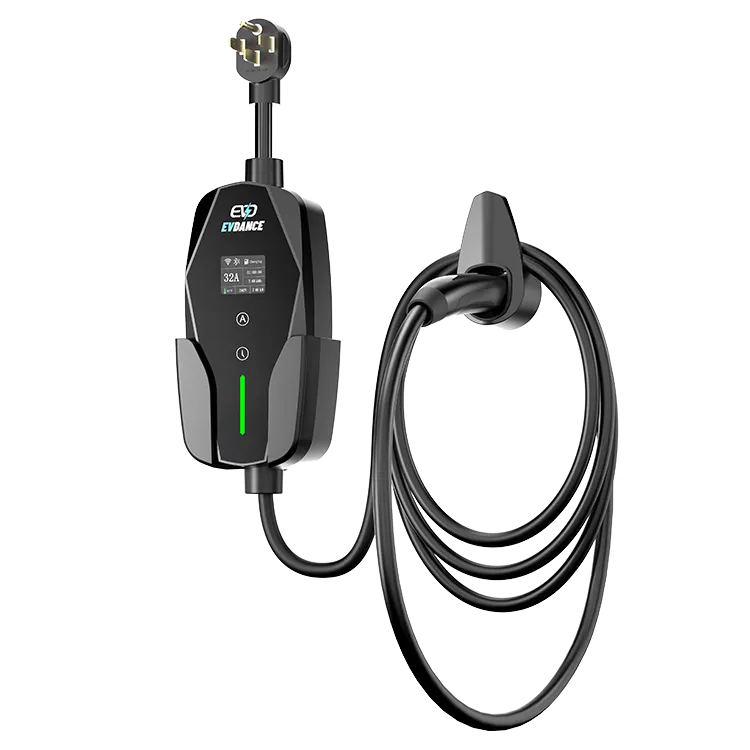
- Turn the charger down. An adjustable charger set to a lower current still adds useful range overnight. The EV-ACS3210T portable charger adjusts from 10 A to 32 A in six steps, and the EV-ACS4005T offers 16, 24, 32 and 40 A settings.
- Use an existing circuit an electrician has checked. A portable charger on a sound, correctly rated outlet avoids new wiring — but in an older home, have that outlet and its circuit assessed first rather than assuming.
- Add load management. A device that watches the house load and slows charging when the house is busy can fit a charger into a service that a fixed full-power circuit would not.
- Sequence the big work. If a panel or service upgrade is coming anyway for other reasons, the charger circuit can be added in the same project.
What Not to Do
Do not treat an old, unassessed outlet as a permanent charging point simply because the plug fits, and do not judge capacity by counting empty slots in the panel — capacity is a load calculation, not a slot count. Above all, do not wire any of this yourself: as our guide to installing a Level 2 charger yourself explains, the new circuit and any panel work belong to a licensed electrician.
Frequently Asked Questions
Does all the old wiring have to be replaced before I can charge?
Not automatically. The assessment concerns the service, the panel and the circuit the charger will use. Wiring elsewhere in the house is a separate conversation with your electrician.
Can I just use Level 1 charging in an older home?
Level 1 draws about 1 kW, so it is the gentlest option for a small service, and it covers low daily mileages. Have the outlet and circuit checked first anyway — age affects outlets as much as panels, and the charge will run for many hours at a time.
Will the inspector examine the whole house?
Inspection covers the new work and what it connects to; how far an inspector looks beyond that varies by area. Ask your electrician what to expect locally before the work starts.
Related Reading
- What Size EV Charger Can I Have at Home? Panel Capacity Explained
- What Size Breaker Do I Need for an EV Charger?
- Can I Install a Level 2 Charger Myself?
- How Long Does EV Charger Installation Take?

