
An EV charger datasheet packs a lot of information into one page. For importers, distributors and project buyers, reading it correctly is the first step to choosing the right product and avoiding costly mistakes. This guide walks through the main sections and what to check in each.
Electrical Specifications
| Line | What it tells you | What to check |
|---|---|---|
| Input voltage | Supply the charger is designed for | Matches your grid: e.g. 230V single-phase, 400V three-phase, 240V split-phase |
| Rated power | Maximum output | Consistent with voltage × current × phases |
| Max / adjustable current | Current limit and user settings | Steps suit the circuits your customers have |
| Grid plug or connection | Plug type or hardwired terminals | Correct for the local sockets and rules |
| Vehicle connector | Type 1, Type 2, NACS, GB/T | Matches the cars in your market |
| Charging mode | Mode 2 (portable) or Mode 3 (fixed) | Allowed for the intended use |
Check the Numbers Add Up
Power should equal voltage × current (× 3 for three-phase). A 32A single-phase charger at 230V gives about 7.4 kW; at 240V about 7.7 kW. A 32A three-phase charger at 400V gives about 22 kW. If the numbers do not add up, ask the supplier.
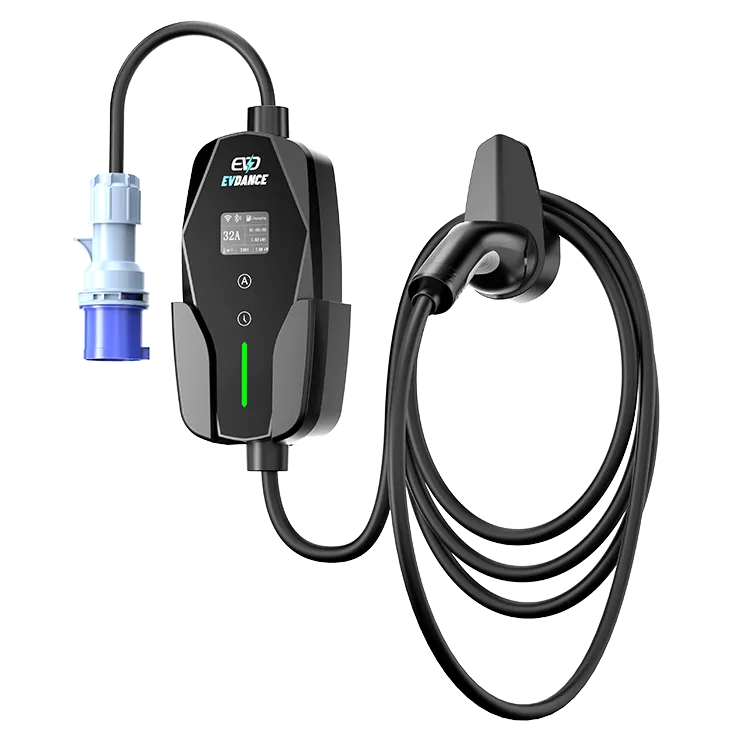
Physical and Environmental Specifications
- IP rating: IP65 or IP66 for outdoor use; check whether it applies to the control box, the connector or both.
- Operating temperature: −30°C to +50°C is common; check your climate extremes.
- Cable length: typically 5 m to 8.5 m; choose for the parking layout.
- Weight and dimensions: important for portable chargers and packaging.
Connectivity and Software
Look for Wi-Fi, Ethernet or 4G, the app platform, OCPP version (1.6J or 2.0.1), load management and OTA firmware updates. For commercial buyers, OCPP support means the charger can connect to many back-office platforms.
Certifications: Verify, Do Not Assume
A certification logo on a datasheet is a claim. Ask for the certificate or test report, check the model number matches, and confirm the certificate is valid for your market. Different variants of the same product can hold different certifications, so check the exact model you are buying. Our safety guide explains why this matters.
Warranty and Support
Check the warranty length, what it covers, who pays shipping for returns and whether spare parts are available. See our warranty and repairs page. EVDANCE product pages, such as the EV-ACS3210E, list full specifications for each model.
Related Reading
- OEM and Private-Label EV Chargers: A Complete Guide for Brands
- Private-Label EV Chargers: Packaging, Labeling and Manuals
- EV Charger Warranty and After-Sales Terms: A Distributor’s Checklist
- EV Charging Industry News: NEVI Funding Returns, the 30C Tax Credit Ends, and China’s Chargers Hit 23.68 Million
Key Takeaways
- Check that power, voltage and current add up.
- Match grid plug, connector and charging mode to your market.
- Check IP rating scope and temperature range.
- Ask for certificates for the exact model, not just logos.
Sources & Standards
- IEC 61851-1 — Electric vehicle conductive charging system
- IEC 60529 — Degrees of protection provided by enclosures (IP code)
- IEC 62196-2 — Type 2 vehicle connector