
No. Most hardwired Level 2 chargers do not need a neutral wire. They run on 240 volts supplied by two hot conductors, plus an equipment ground, because the charger itself does not use 120 volts for anything. The exception is the circuit, not the charger: if the manufacturer instructions call for a neutral, or a receptacle on the circuit needs one, the manufacturer’s instructions and the National Electrical Code govern — and a licensed electrician makes that call.
Key Takeaways
- Most hardwired Level 2 chargers use two hots and a ground — no neutral.
- A NEMA 14-50 receptacle has a neutral terminal; a 6-50 and a hardwired charger do not use one.
- Breaker sizing follows the NEC 125% continuous-load rule, neutral or not.
- Manufacturer instructions and a licensed electrician decide the final wiring.
Why a 240V Charger Skips the Neutral
A neutral exists to carry current back on a 120V leg and to provide the 120/240V split that household appliances such as dryers and ranges use. A Level 2 charger draws evenly across both hot legs at 240V, so there is no unbalanced 120V load for a neutral to carry. The ground is a separate conductor: it is there for fault protection, it is not a neutral, and the two are never interchangeable. Our overview of how an EV charger is wired walks through what each conductor does.

Where a Neutral Shows Up: Plugs and Receptacles
Confusion usually comes from receptacles. A NEMA 14-50 outlet has a neutral terminal because the outlet standard was designed for appliances that use both 120V and 240V; a NEMA 6-50 has no neutral terminal at all. A plug-in charger with a 14-50 plug typically does not use that neutral pin for charging — but the receptacle type still has to match the circuit your electrician installs. Our comparison of NEMA 14-50, 6-50 and 5-15 outlets and our guide to whether a NEMA 14-50 needs a neutral cover the receptacle side of this question.
| Connection | Hot conductors | Neutral | Ground |
|---|---|---|---|
| NEMA 6-50 receptacle | 2 (240V) | No terminal | Yes |
| NEMA 14-50 receptacle | 2 (240V) | Terminal present | Yes |
| Typical hardwired Level 2 charger | 2 (240V) | Not used | Yes |
Breaker Size and the Continuous-Load Rule
Skipping the neutral does not change breaker sizing. EV charging is a continuous load under the NEC, so the breaker is sized at 125% of the charger current: a 32 A charger needs a 40 A breaker, a 40 A charger a 50 A breaker, and a 48 A charger a 60 A breaker. Conductor size follows the breaker and the run; our guide to wire size for an EV charger explains how to check it. Wire and breaker choices belong to the installer, not to trial and error.
Chargers That Can Be Hardwired
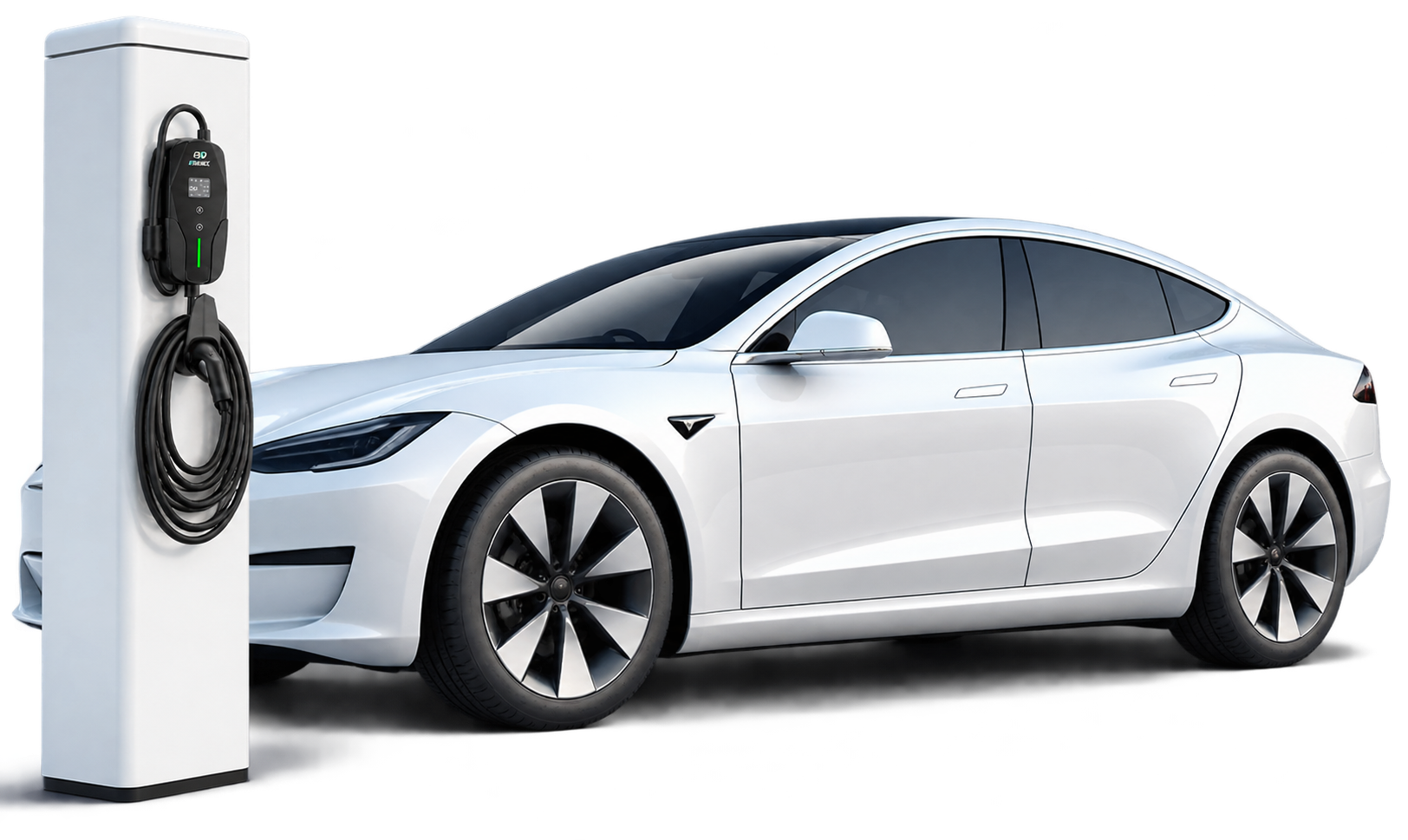
The EVDANCE EV-ACT5006T 48A Level 2 wall charger can be hard-wired or connected with a NEMA 14-50 plug, and its manual is the document that states the terminals it needs. Whatever model you install, the same order applies: read the manufacturer instructions, size the circuit to the NEC continuous-load rule, and have a licensed electrician connect and check the work.
Frequently Asked Questions
My panel has a neutral bar. Does the charger connect to it?
No. On a typical hardwired Level 2 installation only the two hot conductors and the ground land in the charger. What happens inside the panel is the electrician’s work and follows the equipment instructions.
Can I leave the neutral out of a 14-50 circuit to save money?
That is a decision for the installing electrician under local code, not a DIY shortcut. Some installations omit it where the charger is the only load; others keep it for flexibility. Ask before the circuit is run, not after.
Does a charger ever need 120V?
The charging circuit does not. Small loads such as a display or Wi-Fi radio are powered inside the unit from the 240V supply. If a specific model’s instructions say otherwise, those instructions win.
Related Reading
- Does a NEMA 14-50 Need a Neutral for EV Charging?
- How Is an EV Charger Wired? A Plain-English Overview
- What Size Wire Do You Need for an EV Charger?
- EV Charger Hardwired vs Plug-In: Which Should You Choose?

