
Yes — a small business does not need a formal charging program to let a few staff charge at work. With two or three EVs on site, one shared Level 2 charger, a simple rota and one clear rule about who pays is usually enough. Formal programs with surveys and phased rollouts suit larger employers; at small scale they add paperwork faster than they add fairness.
Key Takeaways
- Two or three staff EVs need one shared Level 2 charger and a rota, not a formal program.
- Split the day into turns; the longest commute gets priority on busy days.
- Electricity is a few dollars per top-up at commercial rates — pick free, flat or metered, and write it down.
- Add RFID access and a second connector when a fourth EV or visitor use appears.
Start With One Shared Charger
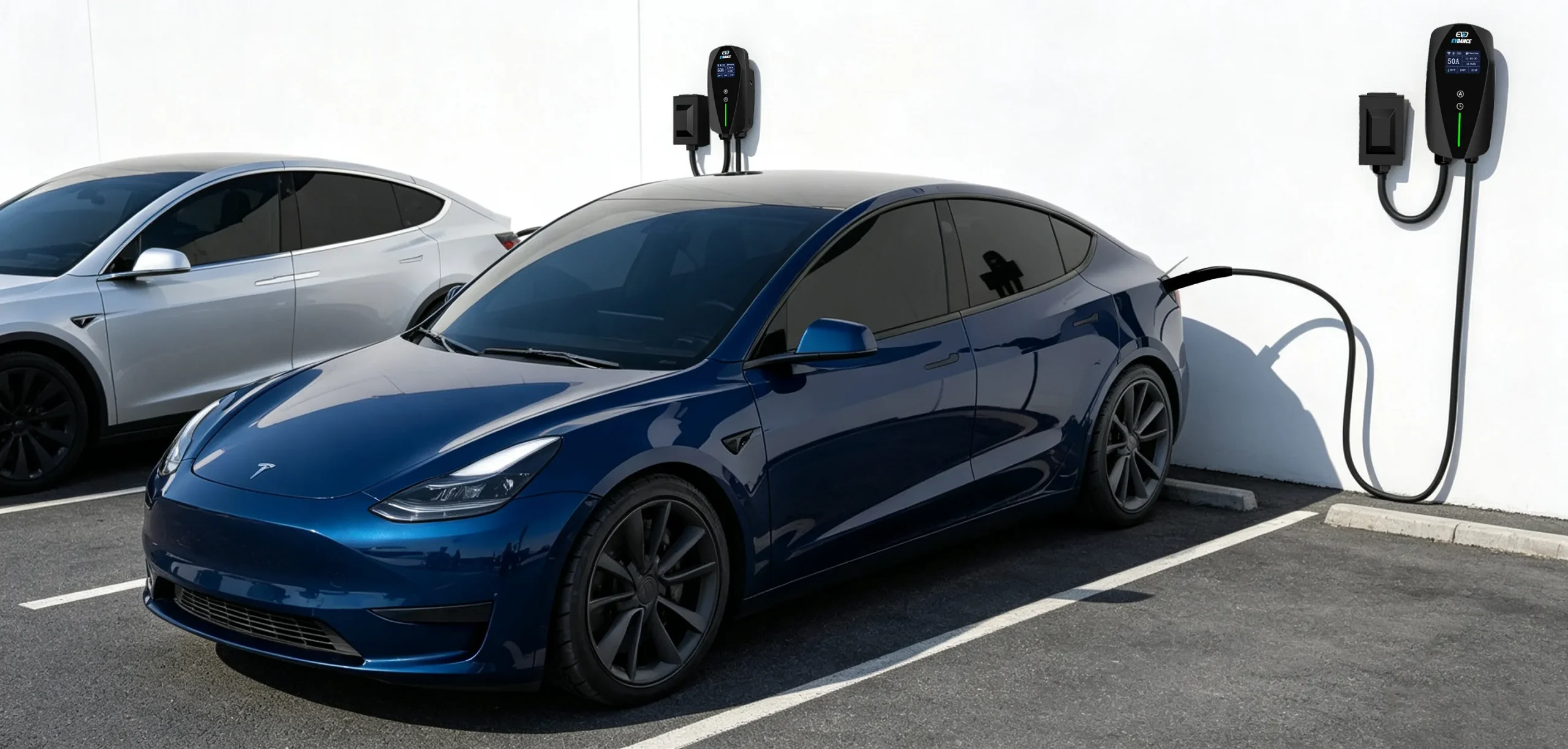
Staff cars sit parked for a full working day, so speed is rarely the problem. U.S. DOT figures put Level 2 charging at 7–19 kW, adding roughly 10–20 miles of range per hour. A single 7 kW charger used across an eight-hour day can serve two cars in half-day turns and still return more charge than a typical commute uses. Start with one charger near the building, on a circuit your electrician confirms has capacity — EV charging is a continuous load under the NEC, so the breaker is sized at 125% of the charger current. Our guide to choosing a charger for a small business covers the hardware side.
A Rota That Feels Fair Without Software
- Split the day. One car charges in the morning, the other after lunch; swap the cable at the break.
- Keep a shared list. A group chat or a whiteboard by the charger beats a booking system at this scale.
- Need-based priority. The longest commute or the lowest battery goes first on busy days — agree this in advance.
- Move when done. A finished car frees the cable, even if it stays in the car park.
How colleagues share politely is covered in more depth by the workplace charging program guide, which also shows the formal route if you later grow into it.
Decide Who Pays — With Real Numbers
The electricity itself is cheap at small scale. At the U.S. average commercial price of 14.53 cents per kWh (EIA), a 20 kWh top-up costs about $2.91. Three options cover most small businesses:
| Option | How it works | Example cost |
|---|---|---|
| Free as a perk | The business absorbs the electricity; simplest to run | Three staff topping up 20 kWh twice a week ≈ $70/month, labelled estimate |
| Flat monthly contribution | Each driver pays a fixed amount toward the bill | Set it from a month of meter readings, then review quarterly |
| Metered at cost | The charger’s meter or app records each session; drivers reimburse per kWh | 20 kWh session ≈ $2.91 at 14.53 cents/kWh |
Write down whichever you choose, even if it is one sentence in the staff handbook. Tax treatment of workplace charging varies by country and setup, so ask a tax adviser rather than assuming it is tax-free. A federal credit applied to qualifying business installations placed in service through June 30, 2026; check the IRS page and DSIRE for what applies to a new installation now.
When You Outgrow the Simple Setup
Add structure when a fourth EV arrives, when the rota causes friction, or when visitors start using the charger too. That is the point for RFID or app-based access, per-user metering and more than one connector. The EV-ACT3204PE 22 kW wallbox offers RFID and app control, and the EV-AC03201T dual-connector station serves two cars from one unit with OCPP 1.6J user management — see also how smart EV chargers work. More options are listed under commercial EV charging.

Frequently Asked Questions
How many staff EVs can one charger realistically serve?
Two comfortably, three if commutes are short and turns are disciplined. The limit is not energy — a workday offers plenty of hours — but cooperation at swap-over times.
Do we need a written policy for two or three drivers?
A short written note is enough: who may charge, how turns work, and who pays. It prevents the arrangement depending on one person’s memory when staff change.
Can staff charge a partner’s or visitor’s car too?
Decide explicitly. Most small businesses limit the perk to staff cars, because open access quietly turns a staff charger into a public one and breaks the rota.
Related Reading
- How to Plan a Workplace EV Charging Program
- What Is the Best EV Charger for a Small Business?
- RFID and User Management for Shared EV Chargers
- How Do Smart EV Chargers Work?

