
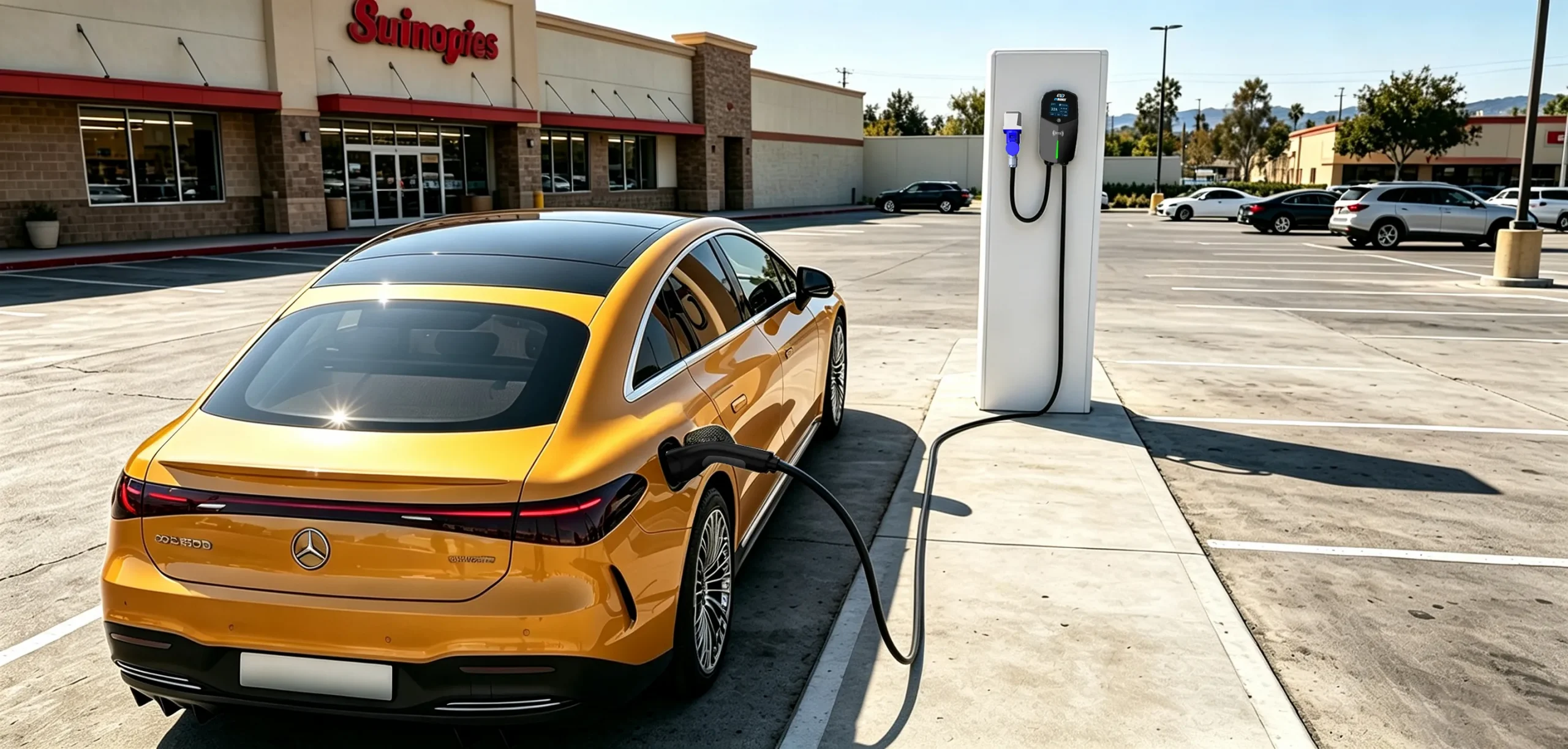
Yes — chargers are appearing at petrol stations because those sites already have what public charging needs most: a visible plot on a busy road, room to park, lighting and a shop. Forecourt charging is built around short stops, so the units are usually DC rapid chargers rather than slow AC posts. For drivers it works like any other public rapid stop: park in the marked bay, plug in, pay, and use the shop while the car charges.
Key Takeaways
- Petrol stations offer charging the location, parking and shop it needs.
- Forecourt charging is usually DC rapid, built around a short stop.
- Slower bay turnover and electrical capacity are the real limits.
- Payment is usually at the charger or in an app, not at the till.

Why Fuel Retailers Want Chargers
- The sites stand on main routes where drivers already stop, which is the hardest part of a charging business to buy later.
- A charging stop lasts longer than a fuel stop, so the shop, coffee and restrooms earn more from each visit.
- Fleets, vans and high-mileage drivers pass the same forecourts every day, giving the site repeat users instead of one-off visits.
- Forecourts are open, lit and staffed for long hours — the qualities drivers look for in a public charging stop.
None of this requires the fuel side to disappear. Most sites that add charging run both offers side by side, and let the mix change as their customers change.
What a Forecourt Charging Stop Is Like
| Aspect | What to expect |
|---|---|
| Charger type | Usually DC rapid. The U.S. DOT puts DC fast charging at 50–350 kW, adding roughly 180–240 miles of range per hour of charging. |
| Where the bays are | Marked bays, often at the edge of the forecourt rather than under the pump canopy. |
| Payment | At the charger or in the operator’s app. Federally funded corridor stations in the US must accept contactless card payment with no membership required. |
| While you wait | The dwell is the point: shop, coffee and toilets are a few steps from the bay. |
| Finding one | Locator maps list forecourt sites like any other station. |
Where the Fit Is Awkward
A fuel business is built on minutes per customer. A rapid charge takes longer, so bays turn over more slowly, and a site has to give charging real space rather than a spare corner. Electrical capacity is the second limit: several rapid units need a large supply. The DOE-cited installation figures for DC fast charging — about $38,000–$90,000 of equipment plus $20,000–$60,000 of installation per unit — explain why forecourts tend to add chargers in ones and twos, not rows. How the station side works as a whole is covered in how EV charging stations work.
What It Means for Drivers
Treat forecourt charging as an en-route top-up. The price is set by the operator, like other rapid charging — check it on the unit or in the app before you start, and see how to use a DC fast charger for the session itself. Station locators increasingly list these sites, as where to find EV charging stations explains. And do not expect every petrol station to follow: passing traffic, space and power decide, site by site.
Hardware That Fits a Forecourt
Sites with limited electrical headroom often start with compact DC. The EVDANCE EV-RHDC30K-L compact DC fast charger delivers 22 kW DC from a small cabinet, runs OCPP 1.6J and is rated IP54. Forecourts that also host longer stays add AC, such as the EV-AC03201T dual-connector AC station sharing up to 43 kW across two cars. The commercial charging solutions page sets out the options for site operators.
Frequently Asked Questions
Can I pay for charging at the till, like petrol?
Sometimes, but do not count on it. Most forecourt chargers are run by a charging operator rather than the shop, so payment happens at the unit or in its app. Look for contactless payment on the charger itself.
Are petrol-station chargers always fast?
Usually rapid DC, because the stop is short — but read the rating on the unit before you rely on it. Sites with cafés or longer stays sometimes add slower AC posts as well.
Will every petrol station get chargers?
No. Power capacity, space and passing EV traffic decide, and the installation cost is significant, so rollout starts with busy road sites rather than every forecourt.
Related Reading
- How Do EV Charging Stations Work?
- How to Use a DC Fast Charger: A Beginner’s Guide
- Where to Find EV Charging Stations
- EV Charging for Car Dealerships: What to Install and Why

