
In most cases, the charger itself cannot be repaired — and it is not designed to be. A home EV charger is a sealed, safety-listed unit with no user-serviceable parts inside. What can be fixed sits around the box: a tethered cable assembly on some wallboxes, the outlet and circuit, and settings or app faults that are not hardware failures. Before paying anyone, check whether the warranty already covers the problem.
Key Takeaways
- Home chargers are sealed units; the electronics inside are not a repair item for owners or electricians.
- Cable assemblies, holsters, outlets and settings are the fixable layer around the box.
- Check the warranty first — EVDANCE chargers carry a 3-year standard warranty.
- Heat damage, cracks or water inside mean stop and replace, not repair.

Why the Box Itself Is Sealed
A charger’s safety listing applies to the complete unit as it was tested — enclosure, electronics and cable together. Our explainer on how NRTL certification works sets out why: opening the case, swapping a board or soldering a joint produces a product that no longer matches the tested one, and normally ends the warranty too. Parts inside also connect to mains power and can stay dangerous after unplugging.
Manufacturers design chargers for exchange, not field repair: when the electronics fail, the route is a serviced or replacement unit, not a component-level fix at home.
What Can Actually Be Fixed
| Part | Who can deal with it | What is realistic |
|---|---|---|
| Tethered cable and connector | Manufacturer or qualified technician | On many wallboxes the whole cable assembly can be swapped for an approved part. The cable itself is never taped or spliced — see how long charging cables last and why they are replaced, not repaired. |
| Holster, caps and cable hooks | Owner | Cheap to replace, and they prevent the drops and grit damage that kill connectors. |
| Wall outlet or circuit fault | Licensed electrician | That is the installation, not the charger — and a worn receptacle imitates a charger fault: a loose 14-50 outlet overheats. |
| Dead display, buttons or app connection | Manufacturer support | Often a settings, firmware or account problem rather than failed hardware. If a control board has died, it is a maker repair or exchange. |
| Control box on a portable charger cord | Nobody | The cord set is one sealed assembly; a failed control box means a new unit. |
| Internal power electronics | Manufacturer service only | Sealed for safety. Do not open the unit, and do not let anyone else open it either. |
Start With the Warranty
Before comparing repair quotes, find out what the maker already owes you. Check the warranty length, what it covers, and whether labour is included — our comparison of what charger warranties actually cover walks through the differences. Have the model, serial number, purchase date, a short fault description and photos of any damage ready.
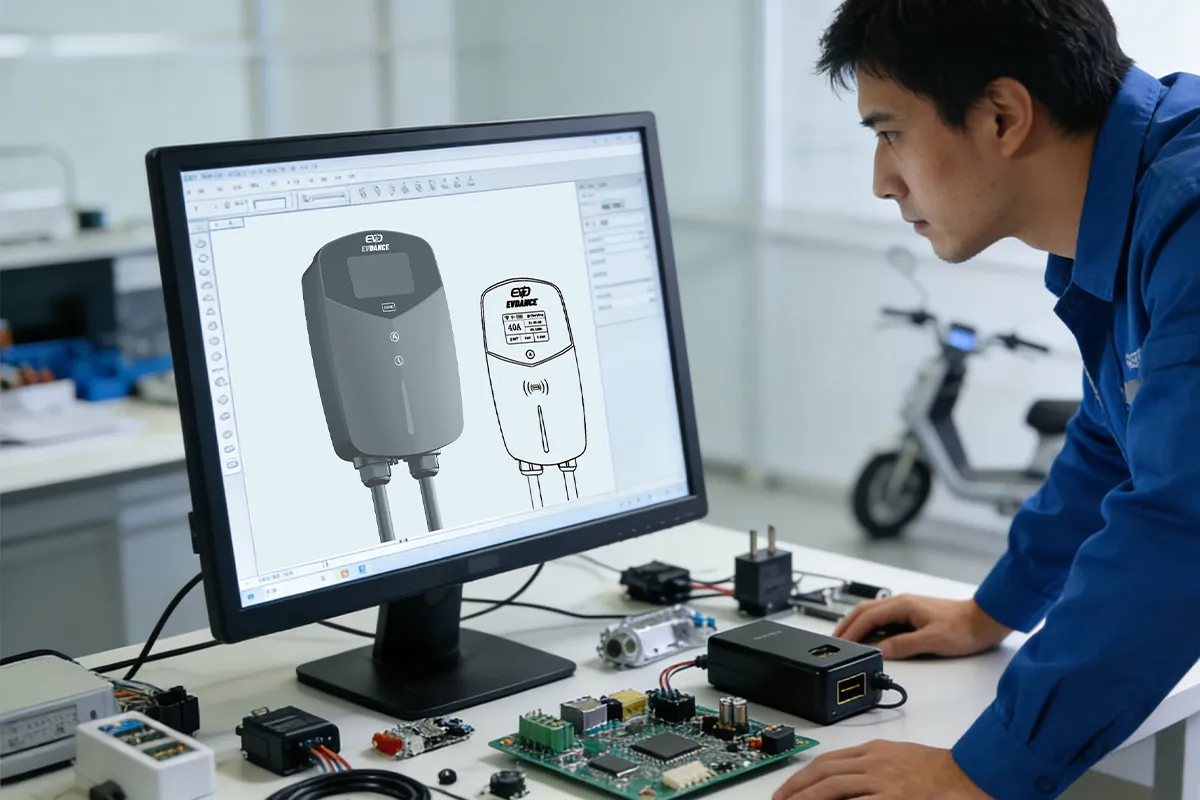
EVDANCE chargers carry a 3-year standard warranty. The EV-ACT5006T 48A Level 2 wall charger (hard-wired or NEMA 14-50P, NACS, 25 ft cable, IP65/IP66, ETL/FCC/CE) and the EV-ACS4005T 40A NACS portable charger (9.6 kW, adjustable 16/24/32/40 A, IP66) are both covered by that warranty — so a dead unit inside the term is a claim, not a purchase decision.
Repair or Replace: How the Decision Usually Falls
- Still in warranty: take the manufacturer’s route. A claim costs you time, not a new charger.
- Out of warranty, cable-only damage: ask for the price of a replacement cable assembly and the price of a new unit, and compare the two figures before deciding.
- Electronics dead on an older unit: replacement usually wins, especially if a newer car could use more power than the old unit offers (see how long home chargers last).
- Heat damage, cracked housing, water inside, burning smell: stop using the charger. Safety damage is not a repair candidate at any price.
Frequently Asked Questions
Can I open my charger and replace a circuit board myself?
No. The unit is listed for safety as a sealed whole, opening it ends the listing and the warranty, and internal parts can hold a dangerous charge. Board-level work belongs to the manufacturer.
Can my electrician repair the inside of the charger?
An electrician’s territory is the supply side: the circuit, breaker, outlet and the charger’s electrical connection. Inside the enclosure is the manufacturer’s territory. If the fault is in the installation, the electrician fixes it; if it is in the unit, it goes back to the maker.
My charger still charges but the screen has died. Is that repairable?
Sometimes — displays and control boards are maker-level repairs, and some faults turn out to be firmware or app issues rather than hardware. Contact the manufacturer before assuming the worst, and do not ignore it: if you cannot set or verify the charging current, the charger is not fully usable.
Related Reading
- How Long Do Home EV Chargers Last?
- How Long Do EV Charging Cables Last, and Can They Be Repaired?
- Which EV Charger Has the Best Warranty?
- UL and ETL Listing for EV Chargers: How NRTL Certification Works

