
Usually yes — but the charger is rarely the obstacle. A basement garage sits below living space, inside a building someone owns and insures, so the decision belongs first to whoever controls that building and to the local code review for enclosed below-grade parking, and only then to the installer. Work through who decides and what they check, and most basement projects are straightforward.
Key Takeaways
- Permission comes before hardware: the building’s owner, board or landlord decides first, the local code review second.
- The review covers the enclosed below-grade space, the electrical design at the 125% continuous-load rule, damp, and access.
- No blog can give your building’s answer — enclosed-space rules vary by building type and jurisdiction.
- A portable unit on an existing outlet is appliance use, but the outlet’s suitability is still an electrician’s confirmation.

Who Decides: Three Different Basements
“Basement garage” covers three situations with three different decision-makers. Find yours before you price any hardware:
| Your situation | Who decides | Their first question |
|---|---|---|
| Basement garage in your own house | You, within the local permit and electrical code process | Does the panel have capacity, and does the permit cover a new circuit in a below-grade garage? |
| Basement parking in a condo or apartment building | The building’s board or management, under its own rules | Do the building rules allow chargers, and who pays for the shared electrical work? |
| A rented home with a basement garage | Your landlord, in writing | Is a fixed installation allowed at all, and on what terms at the end of the lease? |
The shared-building case is where projects stall: the electrical feed, the fire strategy and the parking allocation are all building matters, which is why our guide to apartment and condo charging in shared parking starts with the building’s process rather than the charger.
What the Check Actually Covers
Whoever decides, the review works through the same subjects. None of them is answered by a charger brochure:
- The enclosed-space review. A basement is enclosed and below grade, so ventilation and the separation between the garage and the rooms above sit inside the local building and fire code review. What that review requires varies by building type and jurisdiction — it is a local answer, not a national one.
- The electrical design. A new charging circuit is a continuous load, sized at 125% of the charger’s current under the National Electrical Code — a 32 A charger needs a 40 A breaker. Capacity, route and protection are a licensed electrician’s design and a permit matter. Our explainer on whether an EV charger needs GFCI protection covers the protection side.
- Water and damp. Below-grade walls sweat and basements flood more readily than ground floors, so the unit’s sealing rating matters: read it against our IP ratings guide, and treat standing water as a stop-and-check problem, not a charging location.
- Access and signal. The car still has to get in — ramp, headroom and turning space are practical checks, not paperwork. A home charger needs no network to charge; app features need a connection, and home Wi-Fi may or may not reach a basement wall.
Hardware That Fits the Space
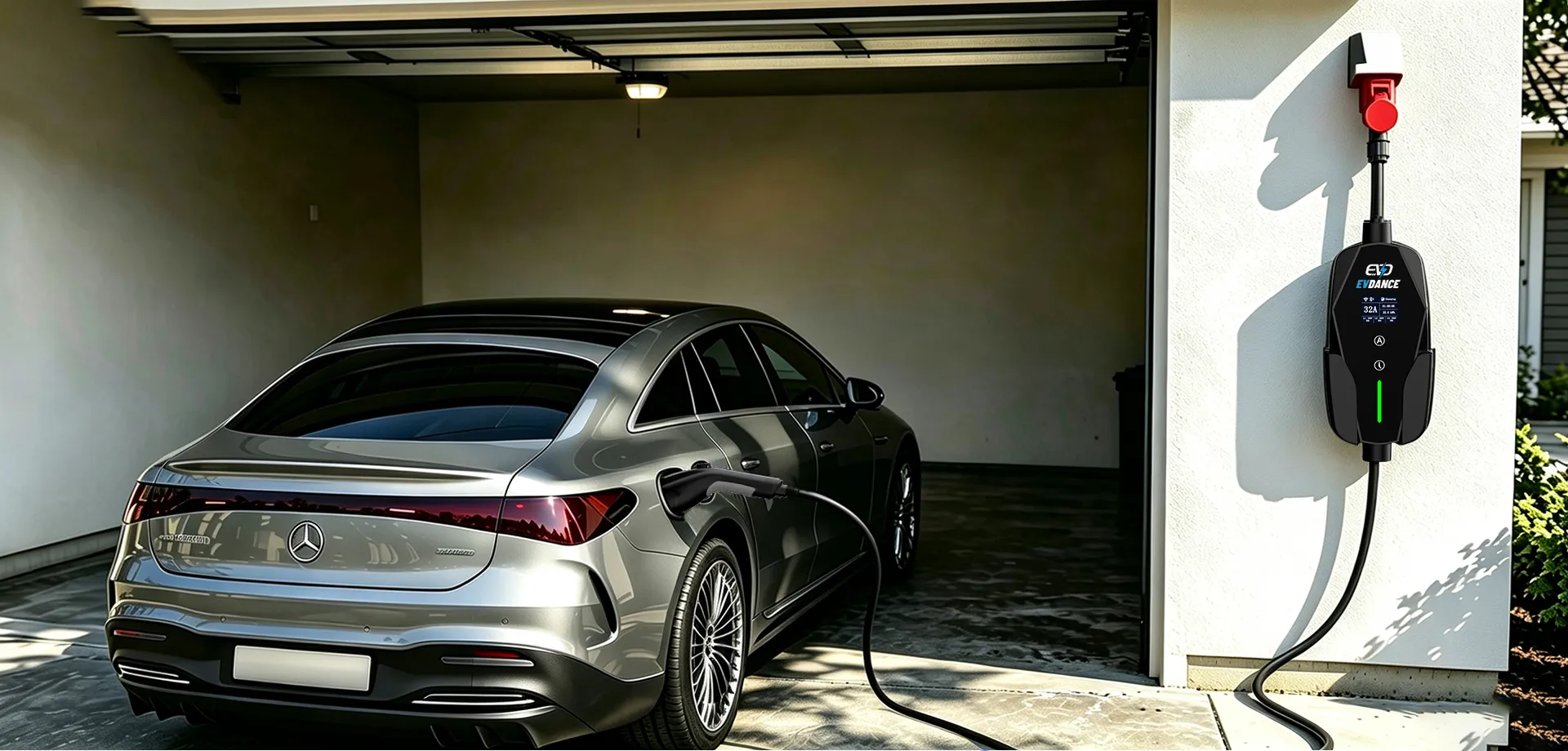
For a fixed basement installation, the EVDANCE EV-ACT5006T is a NACS wall charger running up to 48 A, hard-wired or on a NEMA 14-50P plug, rated IP65/IP66 — sealing that suits a below-grade wall, installed to its manual by your electrician. Where a building will not approve fixed work, a portable unit such as the EV-ACS4005T (9.6 kW, IP66) used on an existing suitable outlet is use of an appliance, not an installation — but the outlet’s suitability in a basement is still an electrician’s confirmation, not an assumption. The wider range is on our residential charging page.
Frequently Asked Questions
I own my house — do I still need approval for a basement charger?
Not approval, but process: a new charging circuit is permitted electrical work in most jurisdictions, designed and signed off by a licensed electrician. Ownership removes the landlord or board question, not the permit and code questions.
What if my building says no?
Then the building’s answer governs its shared electrical system and parking. Ask for the refusal in writing and ask what would change it — a different bay, a load-managed design, or waiting for a building-wide project are the usual routes. Some places have renter or owner rights in this area; those live in your local law, which is a local check, not a blog answer.
Does a basement charger need ventilation for the car?
Charging an EV produces no exhaust, so the question is not the car — it is what the local code review asks of an enclosed below-grade garage as a space. That review is the building’s and the authority’s, done before the design is fixed.
Related Reading
- Apartment and Condo EV Charging: Solutions for Shared Parking
- Should an EV Charger Be Inside or Outside the Garage?
- Does an EV Charger Need GFCI Protection?
- IP Ratings for EV Chargers: IP54, IP65 and IP66 Compared

