
At a DC fast charger, no — the cable is part of the station. At public AC posts, it depends: a tethered post has its own cable attached, while a socket-only (untethered) post, common across Europe, has nothing to plug into your car until you connect your own cable. The app or station listing tells you which type you are heading to.
Key Takeaways
- DC fast chargers are always tethered — you never need your own cable at one.
- Public AC posts come in two kinds: tethered, and socket-only — mostly in Europe, where you bring a Type 2 cable.
- The station listing and its photo tell you which kind you are heading to.
- A portable charger is a different tool, for power outlets — it does not work at a socket-only post.
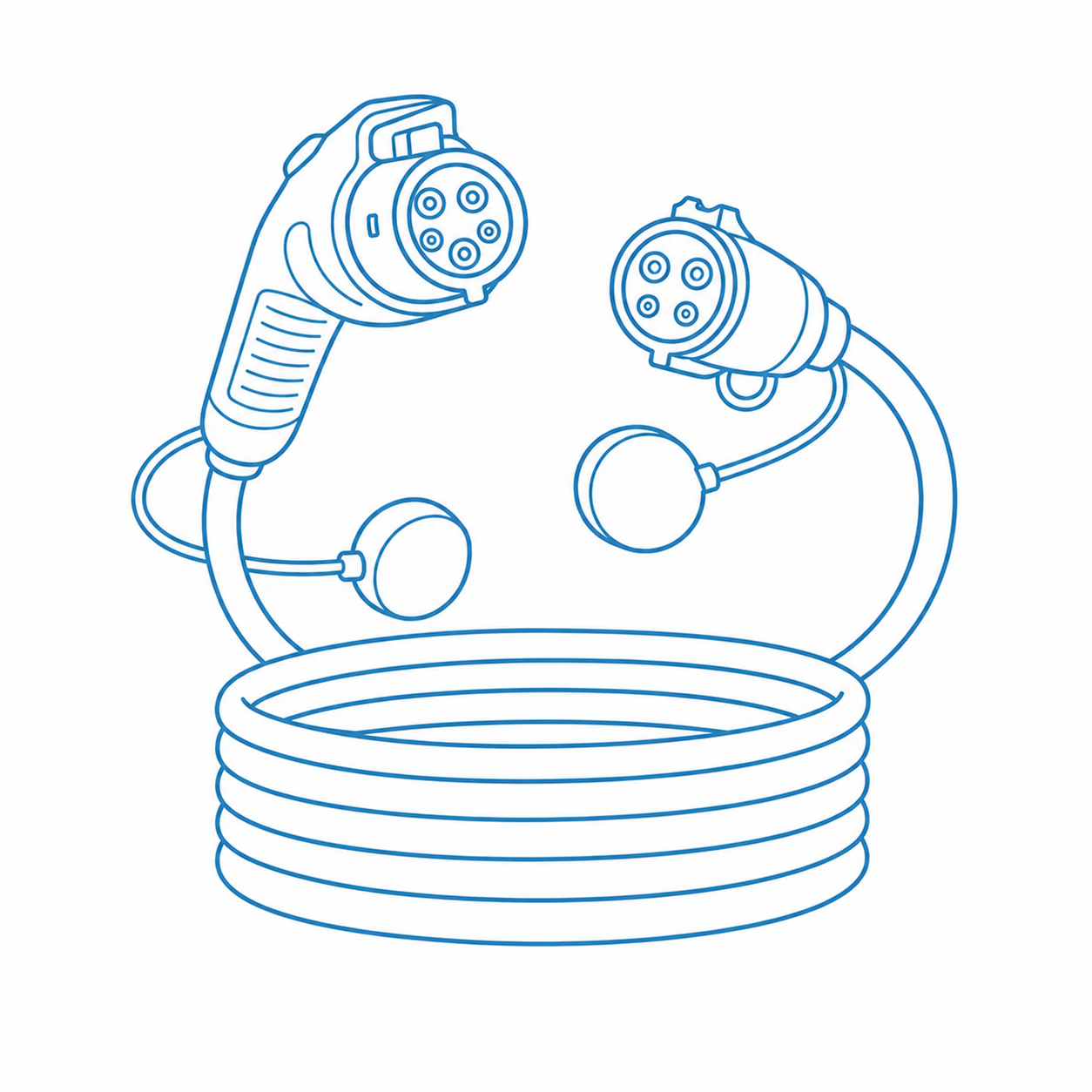
Two Kinds of Public AC Post
| Tethered post | Untethered (socket-only) post | |
|---|---|---|
| What you see | A cable fixed to the unit, ending in a connector for your car | A socket behind a flap, and no cable |
| What you bring | Nothing — unclip the cable and plug in | Your own charging cable, post connector at one end, car connector at the other |
| Where it is common | North American public Level 2 charging, with a J1772 cable | Street and car-park charging across much of Europe, using Type 2 sockets |
| Why operators choose it | Simplest for drivers; the operator maintains the cable | No cable to damage or steal; one post serves every car with the matching socket |
Federal NEVI rules set the US pattern for corridor stations: DC ports use CCS1 and Level 2 ports use J1772, both supplied as part of the station. Socket-only posts belong mostly to the European Type 2 world, where carrying a cable is a normal part of owning an EV.
DC Fast Chargers Are Always Tethered
A DC fast charger’s cable is heavy, cooled on the fastest units, and permanently attached. You pick the CCS1 (or, on some networks, NACS) handle that fits your car and plug in, as our guide to how to use a public EV charger walks through. If the cable looks damaged, do not use it; report it and move on, following the checks in why your EV charger is not working.
How to Tell Before You Arrive
- Read the station listing. Apps and the DOE Station Locator describe the connector type; a listing that mentions a socket, or a photo showing a post with no cable, means bring yours.
- Look at the photo, not just the map pin. A coiled cable or holster on the unit means tethered. A plain flap on the front means socket-only.
- Match the standard, not the brand. In Europe, socket posts are Type 2 and your cable is Type 2 at both ends. In North America a cable-less public post is rare — your portable charger is for outlets, not for these posts.

The Cable to Carry — and the Tool That Is Not a Cable
For socket posts, the cable is a plain link: a connector for the post at one end and one for the car at the other, rated at least as high as the post and your car can draw. Keep it dry, coiled loosely, and check the connectors for damage before use.
Do not confuse that cable with a portable charger. A portable unit such as the EVDANCE EV-ACS3210E 32A Type 2 portable charger (single-phase, about 7 kW, IP66) holds the safety electronics and a plug for a power outlet — it charges you at a house or campsite socket, not at a public socket post. Drivers touring Europe often carry both: the plain cable for street posts, and a portable charger like the EV-ACS3205PE 22 kW three-phase portable charger for outlets where they stay. The full range is on the products page.
Frequently Asked Questions
Can I plug my portable charger into a socket-only post?
No. A socket post expects a plain cable and does its own control and metering. A portable charger’s plug fits power outlets, not charging-post sockets, and the two would not start a session together.
What if the tethered cable at a station is too short or damaged?
Reposition the car if you safely can — charge ports sit in different corners on different models. If the cable or connector is damaged, do not use it: report it in the app and use another unit. A connector that will not come out is a separate problem, covered by why your EV charger won’t disconnect.
Does using my own cable change the charging speed?
Only if the cable is rated below what the post and car would otherwise use — the session is limited by the weakest part. A cable rated for the post’s output makes no measurable difference.
Related Reading
- How to Use a Public EV Charger (and How to Stop It)
- Why Won’t My EV Charger Disconnect? Stuck Connector Fixes
- Why Is My Electric Car Charger Not Working? A Driver’s Checklist
- Why Is EV Charging So Expensive at Public Stations?

