
No — most EV chargers are not three-phase. Most home chargers are single-phase, and three-phase models are the 11 kW and 22 kW units sold mainly for European supplies. You can tell which kind a charger is without any tools: read its power rating, its rating plate and, on portable models, its plug.
Key Takeaways
- Most home chargers are single-phase; 11 kW and 22 kW AC chargers are the three-phase models.
- The rating plate settles it: 400 V and “3-phase” versus 230 V single-phase.
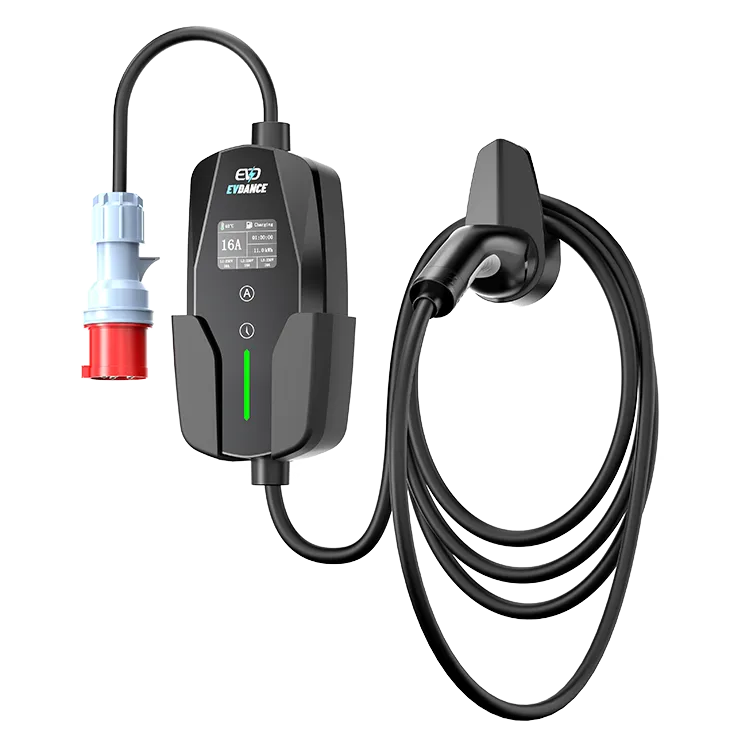
- A red CEE five-pin plug marks a European three-phase portable; Type 2 at the car end tells you nothing.
Start With the Power Rating
The fastest clue is the number on the box. AC charger ratings fall into two families, because the rating is just supply voltage multiplied by current, multiplied again by the number of phases:
| Clue | Single-phase | Three-phase |
|---|---|---|
| Rated power | 3.7 kW or 7.4 kW (about 7 kW class) | 11 kW or 22 kW |
| Voltage on the rating plate | 230 V (Europe/UK) or 240 V (North America) | 400 V |
| Phases stated on the plate | 1-phase | 3-phase |
| Portable charger’s mains plug (Europe) | Blue CEE plug, or a domestic plug | Red CEE five-pin plug |
One trap: a North American charger rated at 11.5 kW sounds like a European 11 kW three-phase unit, but it is not. North American homes use 240 V split-phase supply, which counts as single-phase for charging; the power comes from higher current instead. Our explainer on single-phase vs three-phase EV charging works through where each number comes from, and charging time at 7 kW, 11 kW and 22 kW covers what each delivers.
Read the Plug and the Plate
The connector that goes into the car will not tell you the answer: a Type 2 plug carries both through the same shell, so the car end looks identical either way. The supply end is where the evidence sits:
- The rating plate on the charger body or in its manual states the input voltage and phases. 400 V and “3-phase” settle the question; 230 V means single-phase.
- The mains plug on a European portable charger: a red CEE five-pin plug is the three-phase fitting, as our guide to CEE plugs for three-phase portable chargers sets out. A blue CEE or a normal household plug means single-phase.
- The spec sheet for wallboxes: 11 kW and 22 kW AC models are three-phase designs, while 7 kW class models are single-phase.
- In North America, a NEMA plug such as 14-50 is never a three-phase fitting — see whether NEMA 14-50 is three-phase for why.
Check the Car as Well
Identifying the charger is only half of the match. The car’s onboard charger decides how much AC power the car can accept, and it has its own phase rating, printed in the owner’s manual under “onboard charger” or “AC charging”. A car with a single-phase onboard charger plugged into a three-phase charger simply charges at its single-phase rate — nothing is harmed, but none of the extra capacity is used. A car that accepts 11 kW or 22 kW on three phases needs a three-phase charger and supply to reach those speeds. The U.S. DOT’s charger types and speeds page puts Level 2 at 7–19 kW overall, which is why both families share the same label.
Three-Phase Models From EVDANCE
EVDANCE’s three-phase range is built around the two standard ratings. The ACS1605PE 11 kW three-phase portable charger draws 16 A per phase from a CEE five-pin socket, with a Type 2 connector, 7.6 m cable and IP66 sealing. The EV-ACS3205PE 22 kW three-phase portable charger doubles that with a 32 A CEE plug. For a fixed installation, the EV-ACT3204PE 22 kW wallbox is a three-phase Type 2 unit with RFID and app control. If your supply is single-phase instead, a single-phase portable such as the EV-ACS3210E (about 7 kW, Type 2, IP66) is the matching class.

Frequently Asked Questions
Is a 22 kW charger always three-phase?
For AC charging, yes: 22 kW is the three-phase figure (400 V, 32 A per phase), and no single-phase home supply delivers it. DC fast charging is a separate system that bypasses the car’s onboard charger.
Can a three-phase charger charge a single-phase car?
Yes. The car takes the power its onboard charger can handle, at its single-phase rate. The charger’s extra phases stay unused, so the combination works — it just charges at the car’s speed, not the charger’s headline speed.
Do US homes have three-phase power for EV charging?
Residential supply in North America is 240 V split-phase, which is single-phase for charging purposes. Home Level 2 charging there scales by current — up to about 11.5 kW at 48 A — rather than by phases.
Related Reading
- Single-Phase vs Three-Phase EV Charging: 7kW, 11kW and 22kW Explained
- How Long Does It Take to Charge an EV at 7 kW, 11 kW and 22 kW?
- CEE Plugs Explained: Choosing 16A or 32A for a Three-Phase Portable EV Charger
- Is NEMA 14-50 Three-Phase?

