
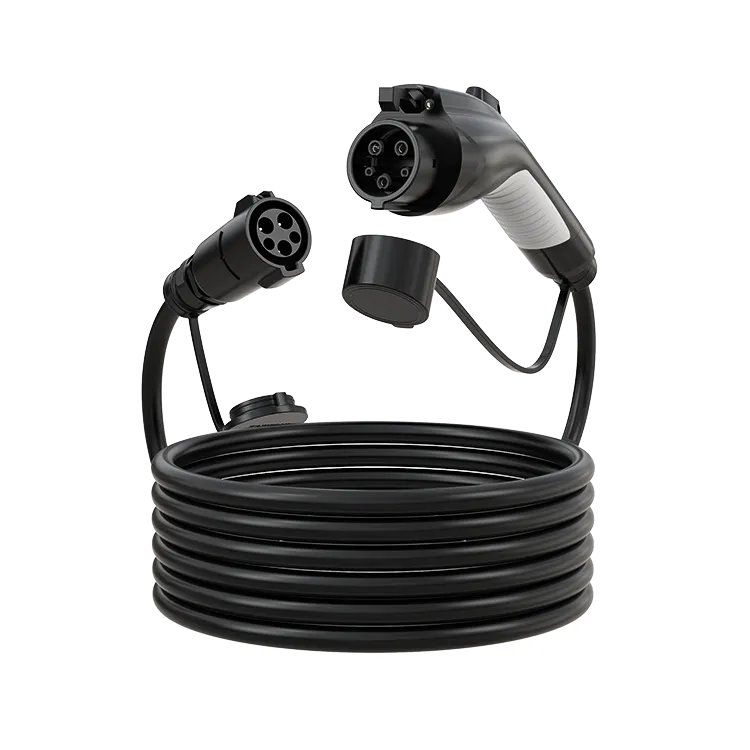
Start with the specification, because it decides the question: the EV-AC04001U ships with a 25 ft cable — the only length on the manufacturer’s listing; there is no 28 ft version of this model to order. So the driveway question is whether 25 ft honestly reaches. It does when the car parks tight to the house with its port on the house side. When it does not, the answers are parking direction, outlet placement, or a different model — in that order.
Key Takeaways
- The EV-AC04001U is listed with a 25 ft cable only — no 28 ft variant of it exists.
- A driveway spends cable on the building exit and the pavement crossing before the car, so measure the real route.
- Parking direction flips the port between the near and far corner; it is the first fix when reach falls short.
- After that: outlet placement by an electrician — or, for NACS households, the EV-ACS4005T, which genuinely offers 28 ft.
A Driveway Spends Cable Before the Car
Garage measuring starts a few feet from the car. Driveway measuring starts a room away. The cable starts at an outlet that usually sits inside the garage or on an inside wall, so three spends come first: the run to the door or wall exit, the drop and turn as it leaves the building, and the surface route across the pavement, which belongs along an edge, not across the middle where feet and tyres cross. Only then does the cable start on the car itself — and there, parking direction takes over. Nose-in puts the front of the car nearest the house; backed-in puts the rear nearest. A charge port on the far corner in one direction is on the near corner in the other, so the same car can fit inside 25 ft parked one way and fall short parked the other.
| Driveway pattern | Does 25 ft reach? | If not, the fix |
|---|---|---|
| Outlet on an outside wall beside the parking pad | Yes, comfortably | — |
| Car nose-in, charge port on the front corner near the house | Yes | — |
| Car nose-in, charge port at the rear, far corner | Marginal | Measure the real route; parking backed-in brings the port to the near end |
| Car backed in, port ends up away from the house | Often not | Flip the parking direction before spending anything |
| Wide driveway, car parks on the far side from the outlet wall | Often not | Outlet placement (below), or the longer-cable model |
When 25 ft Does Not Reach
- Change the parking, not the charger. Direction is free and instant: if one orientation puts the port within an honest route measurement, the problem is solved.
- Move the outlet, at decision level. A receptacle placed for the driveway — on the outside wall, or further along the run — is an electrician’s job, and the permanent fix. It is never replaced by an extension cord: hours of continuous charging current is exactly the duty they are not made for.
- Know where the 28 ft option actually lives. Within the EVDANCE portable range, the 25-or-28 ft choice belongs to the EV-ACS4005T — a NACS charger. For a NACS household that is a straight alternative with the extra 3 ft. For a J1772 car, it changes the connector side of the setup, so parking direction or outlet placement is usually the cleaner answer.

The Charger Itself
The EVDANCE EV-AC04001U is a 40 A J1772 portable charger: 9.6 kW, a NEMA 14-50P plug, an IP66 enclosure and the 25 ft cable. The general method for judging reach is in our EV charger cable length guide; how a portable’s speed depends on its outlet is covered in our explainer on whether portable EV chargers work. Measure the route the cable will really take — outlet, building exit, driveway edge, port — with slack in hand at the connector. If the honest measurement lands beyond 25 ft, believe it before you order, not after.
Frequently Asked Questions
Can I order the EV-AC04001U with a 28 ft cable?
No — the listing for this model specifies 25 ft, and there is no longer variant. The 25-or-28 ft choice in the portable range is on the NACS EV-ACS4005T.
Can I extend the cable to reach a far port?
Not with an extension cord — continuous charging current is the load they are unsuited to. The options are parking the other way, an electrician placing an outlet for the driveway, or a charger whose listed cable is longer.
The cable lies on the driveway during every session. Is that a problem?
The unit is rated IP66, but the cable still deserves a route along the driveway edge, out of the walking and driving lines. Our notes on leaving an EV charging cable outside cover what outdoor life does to one.
Related Reading
- EV Charger Cable Length Guide: 5 m, 7.5 m or Longer?
- Can You Leave an EV Charging Cable Outside?
- Do Portable EV Chargers Work? How Speed Depends on the Outlet

