
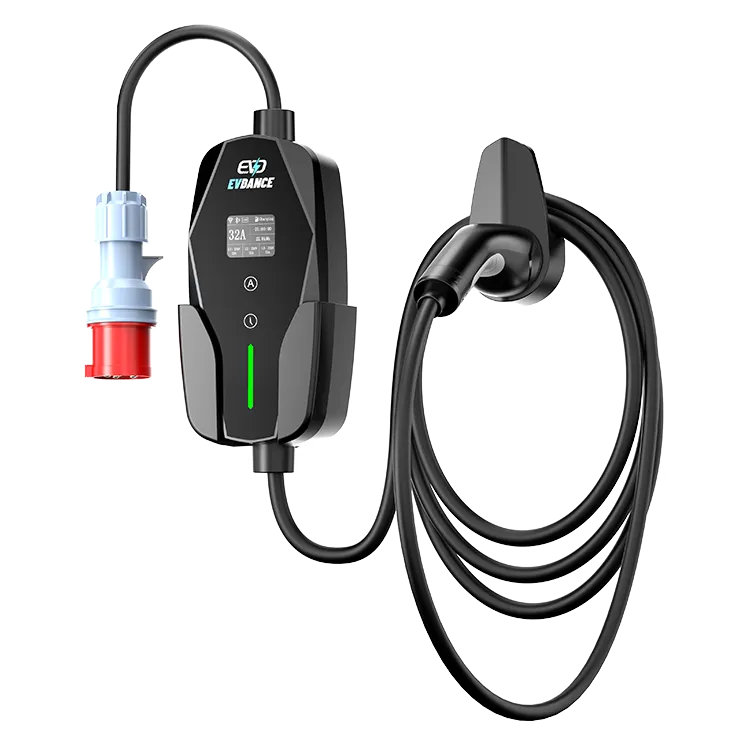
Using the EV-ACS3205PE for the first time is a plug-in sequence, not an installation. Confirm the socket is a 32 A, 5-pin CEE outlet on a three-phase supply, push the charger’s CEE plug fully into it, plug the Type 2 connector into the car, and check the car’s own display, which shows whether the session has started and the rate the car is taking. No wiring, no setup menu — the supply and the car settle the session.
Key Takeaways
- First use is a sequence: right socket, CEE plug in, Type 2 in, confirm on the car’s display.
- The car’s screen is the witness — it shows the session and the rate the car accepts.
- There is no current setting to choose on this model.
- A missing matching socket is an electrician’s job; everything after it is plug-in.
Start With the Socket: The Only Fixed Part
This charger’s whole fixed infrastructure is one socket: five pins, a printed rating of 32 A, and a three-phase 380–400 V supply behind it. Our guide to CEE plugs, 16 A vs 32 A, shows how to identify it. If your site does not have one yet, fitting it is a licensed electrician’s job. First, give the unit a once-over:
- CEE plug: pins straight and clean, housing uncracked.
- Cable: jacket uncut, no crushed sections from transit.
- Type 2 connector: face clean and dry, latch moving freely.
- Display: the 1.77-inch screen intact.
The First Session, Step by Step
| Step | What you do | What confirms it |
|---|---|---|
| 1 | Push the CEE plug fully into the wall socket | The unit’s display lights (power indication, per the manual) |
| 2 | Plug the Type 2 connector into the car until it seats and locks | The car registers the connection on its charge-port indicator or dashboard |
| 3 | Read the car’s charging screen | Charging in progress, at the rate the car is accepting |
| 4 | Wait a few minutes, then check both ends | Plug, socket and connector no more than warm; the session still running |
| 5 | To finish: end the session, unplug the car first, then the wall plug | Coil the cable wide; the unit is ready to store or move |
The car’s display is the witness that matters: the charger offers power, and the car reports what it is actually taking. That reading tells you the first session is real.

What Sets the Speed of That First Session
Two things, neither a setting on the charger. The first is the supply: 32 A on each of three phases at 380–400 V is the labelled arithmetic behind the 22 kW rating (√3 × 400 × 32 ≈ 22 kW). The second is the car: one whose onboard charger accepts 11 kW of three-phase AC charges at 11 kW on this unit, exactly as on a fixed 22 kW wallbox — our explainer on single-phase vs three-phase charging walks through those steps. One honest note: this model’s published specification lists no adjustable current steps; if a buying decision depends on a feature it does not list, confirm it with EVDANCE in writing.
If the First Session Does Not Start
- Nothing lights up: reseat the CEE plug fully; if the unit stays dark, the socket’s supply is a site question — its breaker first, and beyond that an electrician.
- Unit on, car idle: reseat the Type 2 connector until it locks, then check the car for a charge limit or scheduled window holding it back.
- Anything hot, discoloured or smelling of hot plastic: stop, unplug, and have the socket checked — the stop signs in our portable charger safety guide apply.
The charger in this guide is the EV-ACS3205PE: a 22 kW three-phase portable — 32 A at 380–400 V, CEE 5-pin plug on the wall side, Type 2 to the car, a 1.77-inch display and an IP66 enclosure — made by EVDANCE (Shenzhen, founded 2011) with a 3-year standard warranty. Where a site’s sockets are the 16 A class instead, the smaller ACS1605PE is the 11 kW portable built for them.
Frequently Asked Questions
Do I need an electrician to use it for the first time?
Not to plug into an existing, matching 32 A CEE socket — only to fit one, or to confirm a circuit you are unsure about.
Is there a current setting I should choose before the first session?
No. This model’s published specification lists no adjustable current steps; the session rate is settled by the supply and the car’s onboard charger.
How do I know the car is really charging?
The car’s own display shows the charging state, the rate it is accepting, and an energy figure that climbs as the session runs. Check it at the start and again after a few minutes.
Related Reading
- CEE Plugs Explained: Choosing 16A or 32A for a Three-Phase Portable EV Charger
- Single-Phase vs Three-Phase EV Charging: 7kW, 11kW and 22kW Explained
- Portable EV Charger Safety Guide 2026: NEC Rules, Extension Cords, and What to Avoid

