
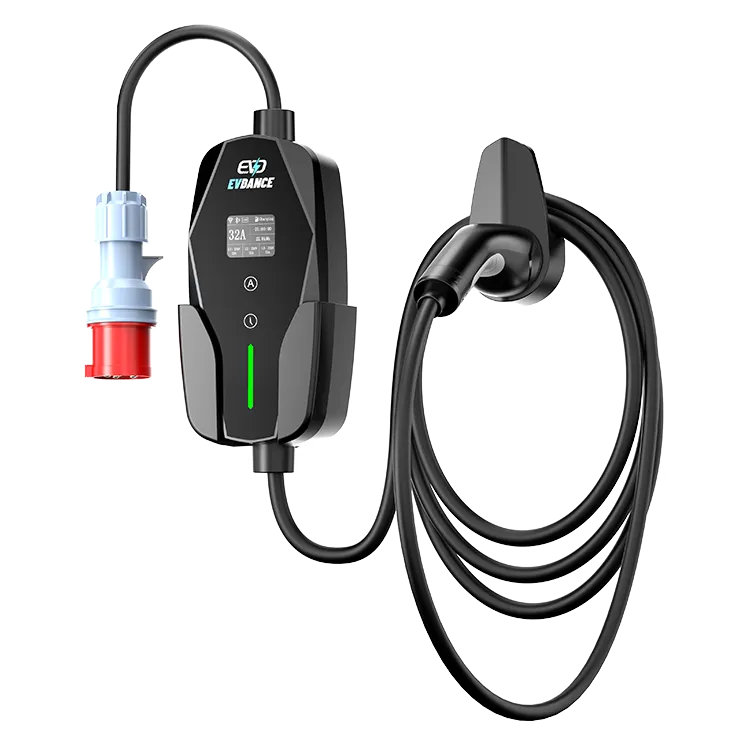
Between hires, a rental car earns nothing while it waits for charge. On a 32 A CEE socket at the return lane, the EV-ACS3205PE offers up to 22 kW — roughly 20 kWh into the battery per hour, allowing about 10% for losses, for a car that accepts the full rate. Most returns need a top-up, not a refill, so the routine around the charger decides readiness more than the hardware does.
Key Takeaways
- Between hires, the timeline is the product: inspect, charge, ready check — most returns need a top-up, not a refill.
- At full acceptance the charger adds roughly 20 kWh per hour; plan each car’s window by the car’s own rate.
- The handover level is the operator’s policy decision — no standard level is stated or implied here.
- Records are the operator’s own log: this model’s specification states a display, not a platform.
The Between-Hires Timeline
| Stage | What happens | Time it takes |
|---|---|---|
| Return | The car arrives; keys and paperwork change hands | Your own process |
| Inspect | Walk the car; check its charge port and the charger’s connector and cable | A few minutes, built into the return check |
| Charge | The car charges for whatever window the next booking allows | About 20 kWh per hour at full acceptance — a 20 kWh top-up is roughly an hour |
| Ready check | Session confirmed finished; the car shows your policy’s handover level | Minutes |
Read the charge stage conditionally: a car whose onboard charger accepts less than 22 kW stretches that stage at its own rate. Plan each car’s window by the car’s acceptance, not the charger’s rating — the discipline our fleet depot charging guide applies overnight, compressed into hours.
Inspect on Return: The Stranger Factor
An owned fleet knows its drivers. A rental fleet’s cars come back from strangers, and the return inspection is where charging joins the routine:
- The charger’s ends, before the next car. Grit in the Type 2 connector gets cleaned before it meets another renter’s car — our connector cleaning guide shows how. Damage to cable or connector takes the unit out of the pool until checked.
- The car’s charge port. Dirt or damage in the inlet is noted at return — a damaged inlet is the car’s own repair route, not something to improvise around.

The Handover Level Is Your Policy, Not a Rule
The charge level a car goes out at is the operator’s own decision — it follows the next booking’s length and what renters expect. This article sets no level, and there is no battery-health percentage to preach here: the charger’s job is narrower — reach the level your policy chose, inside the window the booking allows.
Records: The Log, Without a Platform
Be clear about what this unit is. Its published specification lists a 1.77-inch display as its interface — no app, no RFID, no platform is stated for this model. So between-hires records are the operator’s own return log: car, time plugged in, time ready. If an operation grows into needing per-session platform records, that is a written-confirmation question for EVDANCE, or the territory of a fixed station such as the EV-AC03201T (OCPP 1.6J, RFID).
The unit itself is the EV-ACS3205PE: a 22 kW three-phase portable, 32 A at 380–400 V, CEE 5-pin plug, Type 2 vehicle connector, IP66, made by EVDANCE (Shenzhen, founded 2011) with a 3-year standard warranty. The rental fit is the portable pattern: the fixed spend stays in sockets and circuits at the return lanes — the side our guide to commercial charging installation costs covers — and the pool moves as the fleet changes.
Frequently Asked Questions
How many units does a rental location need?
One per car expected back inside the same turnaround window, plus a spare. At 22 kW each unit clears cars faster than a low-power pool, but simultaneous returns still set the count — fleet size is the wrong denominator.
A returned car only accepts 11 kW of AC. What changes?
Only its time on the charger: it charges at 11 kW, so give it the longest window or the first slot in the lane.
Should the charger go out in the car with the renter?
For this unit the argument runs the other way: its 22 kW exists only at a known 32 A three-phase CEE socket — one a location controls at its return lanes and cannot control out on the road. Keeping the pool at base keeps every session on a chosen socket.
Related Reading
- Fleet Depot Charging: How to Size AC Chargers for Vans and Light Commercial Vehicles
- CEE Plugs Explained: Choosing 16A or 32A for a Three-Phase Portable EV Charger
- Are Portable EV Chargers Worth It?

