
Once a site charges at three-phase power, the next question is rarely “wallbox or portable?” — it is “which jobs does my first charger leave uncovered?” A fixed EV-ACT3204PE covers one bay completely: hardwired, always in place, RFID and app control. A portable three-phase charger covers the rest of the map: any suitable CEE socket, any building, the overflow car. Many sites end up with one of each — this guide shows how the work divides.
Key Takeaways
- The second-unit question is coverage, not preference: which jobs does the first charger leave undone?
- The wallbox owns the daily bay and access control; the portable owns other sockets, other buildings and rented spots.
- An 11 kW portable covers most second-unit work — overnight jobs do not need the second 22 kW.
- Two units running together are a combined load: get the installer’s load calculation before adding the second.

The Jobs a First Charger Leaves Behind
The uncovered jobs have the same shape whichever form you bought first. The second car, queueing for the one bay. The other building — a workshop, a yard, a second property — where cars park but no charger lives. The rented or temporary spot where nothing may be hardwired. And the vehicle that works away and charges wherever it sleeps. A second fixed wallbox answers only the first of those. A portable answers all four, at the price of being fetched, carried and put away.
Dividing the Work
| Job | Fixed ACT3204PE | Portable three-phase unit |
|---|---|---|
| The main bay, used daily | Its home ground — always in place, access controlled | Works, but is fetched and stored every day |
| A second car at the same site | A second bay’s project: circuit, mounting, cost | Plugs into the site’s other CEE socket tonight |
| Other buildings and yards | Cannot follow — it is fitted to one wall | Its home ground — travels to the socket |
| Rented or temporary spots | Needs permission to install | Charges without altering the building |
| Visitors and overflow | Card access decides who may use it | Whoever holds the unit, charges |
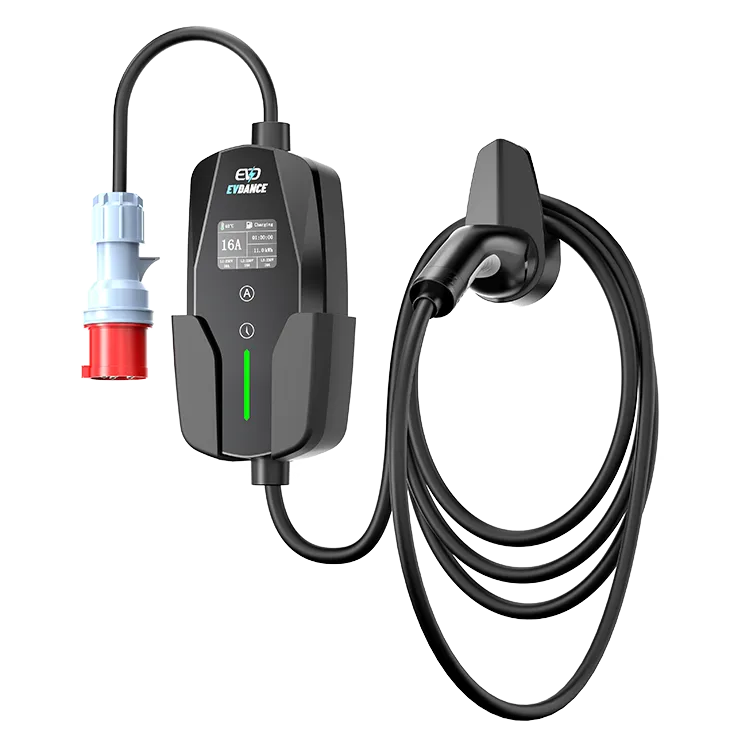
The portable side comes in two ratings: the EV-ACS3205PE at 22 kW on a 32 A CEE plug, and the ACS1605PE at 11 kW on a 16 A plug with a 7.6 m cable. For second-unit duty the smaller one is often the honest fit: overflow and away charging are usually overnight jobs, where 11 kW finishes long before morning. Our explainer on CEE plugs for three-phase portables covers which socket each needs, and our guide to portable charger types places both in the range. Neither portable lists RFID or app control — in the pair, access management lives on the wallbox.
When Both Run at Once
A pair is also a load question. Each unit draws up to 32 A per phase; if both charge at full rate in the same evening, the supply sees the combined draw — so the answer is a load calculation by your installer before the second unit is added. Our guide to load calculation basics for adding chargers to a building works through it. In practice the division softens it — the portable usually runs at the far socket, and overnight jobs rarely peak together — but “usually” is not a design. The calculation is.
The Pair, in One Place
The EV-ACT3204PE anchors the site: 22 kW, hardwired, tethered Type 2 cable, RFID and app control, IP66, CE marked. The portables extend it: the EV-ACS3205PE matches the wallbox’s 22 kW through a plug; the ACS1605PE covers the 11 kW sockets. All three carry EVDANCE’s 3-year standard warranty. EVDANCE is a Shenzhen manufacturer founded in 2011, exporting to 30+ countries. Choosing between them as your only unit is a different question — worked through at single-phase power in our 7 kW portable vs wallbox comparison.
Frequently Asked Questions
Does the second unit need to be 22 kW too?
Rarely. Second-unit work — the overflow car, the away vehicle, the other building — is mostly overnight or occasional charging, where an 11 kW portable finishes in the time available. Match the rating to the job, not to the first charger.
Can the portable back up the wallbox if it fails?
Only where a suitable CEE socket exists near the bay — the portable is a different connection, not a spare wallbox. If continuity at the main bay is critical, that is an argument for the socket being fitted there in advance, which is an electrician’s job.
Which should a site buy first?
The one matching where most charging happens. A daily main bay with several drivers points to the fixed wallbox and its access control; scattered sockets and moving vehicles point to the portable. The second purchase is then the other half of this pair.
Related Reading
- CEE Plugs Explained: Choosing 16A or 32A for a Three-Phase Portable EV Charger
- Portable EV Charger Types Explained: 10A, 16A, 32A and Three-Phase Models
- Adding EV Chargers to a Building: Load Calculation Basics
- 7kW Portable EV Charger vs. 7kW Wallbox: Which Should You Choose?

