
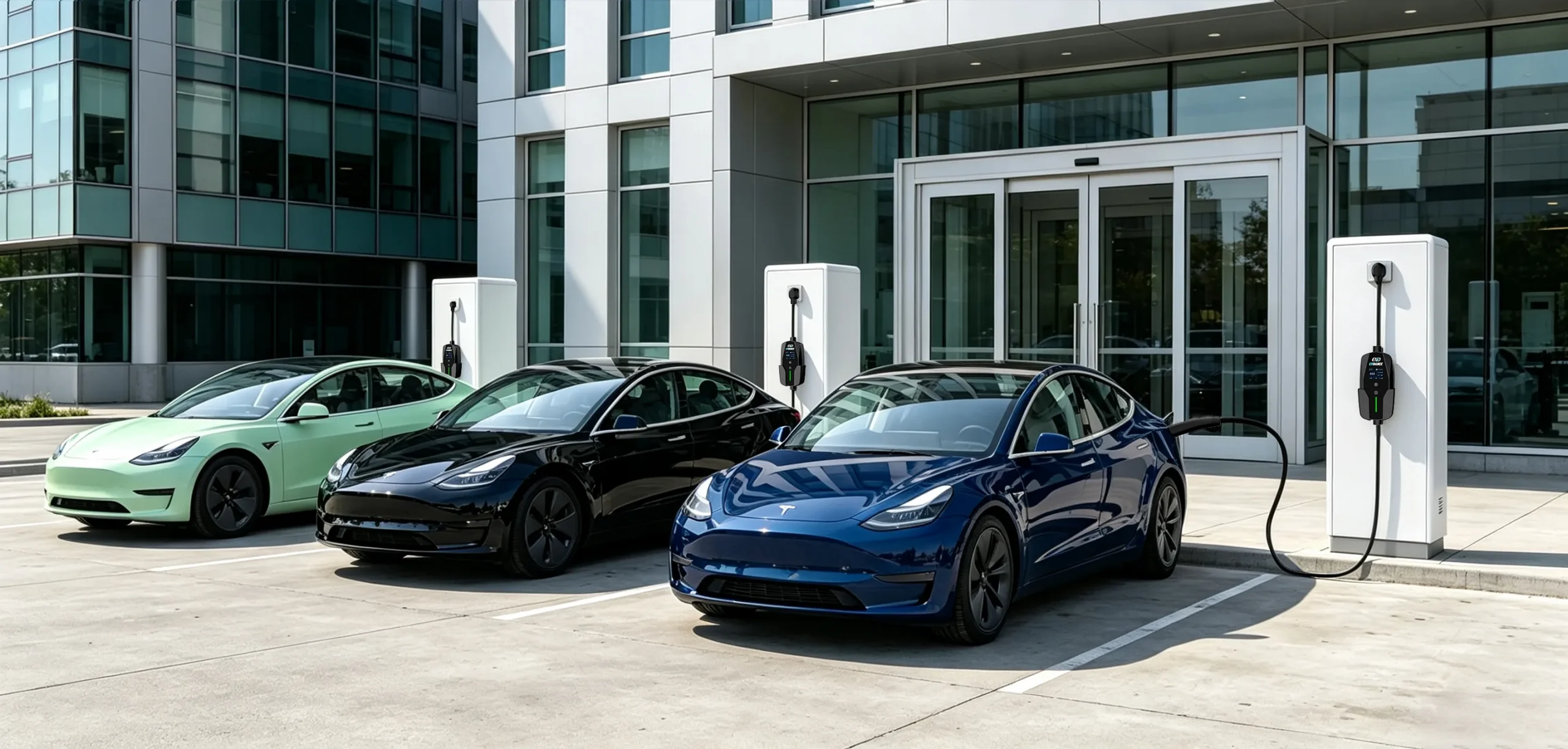
Coworking spaces and business parks need chargers that handle mixed users: members who stay all day, visitors who stay an hour, and tenant fleets. A 22 kW three-phase wallbox like the EV-ACT3204PE, with RFID and app authorization, suits this mix because it identifies each user and charges fast enough for short visits. Pair it with load management and a clear pricing policy.
Key Takeaways
- Plan for members, visitors, fleets and staff.
- Load-managed 22 kW hardware handles mixed stays well.
- Clear rules and pricing keep bays fair.
- Central OCPP management suits multi-building parks.
Who Uses the Chargers
| User group | Typical stay | Authorization | Pricing idea |
|---|---|---|---|
| Coworking members | Half or full day | Member RFID card or app | Included in membership or per kWh |
| Visitors | 1 to 3 hours | App or temporary card | Per kWh or per session |
| Tenant fleets | Overnight or between jobs | Fleet RFID cards | Billed to tenant monthly |
| Park staff | Working day | Staff cards | Employer policy |
Sizing the Installation
Start with a survey of how many EV drivers use the site and how long they stay. All-day parkers need modest power; short-stay visitors need more. A common approach is a mix of bays, all on load-managed 22 kW hardware so power is shared according to demand. Ask an electrician for a load calculation and check the park’s supply capacity before committing. Read load calculation basics and planning a workplace program.
Rules That Keep It Fair
- Set a maximum stay or idle fee once charging finishes, so cars move.
- Reserve one or two bays for visitors.
- Publish pricing at the bays and in the member app.
- Review card lists monthly as members join and leave.
- Agree who handles faults and how quickly, especially across several buildings.
Network and Back Office
For multiple buildings, an OCPP management platform centralises cards, pricing and reports. Check mobile or Wi-Fi coverage at every bay before installation. Read OCPP explained for what to ask a platform provider.
Practical Installation Points
Wall-mounted units suit buildings with walls beside the bays; open car parks may need pedestals. Plan cable routes to avoid trip hazards and protect units from vehicle impact. Good lighting and signage help visitors find and use chargers. Accessible bays deserve thought too: leave enough space beside the car, keep the charger’s controls within comfortable reach, and avoid kerbs between the bay and the unit. Small details like these decide whether visitors find charging easy or give up and leave.
The EV-ACT3204PE is a hard-wired 22 kW three-phase wallbox at 32 A and 380 to 400 V, with a tethered Type 2 cable, RFID and app authorization, an IP66 enclosure and CE and RoHS marks. Business park operators can find layouts on the EVDANCE commercial charging page.
Frequently Asked Questions
How should a coworking space price EV charging?
Many include it in membership up to a limit, then charge per kWh. Visitors usually pay per kWh or per session.
Is 22 kW necessary for a business park?
It helps short-stay visitors with cars that accept higher AC power. Load management lets it share supply efficiently.
Who manages RFID cards in a multi-tenant park?
Usually the park operator, with card groups per tenant or membership level.
Related Reading
- How to Plan a Workplace EV Charging Program
- Adding EV Chargers to a Building: Load Calculation Basics
- OCPP Explained: What Charge Point Operators Need From EV Charger Hardware
- What Is the Best EV Charger for a Small Business? How to Choose

