
Prep charging is a turnaround job: a demonstrator comes back from a test drive and needs charge before the next customer arrives. A fixed 22 kW wallbox answers it in windows, not full charges — about 10 kWh in a 30-minute window, roughly three times what a 7 kW portable adds in the same time, provided the car can accept 22 kW. This guide covers the prep bay case for the EV-ACT3204PE.
Key Takeaways
- Prep charging is measured in windows: about 10 kWh per 30 minutes at 22 kW, versus about 3 kWh from a 7 kW portable.
- Fixed suits the prep bay: always in place, nothing to lend or lose, RFID access keeps an open lot staff-only.
- The speed needs both a three-phase supply with capacity and a car whose onboard charger accepts 22 kW.
- Fixed and portable are complements on a dealer lot, not rivals — the wallbox preps, the portable travels.

Prep Is a Window, Not a Full Charge
Nobody preps a demonstrator from empty. The car goes out charged, comes back down by the length of a test drive, and needs that slice replaced. So the honest comparison is energy per window. The figures below are arithmetic on the chargers’ ratings with about 10% allowed for losses, assuming the car accepts the full rate.
| Charging option | 30-minute window | One-hour window |
|---|---|---|
| EV-ACT3204PE wallbox, 22 kW | About 10 kWh | About 20 kWh |
| Three-phase portable, 11 kW class | About 5 kWh | About 10 kWh |
| Single-phase portable, about 7 kW class | About 3 kWh | About 6 kWh |
Read the 30-minute row as the working day: a car back at midday is ready for the afternoon at 22 kW, still short at 7 kW. That is the whole “faster” claim — a comparison against portable classes on stated ratings, not DC fast charging.
Why Fixed Suits the Lot
The wallbox earns its place on logistics as much as speed. Our guide to EV charging for car dealerships covers site-wide installation; the prep bay is where fixed beats flexible:
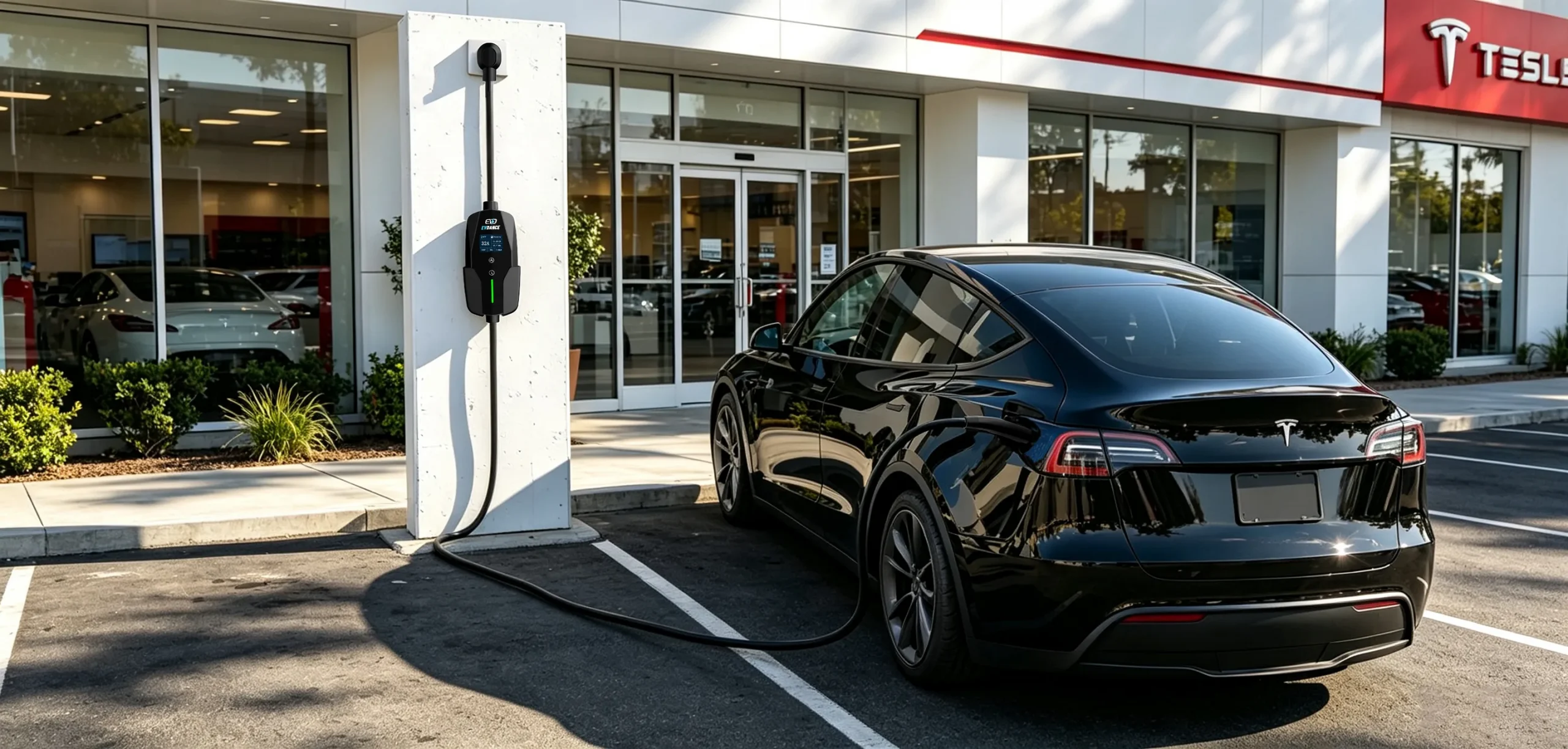
- It is always in the same bay. The car returns to the prep area and plugs in — no unit to fetch or bring back in.
- Nothing leaves the site. A portable travels — that is its strength. The fixed unit cannot be lent out, left in a sold car, or lost.
- Access is staff-only by design. The ACT3204E starts sessions with an RFID card or the app, so a charger on an open forecourt is not free charging for anyone who parks near it. Our explainer on RFID and user management for shared chargers covers card access in practice.
- It is hardwired. No plug and socket is mated all day — a permanent installation, inspected once and left alone.
The Two Conditions That Decide the Speed
The table holds only when two things are true.
The site has a three-phase supply with capacity for the unit. The ACT3204PE is specified at 32 A per phase on a 380–400 V three-phase supply. Whether the lot’s supply carries that alongside the showroom and workshop is an installer’s load calculation, done once.
The car accepts 22 kW. On AC charging, the car’s onboard charger sets the pace. A demonstrator rated at 11 kW preps at 11 kW from a 22 kW wallbox — still double the 7 kW portable’s window, but not the table’s top row. Our explainer on single-phase vs three-phase charging sets out where each rating comes from. Know each demonstrator’s AC rating, and the prep plan writes itself.
The Wallbox Behind the Prep Bay
The EV-ACT3204PE is a 22 kW wallbox for three-phase supplies — 32 A per phase at 380–400 V, hardwired, tethered Type 2 cable, RFID and app control, an IP66 housing suited to an outdoor bay, and a CE mark. Dealerships fitting out several bays order through EVDANCE’s reseller and distributor program. EVDANCE is a Shenzhen manufacturer founded in 2011; the model carries its 3-year standard warranty.
Frequently Asked Questions
How much charge does a 30-minute prep actually add?
About 10 kWh at 22 kW with roughly 10% allowed for losses — a test drive’s worth of driving. The same window adds about 5 kWh at 11 kW and about 3 kWh at 7 kW.
Will the wallbox charge every demonstrator at 22 kW?
No. The car’s onboard charger caps the session. Cars rated at 22 kW AC take the full rate; cars rated lower prep at their own rating. The wallbox cannot raise a car’s limit.
Should a dealership choose a fixed wallbox or a portable?
They do different jobs. The fixed wallbox serves the prep bay — same place, staff-only, always ready. A portable follows the cars: demos away from the bay, loaners that go home with buyers.
Related Reading
- EV Charging for Car Dealerships: What to Install and Why
- RFID and User Management for Shared EV Chargers
- Single-Phase vs Three-Phase EV Charging: 7kW, 11kW and 22kW Explained
- Portable EV Charger Types Explained: 10A, 16A, 32A and Three-Phase Models

