
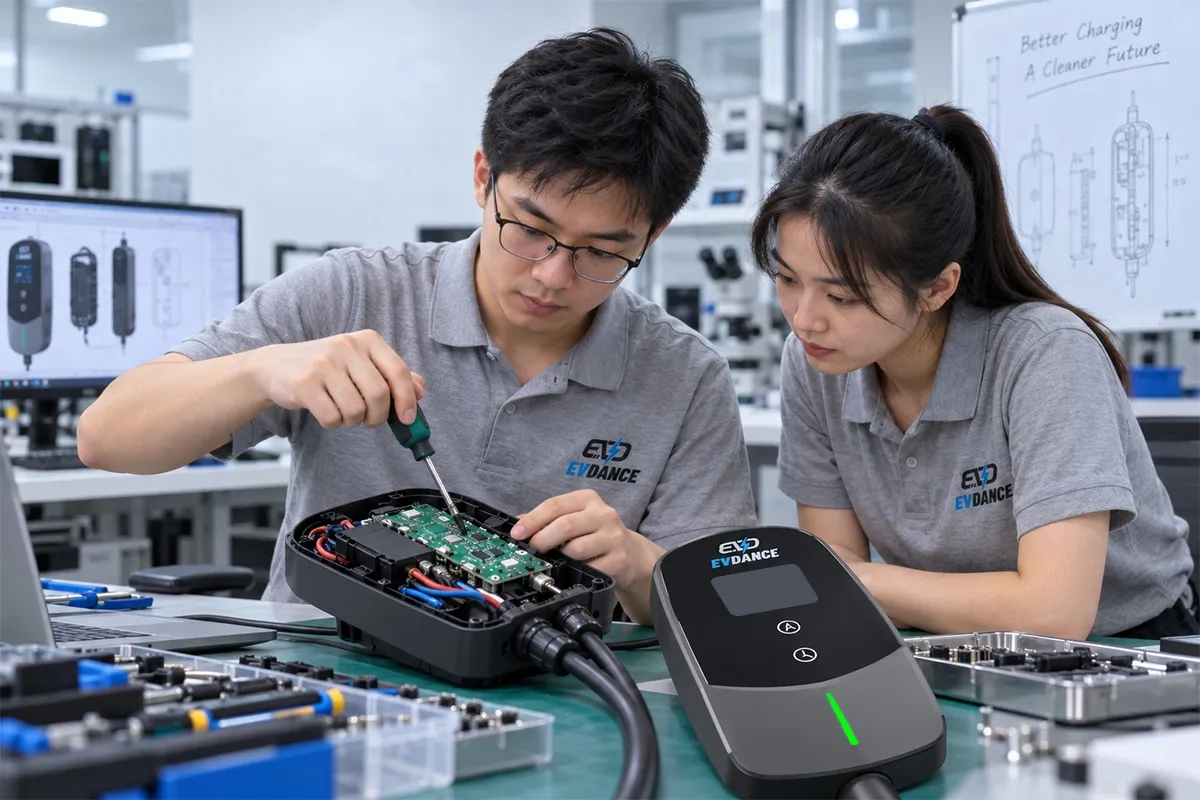
EV chargers are made in stages: printed circuit boards are populated by SMT machines, then inspected and tested; boards, relays, meters and cables are assembled into the enclosure; sensitive parts may be potted or coated; and every finished unit is tested, often burned in under load, before packing. Before any of that, the design must pass certification testing for each target market. Manufacturing an EV charger well depends as much on testing and process control as on the parts.
Key Takeaways
- Chargers are built through SMT, board testing, assembly, potting and final testing.
- Safety tests and burn-in catch most defects before shipping.
- Certification for each market is completed before mass production.
- Buyers should verify test records, traceability and inspection results.
Step by Step: How EV Chargers Are Made
| Stage | What happens | What it catches |
|---|---|---|
| Incoming inspection | Components, cable and enclosures are checked against specs | Wrong or substandard parts |
| SMT | Solder paste is printed, parts are placed by machine and reflow-soldered | Placement and solder issues, via AOI inspection |
| Through-hole and hand work | Relays, terminals and large parts are soldered | Weak joints on high-current parts |
| Board testing | In-circuit and functional tests on each board | Faulty components, firmware load errors |
| Potting or coating | Resin or conformal coating protects boards from moisture | Long-term humidity and vibration damage |
| Final assembly | Boards, cable, connector and seals fitted; torque checked | Loose terminals, poor sealing |
| Safety tests | Hi-pot (insulation), earth continuity, residual current trip | Insulation and protection failures |
| Burn-in and final test | Units run under load; communication and display checked | Early-life failures, overheating |
Certification Comes Before Mass Production
A charger design must be tested against the standards for each market before it is sold. In the US, EV supply equipment is commonly listed by an OSHA-recognized NRTL; in Europe, CE marking under IEC 61851 and related standards applies; the UK uses UKCA or CE marking. Certification fixes the design: changing a critical part later can require retesting. Our guide to EV charger certifications covers the marks buyers should ask for.
How to Manufacture EV Chargers: What a Factory Needs
- Engineering: hardware, firmware and app teams, plus a compliance engineer who manages test reports.
- Production lines: SMT, assembly stations, potting equipment, and load and safety test benches.
- Quality system: traceability by serial number, documented work instructions and failure analysis.
- Supply chain: qualified sources for relays, residual current sensors, cable and connectors.
- After-sales: spare parts, firmware updates and a returns process.
Building this from scratch is a large investment, which is why most new brands work with an existing manufacturer. If you are evaluating suppliers, our factory audit checklist and the guide to factory vs trading company help you verify that a supplier really runs these processes.
What Buyers Should Check
Ask to see test station records, burn-in procedures and serial traceability. Order a sample and test it yourself, then use pre-shipment inspection on the bulk order. EVDANCE has operated its own factory in Shenzhen since 2011, exports to more than 30 countries and offers private label from 100 units with a 3-year standard warranty through our OEM and private-label program.
Frequently Asked Questions
How long does it take to manufacture an EV charger?
Assembly and testing of a unit is fast, but a new private-label model also needs design, sampling and certification, which take far longer than production.
What is burn-in testing?
Running finished units under load for a period so that early-life failures show up in the factory instead of at a customer’s site.
Why are some boards potted?
Potting fills the area around electronics with resin, protecting against moisture, dust and vibration, which helps outdoor durability.
Related Reading
- How to Test an EV Charger Sample Before a Bulk Order
- How an OEM EV Charger Project Works, Step by Step
- UL and ETL Listing for EV Chargers
- What Drives the Unit Cost of an OEM EV Charger

