
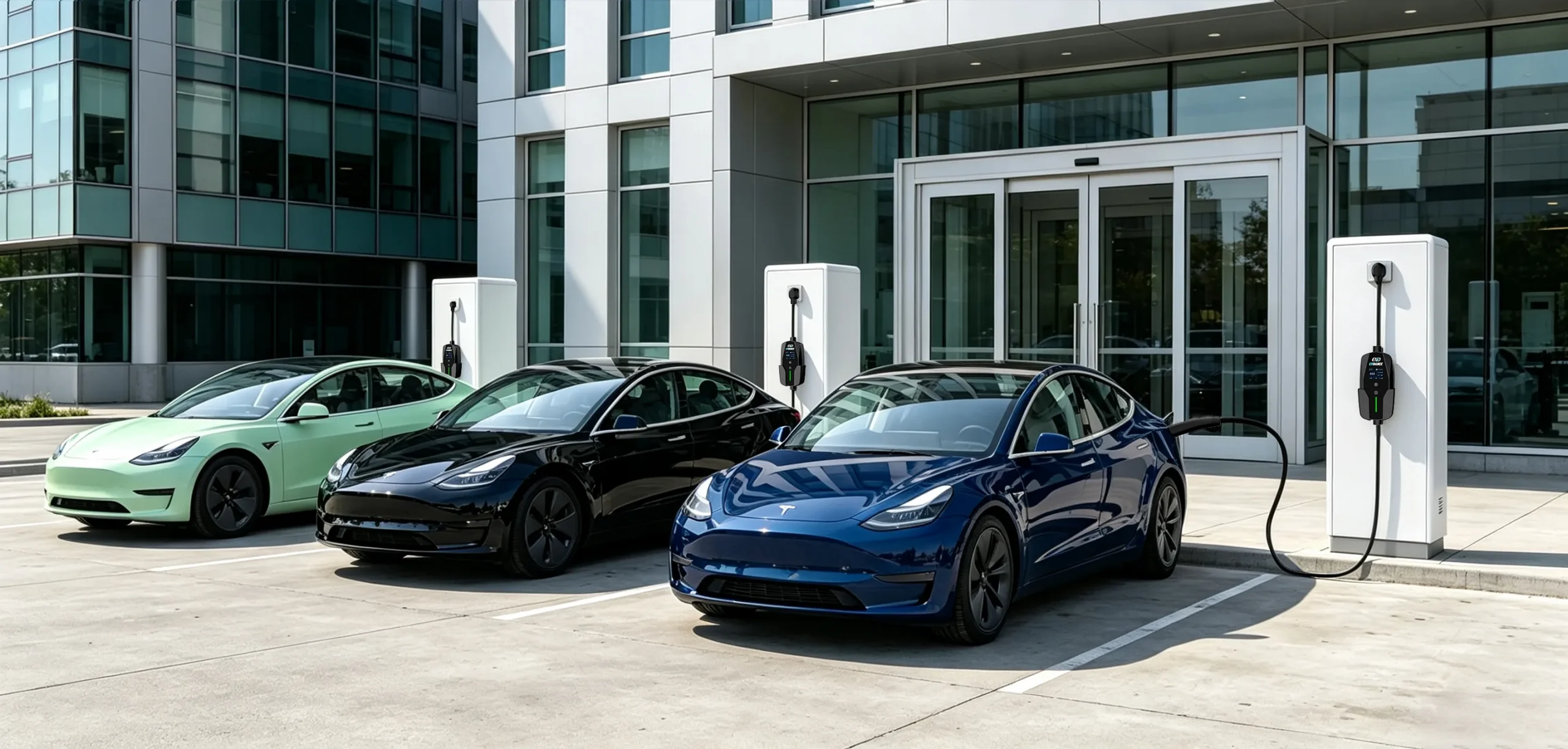
Vehicle-to-building (V2B) is bidirectional charging pointed at a commercial building instead of a house or the grid. EVs parked at a workplace, depot or car park discharge through bidirectional chargers into the building’s own supply, cutting the site’s peak demand or backing up critical loads. The energy stays behind the building’s meter — nothing is exported to the grid, which is what separates V2B from vehicle-to-grid (V2G).
Key Takeaways
- V2B sends EV energy into one commercial building, behind its meter — V2H does the same for a home, and V2G exports to the grid.
- It needs supporting cars, bidirectional chargers and an energy management system; predictable parking is what makes it work.
- The value is internal: lower peak demand and backup for critical loads, not export income.
- Most workplace charging today is one-way AC — V2B is an additional layer to plan deliberately, not a charger feature to assume.

How V2B Differs From V2H and V2G
All three are the same technology aimed at different targets, as our overview of bidirectional charging: V2L, V2H and V2G explained sets out:
| Type | Powers | Typical setting | Energy goes to |
|---|---|---|---|
| V2H | One home | A house, during outages or peak hours | The home’s circuits, behind its meter |
| V2B | One commercial building | A workplace, depot or fleet site | The building’s supply, behind its meter |
| V2G | The grid | Anywhere a utility programme runs | Out through the meter, under a programme’s rules |
Staying behind the meter makes V2B simpler than V2G: no export to sell, no export tariff or programme deciding the value. The value is internal — peak demand the building avoids, and loads that keep running when the supply fails.
What a Building Needs
- Cars that support discharge. Only certain models can send power out, under the car maker’s terms. Which EVs can do bidirectional charging is the starting check.
- Bidirectional chargers matched to those cars. A bidirectional unit converts the battery’s DC back to building AC — a different class of hardware from a one-way workplace charger.
- A building energy management system. Something has to decide when cars charge, when they discharge, and how much charge each driver keeps — without that logic, V2B is parts, not a system.
- Cars that are parked long enough. Fleet vehicles with predictable dwell times and staff cars parked all day are the natural candidates; a car that leaves at noon cannot cover the afternoon peak.
- Electrical work to code. The U.S. DOE’s guidance on procurement and installation of charging infrastructure applies as with any installation: equipment is one line in a project that also covers installation and utility work.
What Buildings Use It For
Peak shaving. Commercial bills commonly include a charge based on the site’s highest demand. Discharging cars through the building’s peak reduces what the site pulls at that moment — the cars supply the building instead of the grid supplying both.
Backup for critical loads. With the right transfer equipment, a building system can keep chosen circuits — lighting, IT, refrigeration — running through an outage, as long as parked cars and reserve settings allow.
Using more of the site’s own solar. A building with rooftop panels can store midday surplus in cars parked through the day and use it later instead of sending it out — the pairing logic of charging a car from solar panels, one step further.
Where Workplace Charging Stands Today
Most workplace and depot charging today is one-way, and for many sites that is the right scope: managed AC charging sized the way our fleet depot charging guide describes. The EVDANCE EV-AC03201T dual-connector AC station — two connectors, up to 43 kW shared, OCPP 1.6J, RFID — is that class of equipment: it charges vehicles and cannot take power back. V2B adds bidirectional hardware, supported vehicles and an energy management system on top. Confirm vehicle support and building requirements before buying anything — the same discipline our bidirectional worth-it checks apply at home scale. The commercial charging solutions page covers the one-way range available now.
Frequently Asked Questions
Is V2B the same thing as V2G?
No. V2G exports through the meter to the grid, under a utility programme that pays for it. V2B keeps energy inside one building’s supply; its value is avoided peak demand and backup — no programme, no export payment.
Can any EV take part in a V2B system?
No. The car must support bidirectional discharge, the charger must match the car, and the car maker’s terms must allow it. Fleets are the usual starting point: vehicles and parking patterns are managed centrally.
Does a building need the utility’s permission for V2B?
Rules vary by utility and by wiring. Anything that can operate in parallel with the grid commonly needs the utility’s review, even when nothing is exported — confirm during design, with the utility and a licensed electrical contractor.
Related Reading
- Bidirectional Charging Explained: V2L, V2H and V2G
- Fleet Depot Charging: How to Size AC Chargers for Vans and Light Commercial Vehicles
- Is Bidirectional Charging Worth It?
- How Do Commercial EV Charging Stations Work?

