
There is no cable size to quote for a 22 kW charger — the size is the output of a calculation, not a property of the charger. A 22 kW three-phase unit is a 32 A-per-phase class load. What cable it needs depends on the run and how it is installed — which only your installer can see. What follows: the inputs that decide the size, and why two quotes for the same charger can name different cables.
Key Takeaways
- A 22 kW charger has no catalogue cable size: the size is the output of your installer’s calculation.
- The inputs are the per-phase current, run length, installation method, grouping, conductor material and the circuit design as a whole.
- Quotes differ because their assumed routes, methods and settings differ — ask each installer to state them.
- Plug-in three-phase portables move the question to the socket’s circuit; hardwired wallboxes make it part of the install.

The Inputs the Calculation Turns On
| Input | Why it moves the size |
|---|---|
| The charger’s current, per phase | The starting point: the stated rating — and the configured setting, if installed below maximum |
| Run length | Voltage drop grows with distance; a long run can push the specification up a size at unchanged current |
| Installation method | A cable in conduit, clipped to a wall, or buried sheds heat differently — the method changes what the same cable may carry |
| Grouping and surroundings | Cables run together, or through warm spaces, run hotter — the calculation accounts for the company a cable keeps |
| Conductor material and terminations | Copper and aluminium are sized differently, and the cable must match the terminals it lands on at both ends |
| The circuit as a whole | The protective device and the property’s earthing arrangement are designed with the cable, not after it |
None of these inputs appears on a product page — which is why no product page, ours included, states a supply cable size. Our orientation guide to wire sizes for EV chargers shows the framing; your building’s number comes at the end of your installer’s version.
Why Two Quotes for the Same Charger Disagree
If two installers specify different cables for the same 22 kW unit, the difference is almost always in the assumed inputs, not in competence:
- Different routes. One quote assumes the short internal route; the other, a longer run around the building — length alone can change the answer.
- Different methods. Surface-clipped and buried sections are calculated differently. Whether the run needs mechanical protection such as armour is a route question — see our guide to armoured cable for EV chargers.
- Different settings. One design runs the charger at full rating; another configures it lower to suit the supply, and sizes for the setting.
- Different futures. A design allowing for a second charger later is a stated choice, not an error — ask whether it is in there.
Ask each installer the same questions: what route and method did you assume, what charger setting is the cable sized for, and what would change the size? Comparable answers make comparable quotes.
The Portable Exception — and the Wallbox Case
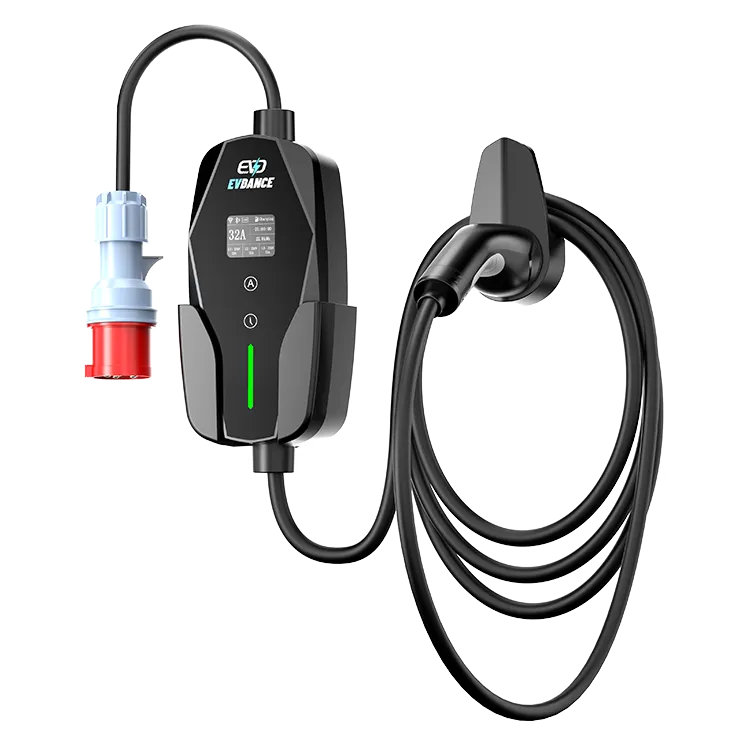
Some 22 kW charging involves no cable choice at all. The EV-ACS3205PE portable (22 kW three-phase, 32 A, CEE five-pin plug, Type 2, IP66) and the 11 kW ACS1605PE plug into a socket: the cable you specify is none, because the designed part is the circuit behind that socket — the same calculation, one step back. The wallbox case is the opposite. The EV-ACT3204PE (22 kW three-phase, tethered Type 2 cable, RFID and app, IP66, CE) is hardwired on the supply side in both versions, so its supply cable is part of the installer’s specification — EVDANCE does not state a size for it. What the buyer controls is arriving with the inputs ready: the unit and its setting, the route, and the panel position. The rest of the range is on our products page.
Frequently Asked Questions
Can I buy the cable myself and have the installer fit it?
Only buy what the installer specifies after the calculation. Bought first, it risks being the wrong type or size for the route and method — and the saving disappears if it has to go back.
Does a shorter run always mean a smaller cable?
It can — length is one input, balanced against all the others. A short run in a hot, grouped route can land on the same size as a longer, easy one.
My charger will be set below 22 kW. Does that change the cable?
It can: the circuit follows the setting the charger is installed at. Agree the setting with your installer before the cable is specified — raising it later can mean new wiring.
Related Reading
- What Size Wire Do You Need for an EV Charger?
- Does an EV Charger Cable Need to Be Armoured? (UK)
- How Is an EV Charger Wired? A Plain-English Overview
- What Size Breaker Do I Need for an EV Charger?

