
The chargers that suit Oman are the ones that pass three checks in writing before you order: their nameplate input window covers the supply your site survey actually measures, their specification answers the heat and dust questions a Gulf site asks, and their connector matches the cars that will use them. This guide states no Omani grid figures — you confirm those locally — and no product temperature ratings, because a rating only counts when the supplier states it for the exact model.
Key Takeaways
- Survey the supply first; the nameplate window of the exact model must cover what the survey measures.
- Heat is a written-confirmation item: a stated temperature range, or shade and cover written into the installation scope.
- Dust is read off the IP code’s first digit — dust-tight for exposed sites, lower ratings only under cover.
- Connector choice follows the vehicle fleet you surveyed, not the catalogue.
Check One: Match the Nameplate Window to a Surveyed Supply
Do not buy against a voltage you read on a forum. Have a licensed local electrician survey each representative site type — villa, office, depot — and record the supply as delivered: voltage, phases and frequency, from the distribution board and the utility’s service documents. Compare that record against the input window printed on the charger’s nameplate and datasheet. A model whose window does not cover the measured supply is out, whatever its other merits. Single-phase and three-phase versions are different purchases, so the survey, not the catalogue family, decides the variant.
Check Two: Heat and Dust, Asked on the Spec Sheet
Oman’s environment asks two questions of any outdoor charger. For heat: does the supplier state an operating-temperature range for this exact model, in writing? If the datasheet is silent, request the figure or treat exposed mounting as unproven and specify shade or cover in the installation scope. Our guide to hot-climate charging covers siting practice in depth. For dust: read the IP rating on the specification, where the first digit grades dust protection — our IP ratings comparison explains the scale — and prefer dust-tight ratings for exposed sites, reserving lower ratings for covered bays.
| Check | Where the answer lives | Who confirms it |
|---|---|---|
| Site voltage, phases and frequency | Site survey of the actual installation point | Licensed local electrician, against utility service documents |
| Charger input window covers the supply | Nameplate and datasheet of the exact model | Supplier, in writing, before the order |
| Heat behaviour at exposed sites | A stated operating-temperature range, or a siting specification (shade, cover, clearance) | Supplier for the rating; installer for the siting |
| Dust protection | The IP code on the specification and test report | Supplier documentation for the exact model |
| Connector fit | The inlet types of the vehicles that will charge | Your fleet and customer survey |

Check Three: Connector Follows the Cars
Connector choice is a fleet question, not a catalogue preference. Survey the vehicles your sites will serve — staff cars, customer cars, delivery fleets — and list their inlets before shortlisting hardware. Our guide to choosing plug, cable and connector by market maps connector families to vehicle populations. For mixed fleets, fixed chargers with the dominant inlet plus portables for the rest usually beats stocking every variant.
EVDANCE Candidates for the Oman Shortlist
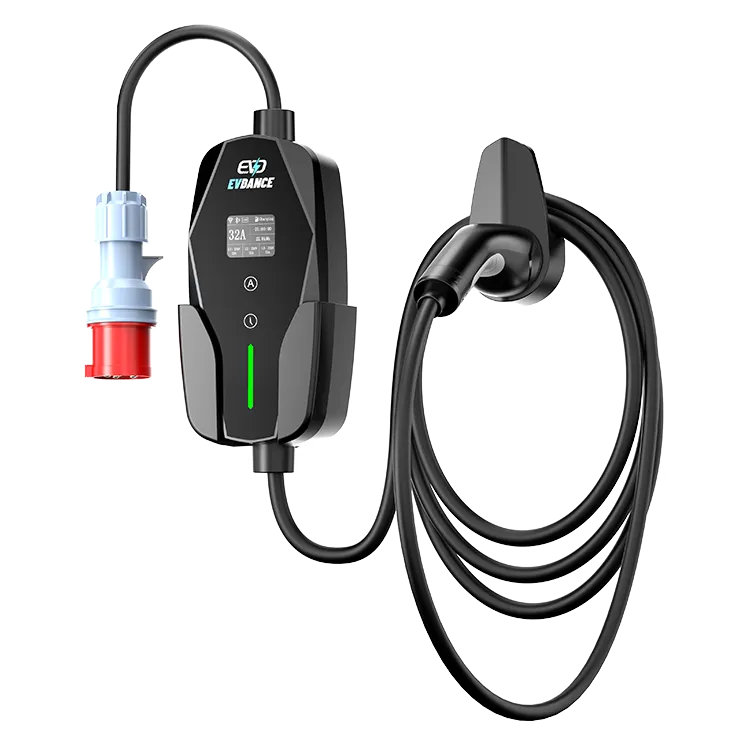
Apply the worksheet to the range on our products page. For three-phase sites, the EV-ACT3204PE is a 22 kW wallbox with tethered Type 2 cable, RFID and app, stated IP66 and CE; the EV-ACS3205PE is a 22 kW three-phase portable with a CEE 32A plug, Type 2 and IP66, and the ACS1605PE is its 11 kW counterpart. For single-phase sites, the EV-ACS3210E portable is about 7 kW, Type 2, IP66. Send your survey figures and site conditions with the enquiry via contact us, and ask for each model’s stated temperature range in the reply.
Frequently Asked Questions
What voltage and phases do Omani sites use?
This article does not state them, on purpose: the binding answer is the supply measured at your site and recorded in the utility’s service documents. Buy against that survey, matched to the charger’s nameplate window.
Is IP66 necessary, or is IP54 enough?
It depends on exposure. A dust-tight rating suits exposed, dusty mounting; a lower rating belongs in a covered bay where the structure does part of the work. Read the two digits with our IP ratings comparison and decide per site, not per catalogue.
The datasheet gives no temperature range. Is that a problem?
It is a missing confirmation, not a hidden fact. Ask the supplier for the exact model’s stated range in writing. Until it arrives, treat fully exposed mounting as unproven and write shade, cover and clearance into the installation scope.
Related Reading
- IP Ratings for EV Chargers: IP54, IP65 and IP66 Compared
- Hot-Climate EV Charging: Protecting Chargers From Desert Heat and Sun
- Choosing Plug, Cable and Connector for an OEM Charger by Market
- EV Charger Certifications Explained: CE, UKCA, UL, ETL, CB and What Buyers Should Ask For

