
The chargers that suit Saudi Arabia are decided at the nameplate, not in the brochure. The unit’s stated input voltage window and phase configuration must cover the supply at your sites — confirmed class by class, in writing — and its enclosure rating and siting must answer the ambient conditions on its spec sheet. This article works through those checks in order; the Saudi supply figures themselves are confirmation items no source here states.
Key Takeaways
- Suitability is read off the nameplate: stated voltage window and phase build against the confirmed site supply.
- Phase availability is a per-site-class question, answered by the utility or installer in writing.
- IP54 stations are covered-bay products; no listing publishes a temperature range, so that figure is confirmed in writing.
- Put your confirmed supply figures in the enquiry and get the market-version match back in writing.
Read the Voltage Window, Not the Headline
A charger’s headline is its output power; suitability starts with its input. The nameplate states that input — a rated voltage or a voltage window, plus a phase configuration. A window tells you the range of supplies the unit accepts; a single nominal figure names only its design supply. Put your confirmed supply figure in the enquiry and ask the manufacturer to name the market version whose window covers it. A unit run outside its stated input is the wrong market version — discover that before the order, not at commissioning.
Phase Availability, Site Class by Site Class
Phase supply is a fact about each property, not about a country. Run the question per site class and let the answer build the shortlist. Our explainer on single-phase vs three-phase charging covers what each supply supports.
| Site class | Supply question to confirm | What the answer selects |
|---|---|---|
| Home and villa | Single-phase or three-phase service at this property? The owner’s installer or the utility confirms it | The single-phase portable family, or the three-phase family where supported |
| Workshop and depot | Three-phase service at the bays where chargers will sit? | Whether the 11 kW and 22 kW three-phase models are candidates |
| Commercial bay | Three-phase service at the bay — and who confirms it in writing? | A wallbox point, or a dual-connector station |
| Fleet yard | What supply reaches the yard, and does the DC unit’s stated input match it? | The AC point mix, and whether a compact DC unit joins the shortlist |
The Ambient Checks on the Spec Sheet
Two enclosure lines belong in the same check. First, the IP rating as stated: portables and the wallbox state IP66 or the IP65/IP66 pair, while the stations state IP54 — dust-protected, not dust-tight — so an IP54 station is a covered-bay choice; our comparison of IP54, IP65 and IP66 ratings explains the codes. Second, the operating-temperature range: no EVDANCE listing publishes one, so for exposed sites it is a written confirmation to the manufacturer before ordering; siting — shade, cover, manual clearances — is handled with your installer, as our guide to hot-climate charging sets out.
The EVDANCE Range by Supply Family
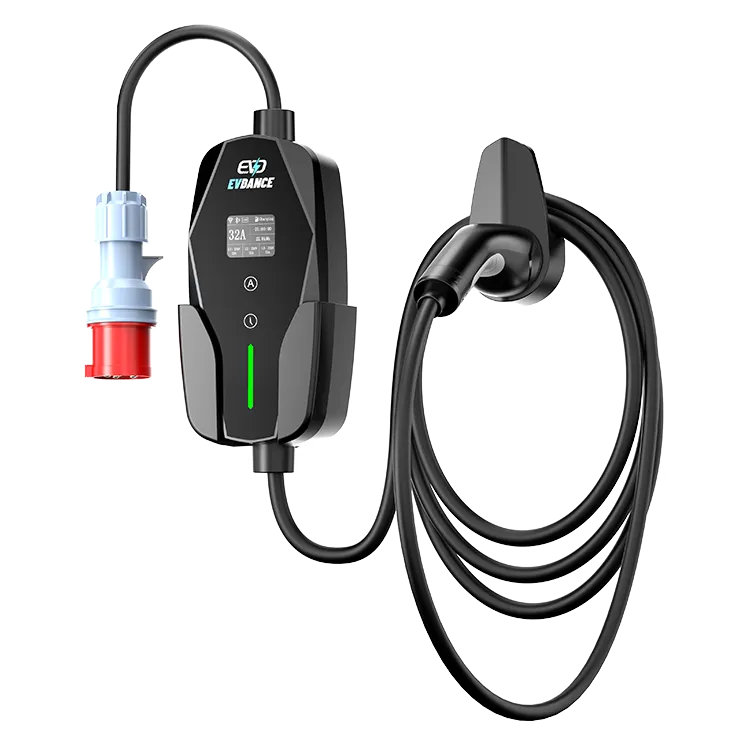
The EV-ACS3210E is the stated single-phase portable: about 7 kW, Type 2, IP66. The NACS and J1772 portables are North American market forms with NEMA plugs — candidates only where both the supply window and the fleet’s connector check pass. On the three-phase side: the ACS1605PE (11 kW, CEE 5-pin, Type 2), the EV-ACS3205PE (22 kW, CEE 32A plug), the EV-ACT3204PE wallbox (22 kW, tethered Type 2 cable, RFID and app, CE) and the EV-AC03201T station (two Type 2 connectors, up to 43 kW shared, OCPP 1.6J, RFID, IP54). The EV-RHDC30K-L adds compact DC at 22 kW DC with OCPP 1.6J — connector variant unnamed in its listing, so confirm it in writing.

EVDANCE is a Shenzhen manufacturer founded in 2011, exporting to 30+ countries, with a 3-year standard warranty. Send your confirmed supply figures through contact us and the market-version match comes back in writing before any order.
Frequently Asked Questions
My site has three phases. Can I still use a single-phase charger?
The model’s stated input configuration decides what it is built for. Ask for the market version matching your confirmed supply, and have a licensed local installer confirm the arrangement for the exact unit.
What voltage figure should I give a supplier?
The confirmed figure from your site survey — utility or installer, in writing. The supplier names the model whose window covers it; neither side works from an assumed national figure.
Is IP54 enough for an outdoor Saudi site?
IP54 means dust-protected, not dust-tight. The IP54 models here are covered-bay stations; for exposed siting, the IP66 models are the dust-tight end — and the temperature range still needs written confirmation.
Related Reading
- Single-Phase vs Three-Phase EV Charging: 7kW, 11kW and 22kW Explained
- Hot-Climate EV Charging: Protecting Chargers From Desert Heat and Sun
- IP Ratings for EV Chargers: IP54, IP65 and IP66 Compared

