
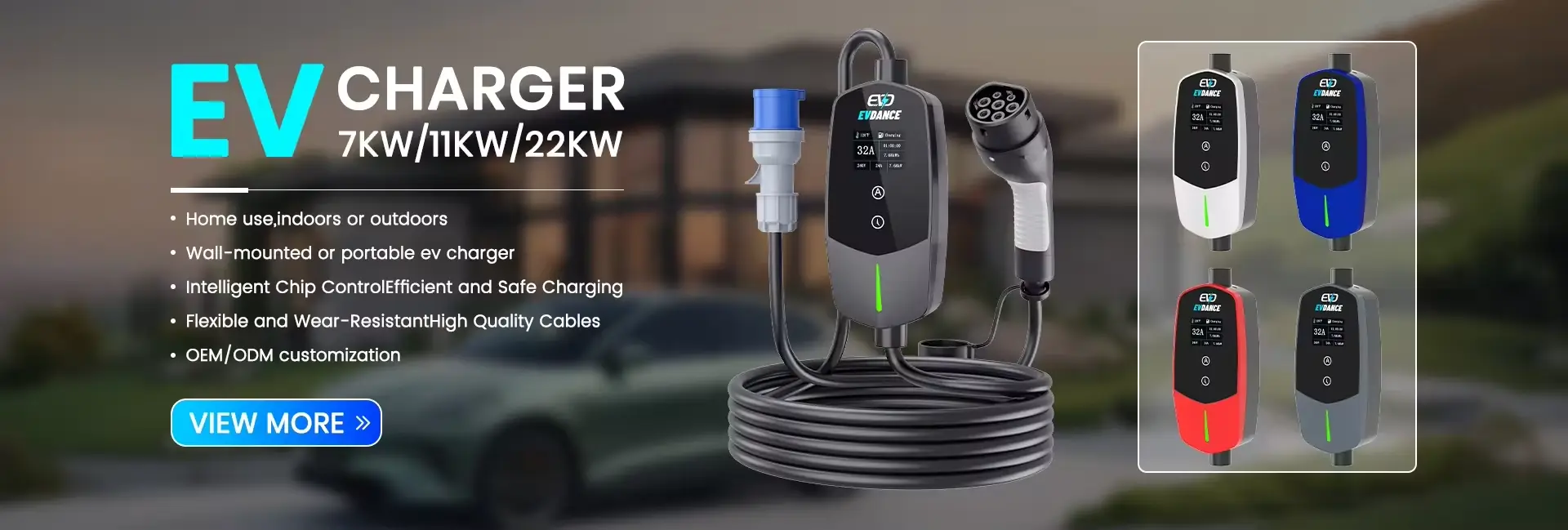
A Type 2 portable EV charger is a Mode 2 charging cable with a Type 2 (IEC 62196-2) vehicle connector, a control box carrying the protection electronics, and a supply plug for the local socket. When a European distributor sources one, the decisions that matter are the supply plug, the current range, the protection inside the box and the test evidence for that exact configuration. The vehicle connector is the easy part: Type 2 is the standard AC inlet across Europe.
Key Takeaways
- Choose the supply plug first: household socket, blue CEE (single-phase) or red CEE (three-phase). It sets the power range.
- The control box is an IC-CPD under IEC 62752, with residual current protection including DC fault detection.
- Write every spec line into the order, including cable length, IP rating and which adapters ship in the box.
- Certification follows the model and the configuration: a new plug or cable can mean new tests.
Start With the Supply Plug
The plug on the wall side decides how much power the charger can deliver and who can use it. Most European ranges carry three groups:
| Supply plug | Supply | Typical power range | Typical buyer |
|---|---|---|---|
| Household socket (for example Schuko) | 230 V single-phase | Low, current set well below the socket rating | Occasional or travel charging |
| Blue CEE | 230 V single-phase, 16 A or 32 A | Up to about 7.4 kW at 32 A | Home garage, campsites, workshops |
| Red CEE 5-pin | 400 V three-phase, 16 A or 32 A | 11 kW at 16 A, 22 kW at 32 A | Homes and businesses with three-phase sockets |
Adapters between these plugs are common, but each one changes the safe current, and some change the number of phases. If adapters ship in the box, the manual must say what current each allows. Our guide to CEE plugs in EV charging covers the socket side.
The Protection Inside the Control Box
In Europe the control box of a Mode 2 portable is an in-cable control and protection device (IC-CPD), covered by IEC 62752. It handles residual current protection, including DC fault detection, plus the pilot signal that tells the car how much current it may draw. When you compare factories, ask for the IEC 62752 test report for the model you will buy. IC-CPD design rules for portables sold in Europe explains the requirements in more detail, and Mode 2 vs Mode 3 explains where a portable sits against a wallbox.
A Sourcing Spec You Can Send to a Factory
| Line | Write down |
|---|---|
| Vehicle connector | Type 2 (IEC 62196-2), tethered |
| Supply plug | Exact plug, phase count and rated current |
| Current steps | Every selectable setting and the default on first use |
| Cable length | Total length, and length each side of the box |
| Ingress rating | Control box and connector, stated separately |
| Operating temperature | Range as stated in the test report |
| Display and timer | Screen size, what it shows, delay-start options |
| Plug temperature sensing | Whether the supply plug has a sensor and what the unit does when it trips |
| Accessories | Bag, wall holder, adapters, and which are included |
| Documents | Test reports, declaration of conformity, manual languages |
A sample built to this sheet is what you test before bulk production. Our checklist for testing an EV charger sample before a bulk order picks up from there.
Cable and Connector Details
Type 2 connectors use the same pin layout whether the cable is single-phase or three-phase, but the cable cross-section and rating differ between 16 A and 32 A versions. Type 2 connector pins explained and 16 A vs 32 A Type 2 cables cover the details.
EVDANCE Type 2 Portable Models
| Model | Max power | Supply plug | Current |
|---|---|---|---|
| EV-ACS1605PE | 11 kW | Red CEE 16 A 5-pin, 400 V 3-phase | 6 / 8 / 10 / 12 / 16 A |
| EV-ACS1602PE | 11 kW | CEE 16 A 5-pin, 400 V 3-phase | 6 / 8 / 10 / 12 / 16 A |
| EV-ACS3210E | 7.68 kW | Blue CEE, 208–240 V single-phase | 6 settings, 10–32 A |
All three can be supplied with your logo, colour and packaging, and with the supply plug your market uses. See the portable EV charger manufacturer page for order sizes and a quote form.
Frequently Asked Questions
Is a Type 2 portable charger the same as a Type 2 cable?
No. A Type 2 cable connects a wallbox or public post to the car and has no electronics. A portable charger plugs into a socket and has a control box with protection and current control.
Does a Type 2 portable work in the UK?
The car side is the same Type 2 connector. The supply plug and the paperwork differ: the UK uses its own socket types and the UKCA mark alongside CE in many cases.
Which supply plug should a distributor stock first?
It depends on your customers’ sockets. Single-phase blue CEE and three-phase red CEE versions cover most home garage and business installs. Household-socket versions are mainly for occasional use.

