
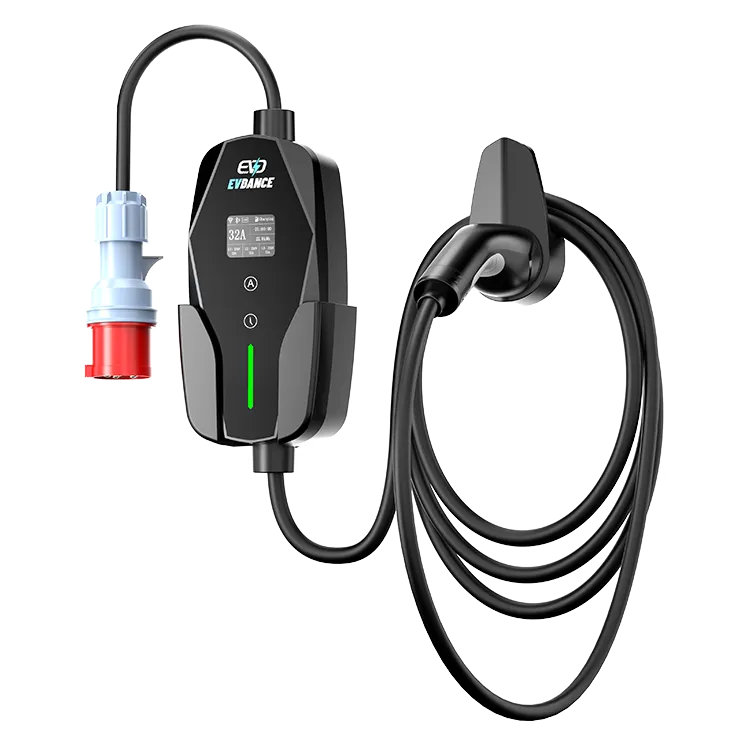
Where a dealer lot already has a red 32 A CEE socket — on a workshop wall, in the valet bay, at the delivery centre — the EV-ACS3205PE delivers up to 22 kW of AC charging with no installation project at all: plug in, charge, unplug, carry it to the next job. “Fast” here is AC arithmetic, stated plainly: about 10 kWh in a 30-minute window, allowing roughly 10% for losses, when the car accepts the full rate. It is not DC fast charging — it is the flexible second charging point the lot did not have to build.
Key Takeaways
- No installation: where a verified 32 A CEE socket exists, this portable delivers up to 22 kW AC the same day.
- The lot jobs are the ones away from the prep bay — handovers, overflow rows, loaners, a second point at peak.
- The speed needs the socket to be a real three-phase 32 A supply and a car that accepts 22 kW; windows are labelled arithmetic, not promises.
- No access control is listed for this unit — sessions are staff-attended, and the unit lives in a named store between jobs.
The Lot Jobs a Portable Covers
Our guide to EV charging for car dealerships covers site-wide installation; a fixed wallbox owns the prep bay. The portable earns its place on the jobs away from that bay:
- Delivery handovers. A sold car gets its top-up where it stands, not after a shuffle to the prep bay.
- Overflow and remote corners. Demonstrators parked beyond the fixed charger’s reach charge at their own row, if a socket serves it.
- Loaner preparation. The loaner charges where it is parked; then the unit goes back in its store.
- A second point at peak. When the fixed bay is occupied, the portable is the extra point for the afternoon — no construction, no downtime.
| Lot job | Typical window | What a 22 kW session adds* |
|---|---|---|
| Handover top-up before delivery | 30 minutes | About 10 kWh |
| Demonstrator between test drives, remote row | 20 minutes | About 6–7 kWh |
| Loaner preparation | 2 hours | About 40 kWh |
*Labelled arithmetic on the 22 kW rating with about 10% allowed for losses, assuming the car accepts the full rate. An 11 kW car adds roughly half — still about double a 7 kW-class portable’s window, by the same arithmetic.
The Two Conditions
The table holds only where two things are true. First, the socket is what it appears to be: a 32 A five-pin CEE outlet on a three-phase supply, as our guide to CEE plugs for three-phase portable chargers sets out. An unverified socket is a question, not a charging point — have the site’s electrician confirm it once. Second, the car accepts 22 kW AC — the car’s onboard charger sets every session’s pace, so know each demonstrator’s AC rating, as our explainer on single-phase vs three-phase charging shows.
Handling Rules for a Working Lot
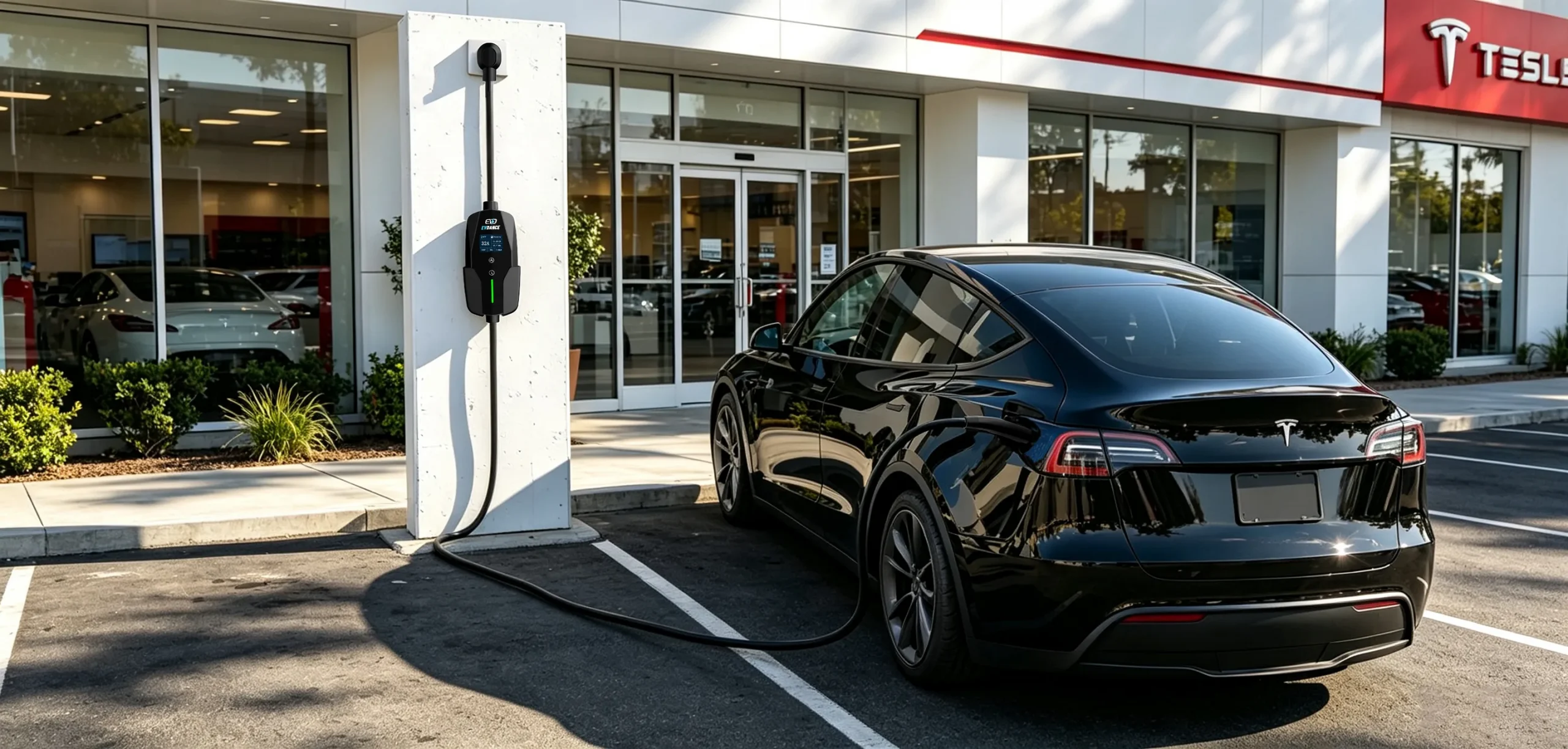
This portable has no access control of its own — its listing states no card or app layer — so its sessions are staff-attended jobs. Three habits keep it that way: a named home (a marked store by the valet bay, so its absence is noticed); cable routed out of drive paths and the unit raised off wet ground while it works; plug pins and jacket checked before each session. Where a site wants card-controlled, unattended charging as the main offer, that is the fixed wallbox’s job — the EV-ACT3204PE covers it.
The Charger in the Store Cupboard
The EV-ACS3205PE is a 22 kW three-phase portable charger: 32 A at 380–400 V, CEE 32 A five-pin plug, Type 2 connector, 1.77-inch display, IP66 housing. Dealership groups equipping several sites order through EVDANCE’s reseller and distributor program. EVDANCE is a Shenzhen manufacturer founded in 2011, and the model carries its 3-year standard warranty.
Frequently Asked Questions
Is 22 kW AC “fast charging” for a demonstrator?
It is fast for AC: about 10 kWh in 30 minutes under the conditions above. DC fast charging is a different class — the U.S. DOT puts it at 50–350 kW — with different cost and installation. For topping up between drives, the AC window is usually the job.
What if the lot has no CEE socket?
Then some installation returns, in the small version: an electrician fitting or verifying a suitable socket is a far smaller job than a fixed charging installation. Price both routes; the fixed wallbox may still win for the main prep bay.
Can anyone plug in and charge on the forecourt?
This portable has no card or app access control in its listing, so treat its sessions as attended staff work and store the unit out of reach between jobs. Unattended public access belongs on a charger specified for it.
Related Reading
- EV Charging for Car Dealerships: What to Install and Why
- CEE Plugs Explained: Choosing 16A or 32A for a Three-Phase Portable EV Charger
- Single-Phase vs Three-Phase EV Charging: 7kW, 11kW and 22kW Explained
- Portable EV Charger Types Explained: 10A, 16A, 32A and Three-Phase Models

