
The power is the same: both sides of this comparison deliver up to 11 kW on a three-phase supply, and the car decides how much of that a session actually uses. The real difference is where the charger lives. The ACS1605PE plugs into a 16 A CEE socket and travels with you; an 11 kW wallbox is hardwired to one wall by an electrician and stays there. Choose by location pattern, not by the wattage on the box.
Key Takeaways
- Same ceiling: 11 kW three-phase on both sides; the car’s acceptance decides the session, not the format.
- The portable trades permanence for reach — every matching CEE socket becomes a charging point.
- The wallbox trades reach for routine — one bay, always ready, nothing to store.
- Access control is a step-up question: EVDANCE’s fixed RFID/app unit is the 22 kW EV-ACT3204PE, not an 11 kW box.
Side by Side
| ACS1605PE portable | 11 kW wallbox (the class) | |
|---|---|---|
| Power ceiling | 11 kW, 16 A three-phase | 11 kW three-phase |
| Connection | CEE five-pin plug | Hardwired into its own circuit |
| Installation | None where a matching socket already exists; an electrician fits one where it does not | An electrician’s install at one fixed position |
| Locations | Any site with a matching socket — the workshop today, a second site tomorrow | One bay |
| Between sessions | Coiled, stored, or carried in the car | Always on the wall, plugged in and ready |
| Access and records | The listing states a 1.77-inch display; no app or access system | Varies by model — check the specific unit’s listing |
When the Portable Wins
The portable wins wherever the socket already exists or the location keeps changing. Rented premises, a home plus a workshop, a business trialling EV charging before committing to fixed installs — in each case the charger follows the car instead of the building. That is the pattern our guide to how speed depends on the outlet describes: a portable’s ceiling is set by the socket in front of it, and a 16 A three-phase CEE socket sets it at 11 kW. It is also the easier unit to replace, lend or take along when you move.

When the Fixed Install Wins
The wallbox wins on routine: one car, one bay, every night, with nothing to fetch, uncoil or store. It also wins where access has to be controlled. Be precise about what that means in this range, though: EVDANCE’s own fixed wallbox is the EV-ACT3204PE, a 22 kW unit with RFID and app control — a step up in power and in access features, not the 11 kW comparator in this table. If card-controlled or billed charging is your actual requirement, that is the conversation to have, rather than expecting it from either side of an 11 kW comparison.
The Unit in This Comparison
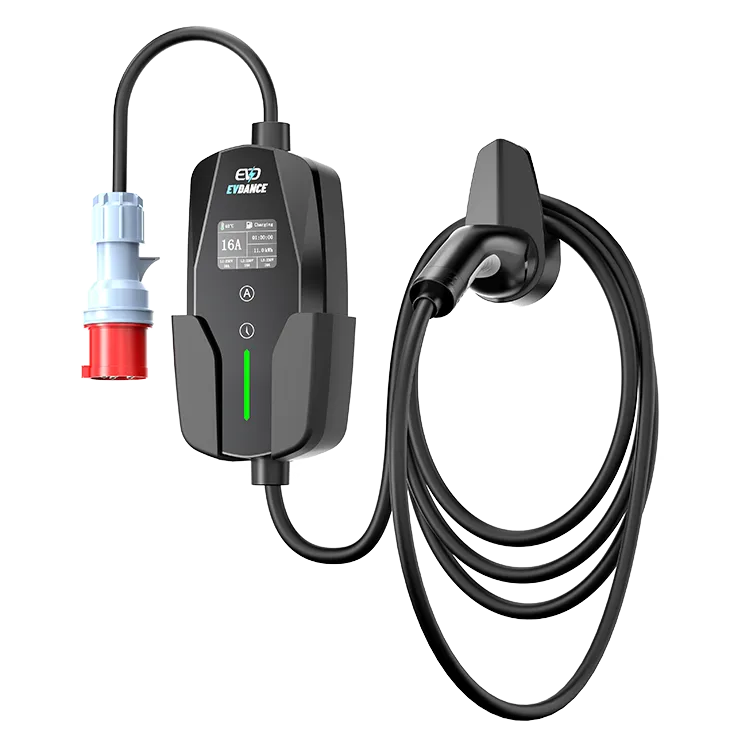
The ACS1605PE is an 11 kW three-phase portable: 16 A at 230/400 V, Type 2 to the car, a CEE five-pin plug to the wall, a 1.77-inch display, an IP66 enclosure and a 7.6 m cable. What the listing does not state — no app, no RFID, no access control — is exactly what the table above leaves blank on its side. Buy it for the socket pattern you actually have, and it is the flexible half of this comparison at full 11 kW.
Frequently Asked Questions
Does an 11 kW wallbox charge faster than this portable?
No. Both are capped at 11 kW, and the session runs at the lower of the charger’s ceiling, the supply and the car’s acceptance. Identical car, identical supply, identical rate.
Can the portable be my only charger?
Yes, if a matching CEE socket is where the car parks. The wallbox’s gain is permanence — always in place, nothing to store — not charging speed.
Which is cheaper to start with?
Where a suitable socket already exists, the portable starts with no installation at all. Where none exists, compare an electrician’s quote for fitting the socket against a wallbox install — the same trade visit prices both.
Related Reading
- 7kW Portable EV Charger vs. 7kW Wallbox: Which Should You Choose?
- Portable EV Charger Types Explained: 10A, 16A, 32A and Three-Phase Models
- Do Portable EV Chargers Work? How Speed Depends on the Outlet
- CEE Plugs Explained: Choosing 16A or 32A for a Three-Phase Portable EV Charger

