
A European vacation rental can offer 11 kW guest charging with nothing installed — if the property already has the socket. The ACS1605PE plugs into a 16 A five-pin CEE socket on a three-phase supply and charges a guest’s car at up to 11 kW, then stores at the property between stays. Most rentals do not have that socket: this is the route for the ones that do.
Key Takeaways
- This route exists only where a 16 A CEE socket on three-phase exists — check class, condition and supply first.
- Overnight at 11 kW refills a day’s driving, at the car’s own rate.
- The unit has no app and no log: the host’s record is a readout in the property log — a tracking figure, never a certified meter reading.
- Guest instructions live in the house manual; the unit stores at the property.
First Question: Does the Property Have the Socket?
The check has three parts:
- The class. This charger needs the 16 A five-pin CEE socket on three-phase — the rating is printed on it. The larger 32 A class is a different fitting, and plugs are never adapted between classes. Our guide to CEE plug classes shows how to read them.
- Its condition and the supply behind it. Before the first guest season, an electrician checks the socket and the supply’s spare capacity. If the property has only household sockets, this unit is not the route.
With no such socket, the alternatives are a fixed wallbox, or pointing guests to public charging — the wider question is covered in our guide to an EV charger at home — houses, rentals and condos.
What 11 kW Means for a Guest Stay
The arithmetic, labelled as such: at up to 11 kW, an hour draws up to about 11 kWh, and a full night — say eight hours — up to about 88 kWh, roughly 79 kWh stored after a ~10% allowance for losses. A guest rarely needs the ceiling: a few evening hours refill what a day’s driving used. The guest’s car decides the real rate — up to 11 kW on three phases if it accepts it; a single-phase car draws one phase’s share and takes longer.
| Guest pattern | What 11 kW gives them |
|---|---|
| Arrives in the evening, leaves next morning | A full overnight window — the easy case |
| Single-phase car | One phase’s share — the stay’s length decides how full it leaves |
Running It as a Host — Without an App
Its listing states no app, no accounts and no session logging. The host’s routine is simpler than it sounds:
- The record is yours to keep. If you want a figure per stay, note the session energy — from the display or the car’s readout — in the property log at checkout. It is a tracking figure — not a certified meter reading, and never present it to a guest as one.
- Most hosts fold it into the rate. An example: a stay that used 40 kWh at an example €0.30 per kWh cost €13.20 — most hosts fold a sum that size into the nightly rate. If you price separately, say so in the listing before anyone books; the tax treatment is your tax adviser’s question.
- Leave the instructions in the house manual. Where to park, how to plug in, what to do if a charge does not start, a phone number. The card is your document — not a product feature.
- Store the unit at the property between stays. Indoors, dry, out of sight between stays — never left plugged in for passers-by.
The ACS1605PE at a Rental Property
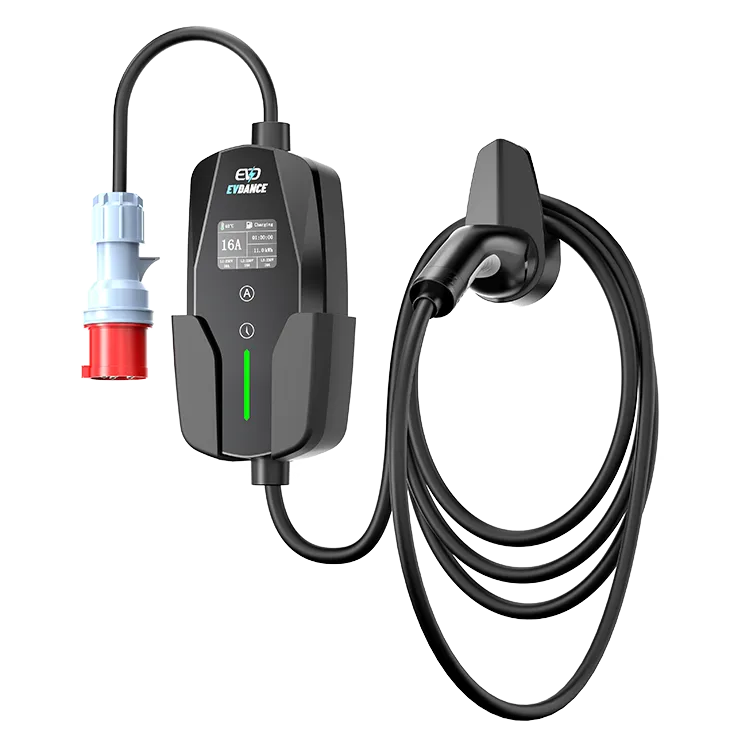
The ACS1605PE is EVDANCE’s 11 kW three-phase portable: 16 A at 230/400 V, CEE five-pin plug, Type 2 to the car, a 1.77-inch display, a 7.6 m cable and an IP66 enclosure, with a 3-year standard warranty. A property that outgrows the portable pattern is the fixed wallbox’s case: the EV-ACT3204PE adds 22 kW with RFID and app access control; multi-property hosts will find managed options under commercial EV charging.

Frequently Asked Questions
Do guests need an app or an account to charge?
No. This unit’s listing involves no app at all. The guest’s side is the house manual: park in the marked spot and plug in. The unit, the socket and the log are the host’s side.
How do I charge guests for the electricity?
Your pricing decision, stated in your listing before booking. If you price separately, base it on your record of the stay’s energy and your own tariff — and present it as the estimate it is, since the display is not a certified meter.
What if my rental has no three-phase socket?
Then this charger is not your route. A fixed wallbox is an installer’s job; until then, give guests the nearest public charging — the planning side is covered in our hotel and guest charging guide.
Related Reading
- Can I Have an Electric Car Charger at Home? Houses, Rentals and Condos
- CEE Plugs Explained: Choosing 16A or 32A for a Three-Phase Portable EV Charger

