
On a dynamic tariff, the price of a kilowatt-hour changes hour by hour, so the saving is made by when you charge, not how much you use. Your car needs the same energy either way; an 11 kW charger like the ACS1605PE delivers it in a short session that fits inside the cheap hours. One honest limit shapes the routine: the listing states no timer, app or scheduling, so timing is done by the car’s charge timer and by when you plug in.
Key Takeaways
- On a dynamic tariff, price follows the hour — the saving is timing, not efficiency.
- Charger size changes session length only — never the price per kilowatt-hour.
- An 11 kW session of about two hours can be placed inside the day’s cheapest hours.
- This model’s listing states no timer or app: use the car’s timer and your plug-in time.
A Dynamic Tariff Has No Fixed Cheap Window
A time-of-use tariff splits the day into fixed blocks — cheap overnight, peak in the evening. Our guide to smart charging and time-of-use tariffs explains that fixed-window version. A dynamic tariff removes the fixed part: the price follows the wholesale market and changes hour by hour. Your supplier publishes the coming hours’ prices in advance; tomorrow’s cheap hours may sit at midday or barely exist. There is no window to memorise — only a price list to glance at, and a session short enough to fit the best of it.
The Maths: Same Energy, Different Hours
Charging cost is energy × price, and the energy half never changes with the charger. Adding 20 kWh to a battery draws about 22 kWh from the supply once losses are allowed for — see how many kWh it takes to charge an EV — and at 11 kW that takes about two hours. What the hour costs is the tariff’s decision. Two invented prices show the shape: €0.15 per kWh in the day’s cheap hours, €0.40 in its expensive ones, for illustration only.
| The same 22 kWh, charged… | Example price | Example cost |
|---|---|---|
| Entirely in expensive hours | €0.40 per kWh | €8.80 |
| Half cheap, half expensive | Mixed | €6.05 |
| Entirely in cheap hours | €0.15 per kWh | €3.30 |
Same car, same battery, same driving — a €5.50 gap made only of timing. Nothing in the table depends on the charger’s size: price per kilowatt-hour is never a charger property, and neither is the energy the car needs — our breakdown of what it costs to charge an electric car at home makes the same point for fixed tariffs. Size decides the session’s length: two hours can be aimed at the cheapest hours; six hours spills into expensive ones whatever you do.
Landing the Session in the Cheap Hours
The ACS1605PE’s listing states no app, timer or adjustable current — it will not chase prices by itself. The levers are these:
- The car’s charge timer. Most EVs hold a start time or departure target. Set it against tomorrow’s prices; the charger supplies power when the car asks.
- Your plug-in time. With no timer in play, the session starts when you connect — so plug in when the cheap hour arrives, not when you get home.
- The session size. A partial top-up tonight, the rest tomorrow, keeps each session inside one cheap block — the battery need not be filled nightly.
If you want the charger itself to hold the schedule, look for it as a stated feature in a smart wallbox’s specification — our wallbox features guide shows how it is usually listed.
The ACS1605PE in a Dynamic-Tariff Routine
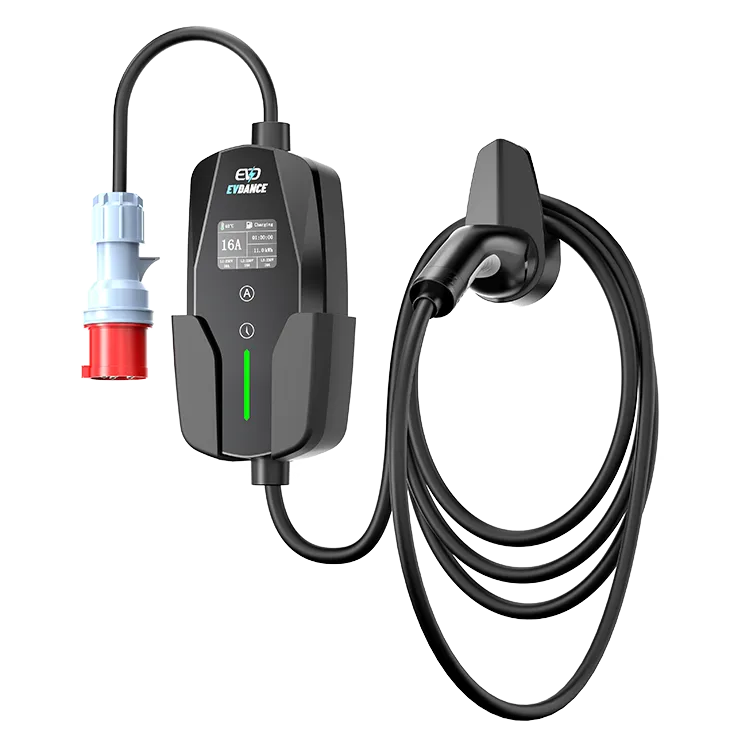
The ACS1605PE is an 11 kW three-phase portable charger: 16 A, 230/400 V, Type 2 connector, CEE five-pin plug, a 1.77-inch display, IP66 sealing and a 7.6 m cable. It suits homes with a three-phase supply and a CEE socket; the residential charging page shows the range. EVDANCE is a Shenzhen manufacturer founded in 2011; the unit carries its 3-year standard warranty. Its contribution here is the short session: two hours placed where prices are lowest.

Frequently Asked Questions
Does a more powerful charger make electricity cheaper on a dynamic tariff?
No. Price per kilowatt-hour is set by the hour, not the charger. More power only shortens the session — which is what helps, because a short session fits inside the cheap hours instead of spilling out.
Can the ACS1605PE start charging by itself when the price drops?
Its listing states no timer, app or scheduling, so use the car’s timer or plug in at the cheap hour. If a built-in schedule matters, confirm it with EVDANCE first — do not assume it.
Do I need to fill the battery every night to save money?
No. The week’s energy is the same however you split it, and small top-ups are often cheapest because each fits inside one cheap block: charge what tomorrow needs, at its cheapest hour.
Related Reading
- Smart Charging and Time-of-Use Tariffs: How Scheduling Cuts EV Charging Costs
- How Much Does It Cost to Charge an Electric Car at Home?
- How Many kWh Does It Take to Charge an EV?
- Is a Level 2 Charger Worth It?

