
One EV-AC03201T replaces two wallboxes with a single floor-standing station: one supply run, one foundation, one network connection. Its cost advantage lives in the installation structure, not in a charger price. In exchange, its two connectors share a 43 kW ceiling, while two separate wallboxes never share: each keeps its own full rating. Layout usually decides first: the station serves the two bays beside it; wallboxes serve bays wherever they are.
Key Takeaways
- The dual station’s saving is structural: one supply run, one foundation, one network connection, one commissioning.
- Two wallboxes never share a ceiling (44 kW combined, independent); the station’s connectors share 43 kW with dynamic allocation.
- Layout usually decides first: adjacent bays fit the station, scattered or gradually added bays fit singles.
- The listing states no connector cable length — get it in writing and measure the bays before the base position is fixed.

Where the Installation Money Goes
The generic comparison is covered in our guide to dual port chargers. For a specific site, price the choice line by line — what gets built once, and what gets built twice:
| Installation item | One dual-connector station | Two wallboxes |
|---|---|---|
| Supply run from the distribution board | One run, sized for the station | Two runs, one per unit |
| Mounting | One foundation for a floor-standing unit | Two wall or post mounts |
| Network connection | One — the platform manages one station with two connectors | Two devices to connect and manage |
| Commissioning | One station, both connectors | Two separate units |
| If one unit fails | Both bays lose their charger until it is repaired | The other bay keeps charging |
For scale only: U.S. DOE-cited figures put public Level 2 at about $3,500 equipment plus $2,500 installation per connector — US numbers, not a quote, but they show why the per-connector installation lines decide the comparison. The last row is the honest counterweight: two independent units fail independently; one station does not.
Layout: One Footprint or Two Positions
- Adjacent bays suit the station. It stands at the head of, or between, two neighbouring bays, and both connectors work from that position. It cannot serve bays at opposite ends of a car park.
- Scattered bays suit wallboxes. Each unit goes where its bay is — wall, column or post — and bays added one at a time fit the same pattern.
- Growth comes in different steps. A third bay means a second dual station (bays three and four) or a third wallbox. Singles grow one bay at a time; the station grows two.
- Check the reach before the foundation. The listing does not state a connector cable length for this station. Ask for it in writing and measure your two bays against it before the base position is fixed — afterwards, the station cannot be nudged.
The Power Difference, Stated Plainly
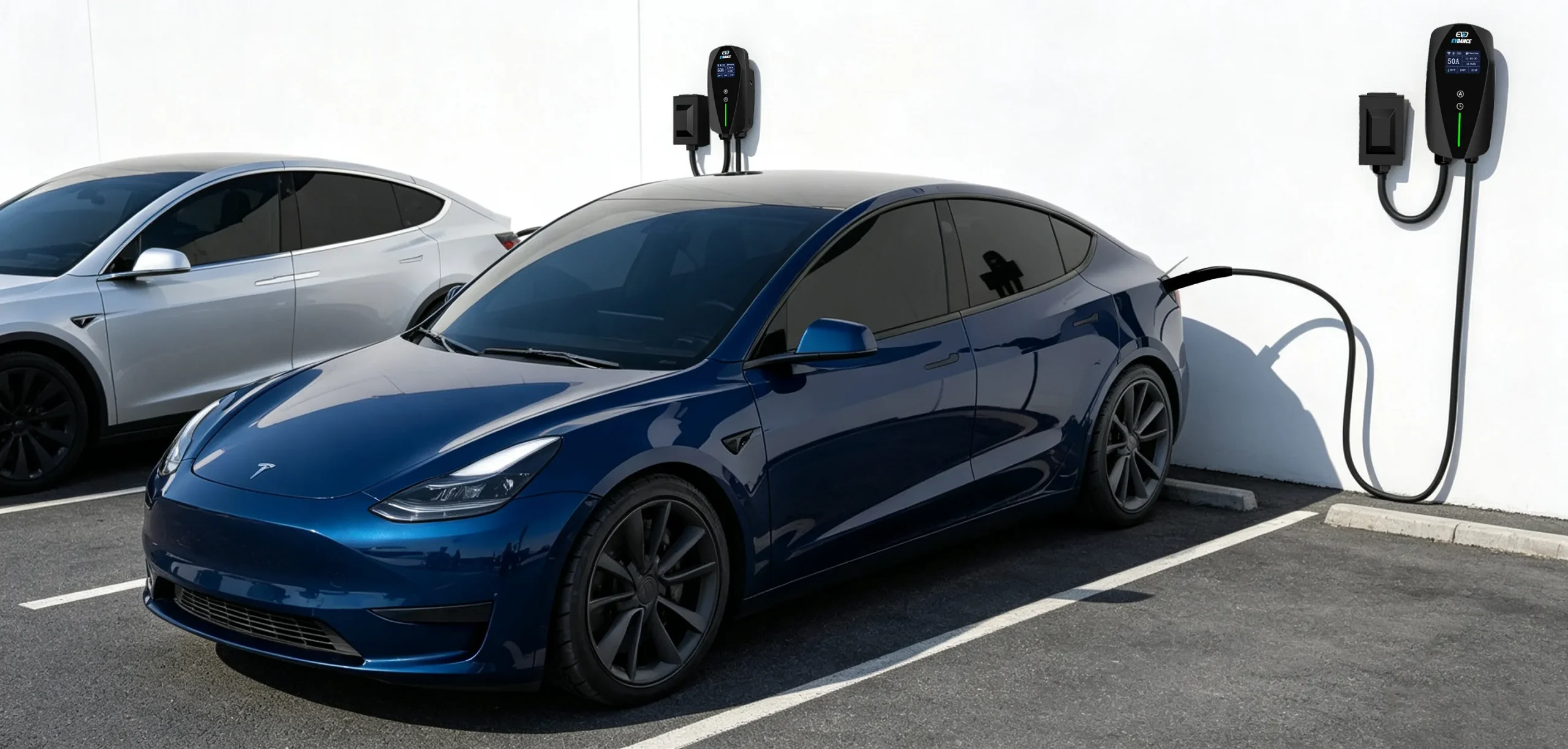
Two 22 kW wallboxes (the EV-ACT3204PE is EVDANCE’s) hold 44 kW combined, and neither can lend the other anything. This station holds one 43 kW ceiling, dynamically allocated: one car alone takes up to 22 kW; two cars share the 43 kW. Nearly identical totals — the difference is independence versus allocation.
The station asks the supply for one connection point sized for its combined draw. Two wallboxes ask for two circuits whose combined draw the building has to carry — our guide to load calculation basics covers the totalling. Neither arrangement escapes the load calculation; they present it differently.
The Two Options
The EV-AC03201T is a floor-standing dual-connector AC station: two Type 2 connectors, up to 43 kW shared (22 kW per connector) with dynamic power allocation, OCPP 1.6J, RFID access, a 7-inch touchscreen and an IP54 enclosure. For single or scattered bays, the wallbox route is the alternative. EVDANCE is a Shenzhen manufacturer founded in 2011; both options carry its 3-year standard warranty. Site planners can compare the wider commercial charging range before quoting.
Frequently Asked Questions
Is one dual-connector station cheaper than two wallboxes?
The installation lines point that way — one supply run, one foundation and one network connection instead of two of each. But no honest total exists without a site quote: equipment prices and groundworks vary. Ask for both configurations priced on the same site plan.
Do the two connectors slow each other down?
They share one 43 kW ceiling with dynamic allocation, and each connector’s ceiling is 22 kW. Two wallboxes never share a ceiling — each keeps its full 22 kW — but their combined 44 kW draw has to fit the supply, which the load calculation checks.
What if the two bays are not next to each other?
Then the dual station is the wrong shape. It serves the two bays beside the position it stands in.
Scattered bays are wallbox territory — one unit per position, each on its own mount.
Related Reading
- What Is a Dual Port EV Charger? How It Works and How to Choose
- Adding EV Chargers to a Building: Load Calculation Basics
- What Is the Best Commercial EV Charging Station? How to Choose
- Apartment and Condo EV Charging: Solutions for Shared Parking

