
A car wash or service station is a natural place to add EV charging, because the visit itself creates the dwell. A wash-and-vacuum stop or a wait at the service desk keeps a car parked for roughly 20 to 60 minutes — too long to waste, too short for AC to add much. A compact DC unit like the EV-RHDC30K-L turns that parked time into a top-up, sited as ordinary forecourt equipment in a parking bay, away from the wash tunnel and the jet-wash area.
Key Takeaways
- Wash and service visits create 20–60 minute dwell — the window a compact 22 kW DC unit is built for.
- IP54 is splash protection, not a washdown rating: the unit is sited in a parking bay, away from the tunnel and the jets.
- Workshop cars that stay for hours belong on AC points; the DC unit serves the waiting driver.
- Charging and washing are separate stages of the visit — the car is never connected in the wash.

Two Visits, Two Dwell Times
One site runs two clocks: the wash customer is on site for minutes, the service customer for hours. Each points at different hardware:
| Customer | Typical stop (labelled scenario) | What charging can add | Better fit |
|---|---|---|---|
| Wash and vacuum customer | About 20–40 minutes | Roughly 7–15 kWh at a sustained 22 kW DC, before losses and taper — a top-up, not a fill | Compact DC |
| Driver waiting on a service | About 30–60 minutes, or the car stays for hours | A DC top-up while they wait; a large charge if the car stays | DC for the wait, AC for the stay |
| Workshop car on the ramp | Several hours | A full charge at AC rates | AC point |
These are planning scenarios, not measured averages — your own forecourt gives you the real ones. The pattern is general, though: short, purposeful stops are where DC earns its place and AC leaves the driver almost where they started.
The Water Question, Answered Honestly
A charging unit at a car wash raises an obvious question, and it deserves a straight answer. The EV-RHDC30K-L’s listing states an IP54 enclosure: protected against dust and against water splashing from any direction. That is not a washdown rating — it does not cover directed pressure jets or immersion. Rain on a forecourt is what this class of enclosure is built for; a jet-wash lance is a different thing entirely.
So the siting rules are simple. The unit stands in a normal parking or waiting bay, never inside the wash tunnel and never where pressure jets are aimed or used. It is cleaned as its manual directs, not with the site’s wash equipment. And the visit’s sequence stays separate: a car is plugged in while parked — during vacuuming, interior cleaning or the service wait — and goes through the wash unplugged, as its own stage of the visit. Where the bay goes is a decision for the operator and the installer.
The Fuel-Stop Minutes Are Not the Market
One honest limit: a driver who stops for fuel and a coffee is gone in ten minutes, and no charger turns that into a charge worth having. The DC unit serves the longer stops the site already has — the wash queue, the vacuum bays, the service desk — while workshop cars are better served by AC points working all day at lower cost, as our guide to how commercial charging stations work sets out.
The EV-RHDC30K-L on a Wash or Service Site
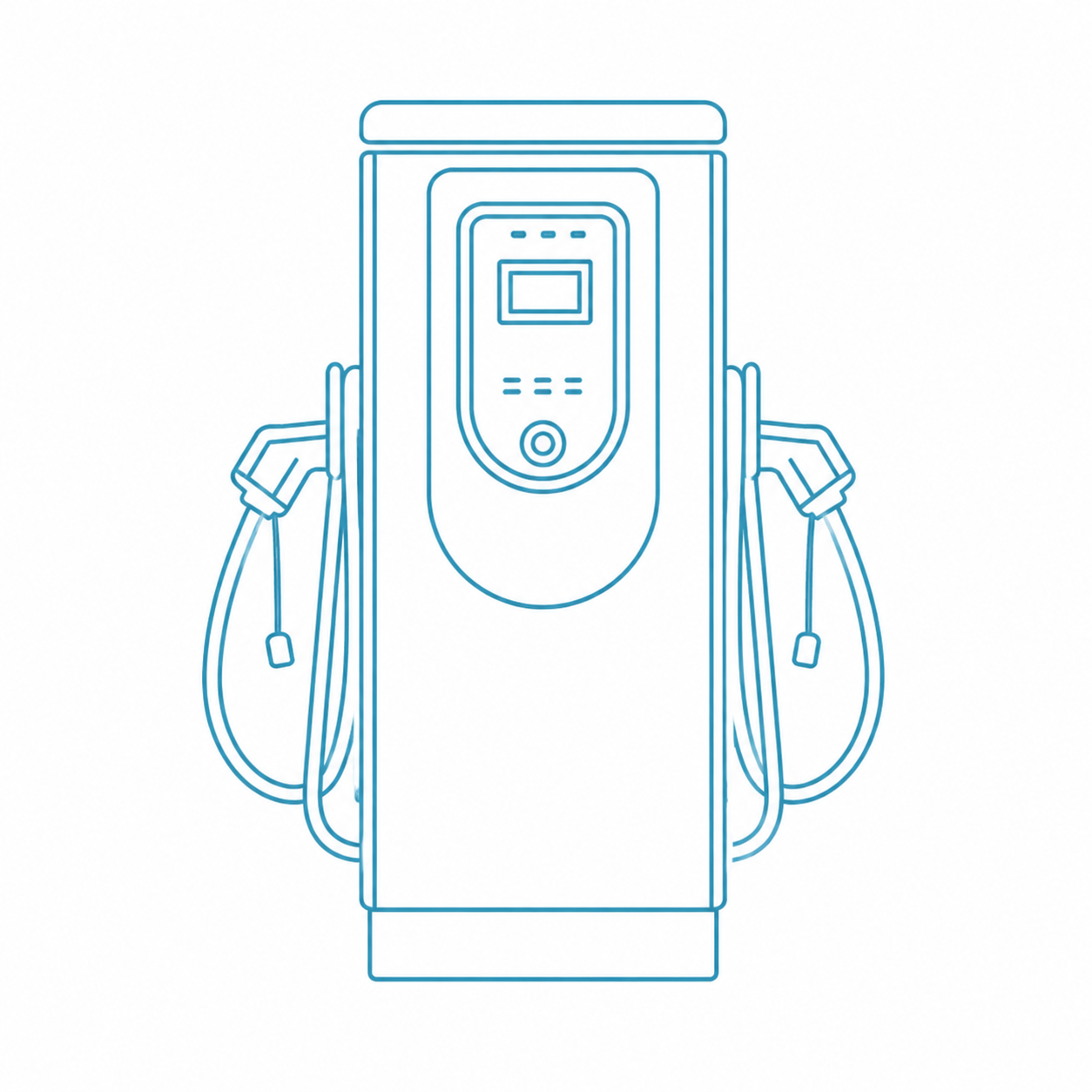
The EV-RHDC30K-L is EVDANCE’s compact DC charger: 22 kW as its product page states it, floor-standing and single-connector, with an IP54 enclosure, an LCD for the driver and OCPP 1.6J, so the operator’s platform runs sessions, access and pricing as the site’s own arrangement. It sits below the U.S. DOT’s 50–350 kW DC fast band — a top-up unit, not a corridor charger. EVDANCE is a Shenzhen manufacturer founded in 2011; the unit carries its 3-year standard warranty. Sites planning a wider mix can review the commercial charging range.
Frequently Asked Questions
Can the charger be pressure-washed like the rest of the forecourt?
No. IP54 protects the enclosure against splashing water, not directed jets. The unit is cleaned as its manual directs, and wash equipment is never aimed at it.
Can a car charge while it is being washed?
No. Charging happens while the car is parked in a bay — during vacuuming, interior cleaning or the wait at the service desk. The wash itself is a separate stage of the visit, with the car unplugged.
What does a 30-minute stop actually add?
As labelled arithmetic, about 11 kWh at a sustained 22 kW, before losses and taper — a useful top-up, not a full charge. Cars staying for hours get more from an AC point.
Related Reading
- How Do Commercial EV Charging Stations Work?
- What Is the Best Commercial EV Charging Station? How to Choose
- Commercial EV Charger Maintenance Checklist

