
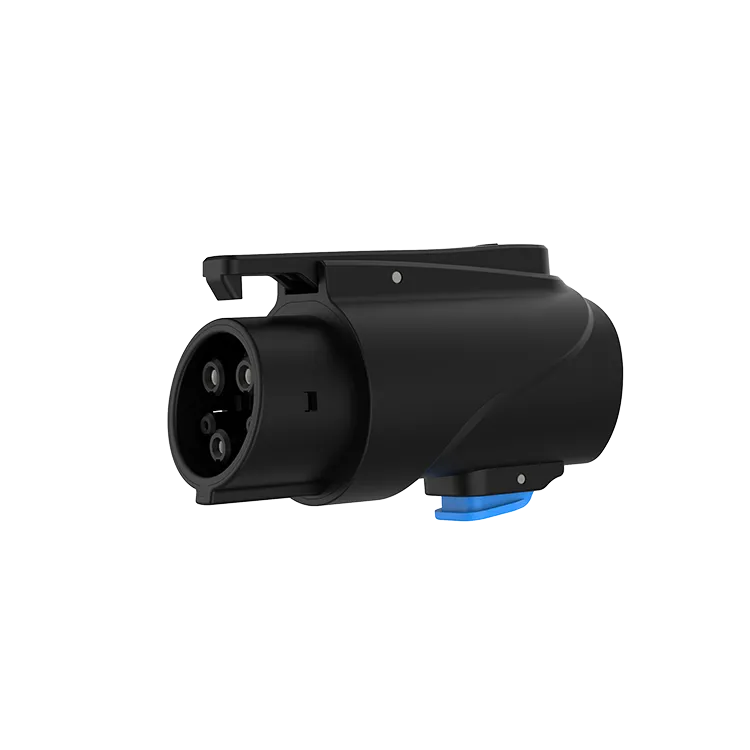
A NACS-to-J1772 adapter works by reshaping a connection, not by changing the electricity. Inside the adapter, each contact of the NACS plug is connected straight to the matching contact of a J1772 socket, so AC power and the charger’s low-voltage signals pass through untouched. The car’s onboard charger still does all the converting, exactly as it does when it plugs into a native J1772 charger.
Key Takeaways
- An adapter maps contacts pin for pin: AC power, ground, and the charger’s signals pass through unchanged.
- The car’s onboard charger does all the converting — the adapter converts nothing.
- The session rate is set by the charger and the car; the adapter’s 80 A rating is only a ceiling.
- It is an AC part in one direction only, with no DC path.
Two Plugs, One Job
NACS and J1772 are two connector standards for AC charging in North America. The shapes differ, but in an AC session both do the same work: deliver alternating current to the car and carry the small signals the charger and car exchange while they charge. Our explainer on what J1772 is covers the older standard, and whether the Tesla charger is NACS covers the newer one. An adapter exists because the electricity agrees even when the plug shapes do not.
What Passes Through, Contact for Contact
The adapter is a mapped path, not a device that reworks anything. Each circuit that enters one side leaves the other side with the same job:
| Circuit | What the adapter does with it |
|---|---|
| AC power contacts | Carries the current through, unchanged — same AC in, same AC out. |
| Ground | Continues through the adapter, so the safety path is never broken. |
| Control pilot signal | Passes charger to car and back, so the two still negotiate how much current the car may draw. |
| Presence and latch signals | Pass through, so the car still knows a plug is seated and held. |
The conducting path is metal: on the JT02, silver-plated copper terminals rated at 80 A and AC 250 V. Because the pilot signal passes through, the charger and the car hold their normal conversation as if they were plugged directly together. The adapter does not join that conversation, store anything, or reinterpret a single signal.
The Power Path, Step by Step
- The charger supplies AC. A NACS wall charger or destination charger offers Level 2 AC power, within the U.S. DOT’s typical 7–19 kW Level 2 band.
- The adapter passes it on. The current crosses the adapter at whatever rate the session runs — the adapter neither raises nor lowers it.
- The car converts it. The car’s onboard charger turns AC into DC for the battery. This conversion always happens in the car during AC charging, adapter or no adapter.
- The lowest limit wins. The session rate is set by the charger’s output or the car’s acceptance, whichever is lower. The adapter’s rating is only a ceiling above both.
What the Adapter Does Not Do
- No conversion. It does not turn AC into DC, change voltage, or prepare power for the battery in any way.
- No extra speed. The 80 A figure is a ceiling, not a boost. A 40 A charger still delivers 40 A through it.
- No DC path. It is built for the AC arrangement only. DC fast charging is a different session entirely, with its own adapter family.
- No reverse use. It works in one direction — NACS charger to J1772 car. The opposite pairing needs the mirror-image part.
The JT02 as the Worked Example
The EVDANCE JT02 applies this mechanism at up to 80 A, AC 250 V, sealed to IP65. The NACS charger it meets most often is a wall unit such as the EV-ACT5006T, a 48 A NACS Level 2 charger: with the JT02 between them, a J1772 car charges at the rate its own onboard charger accepts, and the adapter stays out of the way. That is the whole design — a shaped bridge, carrying power and signals across a difference in plug geometry.

Frequently Asked Questions
Does the adapter convert AC power to DC?
No. The adapter passes AC through unchanged. The car’s onboard charger performs the AC-to-DC conversion, exactly as it does at any Level 2 charger.
Can the charger and car still communicate through the adapter?
Yes. The signal contacts pass straight through, so the charger and car negotiate current and confirm the connection just as they would with a native plug on both ends.
Does the adapter work at a DC fast charger?
No. It is an AC part, wired for the AC pin arrangement. DC fast charging uses a separate connection arrangement and a different adapter family.
Related Reading
- Are EV Charging Adapters Safe?
- What Is J1772? The North American EV Plug Explained
- Is the Tesla Charger NACS? NACS, J3400 and Adapters Explained
- Does J1772 Work With CCS? CCS Connectors Explained

