
A hotel charging package is not one product. It is three layers, each matched to how long the car stays: wallboxes where guests park overnight, one dual-connector station at the arrival bays where stops are shorter, and adapters at the front desk for the plug mismatches the fixed hardware cannot cover. Assemble them in that order and the package handles the ordinary night, the late arrival and the odd connector. How many of each layer a property needs comes from its own busiest nights — this article sets out the composition; our hotel charging planning guide works through the questions behind it.
Key Takeaways
- Build the package by dwell: wallboxes overnight, one dual-connector station at the arrival bays, adapters at the desk.
- Overnight charging is a coverage problem, not a speed problem — a live point at the guest’s bay is the product.
- The station’s two connectors serve the short stays; its OCPP 1.6J records serve the operator.
- The JT02 is a lendable amenity; the JT08/JT09 are information only — DC approval belongs to the guest’s car maker.

The Package by Dwell
| Layer | Where it works | In the package | Access, as listed |
|---|---|---|---|
| Overnight bays | Guest car park rows, where cars sit all night | EV-ACT3204PE wallboxes in three-phase markets; the EV-ACT5006T in North America | RFID card or app (ACT3204PE); the ACT5006T is an open point under the hotel’s terms |
| Arrival and forecourt | Entrance bays, day guests, short stays | EV-ACT3204PE EV-AC03201T kW wallboxes, one per bay | RFID or the 7-inch touchscreen; sessions recorded over OCPP 1.6J |
| The desk drawer | Wherever a guest’s inlet does not match the point | A JT02 adapter, lent by the hotel | The hotel’s own loaner routine — out against a room, back at checkout |
The Overnight Layer: Coverage, Not Speed
A guest car dwells for the length of a night’s sleep, and at that dwell even a modest charge finishes before checkout. So the overnight layer is about coverage — a live point at the bay the guest parks in — not power. In three-phase markets the EV-ACT3204PE carries it: 22 kW on the wall, tethered-tethered-cable version, RFID with app control, so the desk issues a card with the room key and the session belongs to that guest; card administration is covered by our guide to RFID and user management. In North America the layer is the EV-ACT5006T, a 48 A NACS wallbox, with J1772 cars served by the desk layer below.
The Arrival Layer: One Dual-connector Station
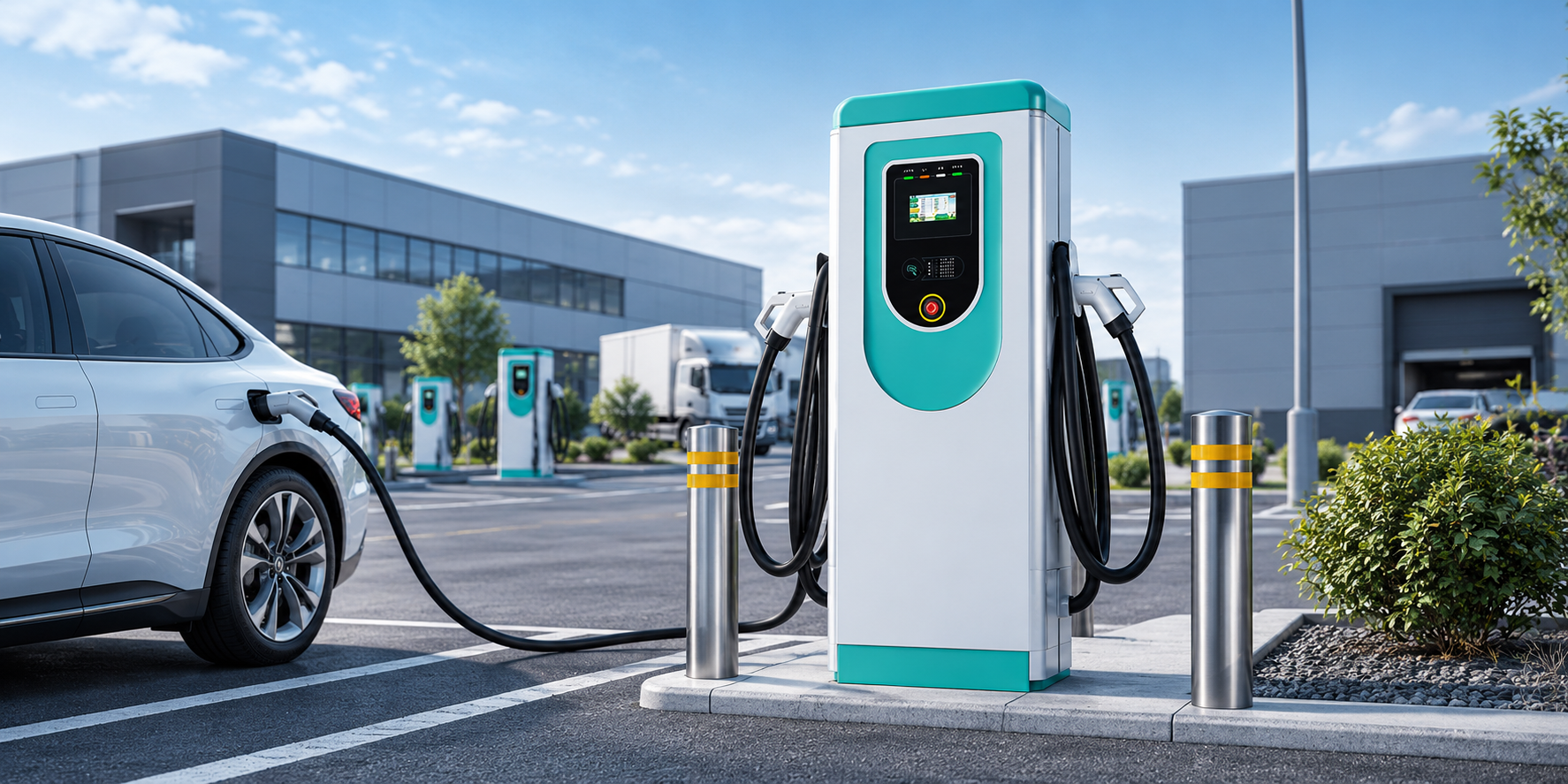
The forecourt has the opposite problem: cars that stop for an hour, not a night. One EV-AC03201T covers it with two Type 2 connectors on a single floor-standing unit — up to 43 kW shared between them, 22 kW to one car — placed where short stays happen: the entrance row, the late arrival’s bay. Its IP54 enclosure suits outdoor posts, and its OCPP 1.6J link gives the operator the session records. Keep the layer in proportion: this is the arrival bay, not a plan to rebuild the car park on stations.
The Adapter Layer — and Its Honest Limit
The desk drawer holds one adapter: a JT02. Sooner or later a J1772 guest meets a property whose points are NACS, or the reverse, and a loaned JT02 — an AC adapter rated to 80 A — closes the gap for the night. Lending it is the hotel’s own choice and routine; the adapter changes the plug shape, nothing else, and it is AC only.
The DC adapters, the JT08 and JT09, do not join the drawer — the honest limit of the package. Using one at a NACS fast charger turns on the car maker’s approval for the guest’s own car and the station being open to it: approvals the hotel cannot hold or lend on a guest’s behalf. So here the DC adapters are information, not an amenity: the desk can tell a CCS1 guest the option exists and what to check with their car maker, and there the hotel’s part ends.
Frequently Asked Questions
How many wallboxes does the package need?
The package defines layers, not counts — the count is your busiest night’s EV guests, plus the arrival bay. Work it from your own records; the hotel charging planning guide sets out the sizing questions.
Can guests pay at the dual-connector station?
The station lists no payment terminal, so payment is the hotel’s arrangement: OCPP session records for the platform, the room bill, or free as an amenity. Whether to charge is a policy call — our piece on whether hotel EV charging is free lays out the decision.
Should the front desk lend DC adapters too?
No. A DC adapter’s safe use depends on the car maker’s approval for the guest’s exact car, which sits with the guest and their maker — not with the hotel. Lend the AC adapter, inform on the DC one.
Related Reading
- Hotel EV Charging: How to Plan Guest Charging That Pays Off
- Do Hotels Have Charging Stations for Electric Cars?
- Is EV Charging at Hotels Free?
- RFID and User Management for Shared EV Chargers

