
For most office buildings, yes — free EV charging is one of the cheapest visible benefits an employer can run, because a workday of Level 2 charging costs little in electricity at commercial rates. But “free” is a policy decision, not a hardware setting. It works when eligibility, fairness to staff who do not drive, and the response to growing demand are settled before the first car plugs in. Offices that skip them end up bolting on limits or prices later.
Key Takeaways
- Free staff charging is cheap in energy; the hardware, not the electricity, is the commitment.
- Settle eligibility, fairness, the landlord’s position and tax treatment before launch, not after complaints.
- Time windows, rotas and priority categories keep a free scheme fair as demand grows.
- Record every zero-price session per user: the records drive reviews and repricing.
What Free Charging Buys an Employer
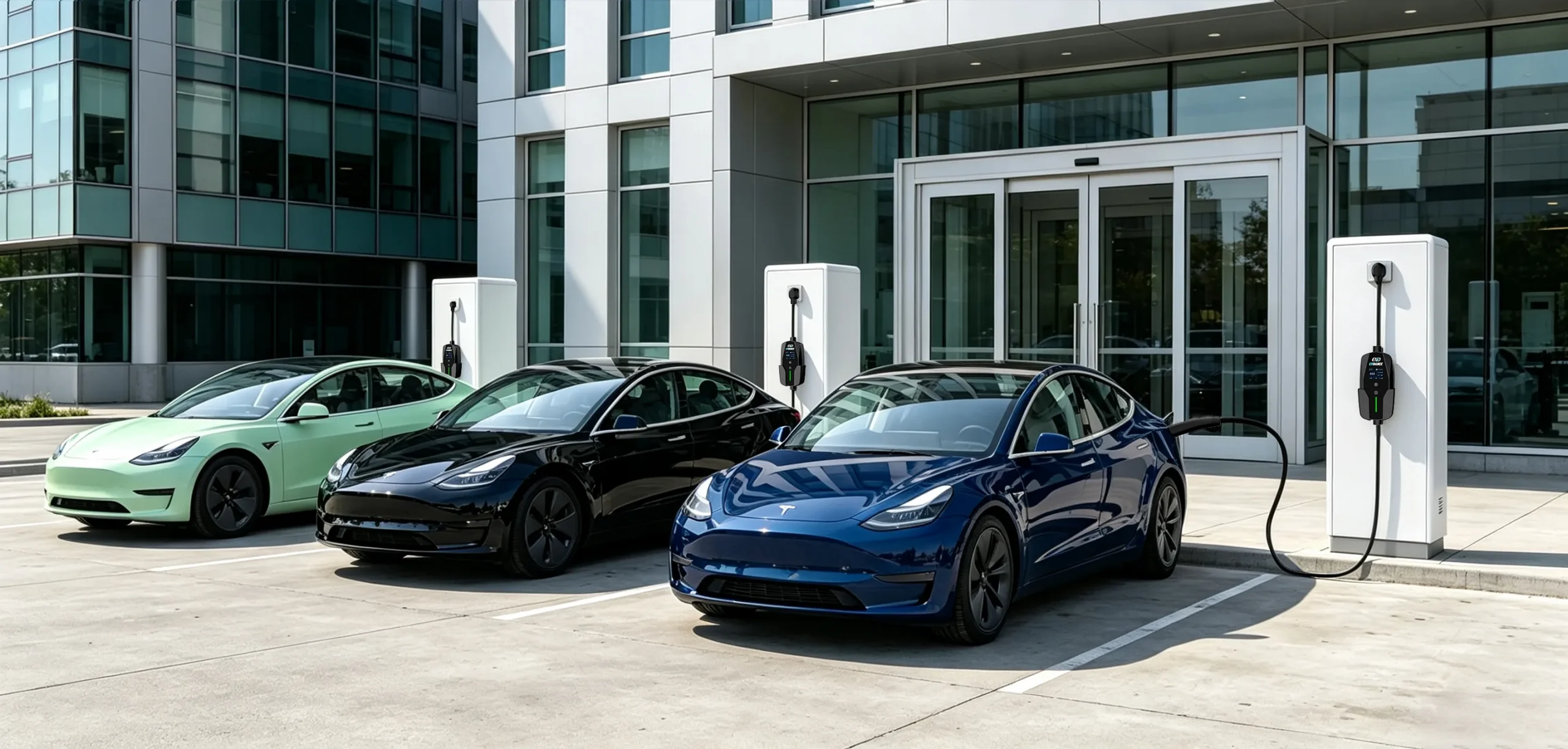
The case for free rests on the size of the bill. U.S. commercial electricity averages 14.53 cents per kWh in EIA figures, so a 20 kWh workday top-up costs about $2.91 at that average; your tariff will differ. The hardware is the real commitment: DOE-cited U.S. figures put public Level 2 at about $3,500 of equipment plus $2,500 of installation per connector. The energy is a small, predictable running cost — and for staff who cannot charge at home, it can make an EV practical at all. Our explainer on whether charging stations cost money sets out the free-versus-paid frame.
The Questions to Settle Before Saying Yes
- Who is eligible? All staff, only EV drivers, or contractors and visitors too? Eligibility defines the access list the chargers enforce — decide it as policy, not at the bay.
- Is it fair to staff who cannot use it? A benefit only drivers can use will be noticed. Some employers accept that, as with parking; others pair it with a wider travel benefit. Have an answer ready.
- Whose building and whose bill? In a leased office the landlord may own the car park and the supply. Confirm who pays for energy and who approves the installation first.
- How is it treated for tax? Free charging may count as a taxable benefit, depending on the country and the situation. Confirm with your payroll team or a tax adviser before launch — never promise staff it is tax-free.
- What is the exit ramp? Write down what would change the deal: sustained queues, a higher tariff, a change of building. A known trigger beats an improvised one.
Keeping a Free Scheme Fair When Demand Grows
| Pressure | Control that keeps it free | How it works |
|---|---|---|
| More EVs than chargers | Session time windows | A half-day limit per car, so two drivers share one bay |
| The same cars every day | A booking or rotation rota | Days allocated across drivers, not first-come-first-served at 8 a.m. |
| Cars left plugged in all week | An idle expectation in the policy | Move when charged; blocking is a conduct matter, not a charger fault |
| Staff with no home charging wait longest | Priority categories | The policy may favour drivers who cannot charge at home, stated openly as a fairness choice |
These are scheduling and access settings, not new hardware; the planning steps are in our workplace EV charging program guide. They cannot create capacity: when the rota is full daily, the honest options are more chargers or a move to charging staff — which the exit ramp already named.
Hardware for a Free Staff Scheme
“Free for staff” only holds if the charger can tell staff from everyone else. The EV-ACT3204PE 22 kW wallbox (three-phase Type 2, cable or socket, RFID and app, IP66, CE) runs a closed list per bay — only an authorised card or account starts a session. For paired bays, the EV-AC03201T dual-connector AC station serves two cars from one unit — two Type 2 connectors sharing up to 43 kW, OCPP 1.6J, RFID, IP54 — and records every session per user even at a zero price. Those records are the evidence base if the scheme later moves to at-cost billing. The wider range is on our commercial charging page.

Frequently Asked Questions
How much does free charging cost an employer per car?
A few dollars: about $2.91 for a 20 kWh top-up at the EIA average, as an example only. The larger cost is hardware: about $3,500 plus $2,500 installed per Level 2 connector, DOE-cited U.S. figures.
Is free workplace charging a taxable benefit for employees?
It can be, depending on the country and the circumstances. Treat it as a confirmation item: ask your payroll team or a tax adviser before the scheme is announced.
What if more staff buy EVs than there are chargers?
First, scheduling controls: time windows, a rota, priority categories. When those are full daily, the choices are expansion or charging staff — which is why the trigger belongs in the policy from day one.
Related Reading
- How to Plan a Workplace EV Charging Program
- Do EV Charging Stations Cost Money? Free vs Paid Charging Explained
- How Much Do EV Charging Stations Charge? Pricing Models Explained
- How Much Does It Cost to Install a Commercial EV Charging Station?

