
Once a dealership’s install plan has settled where chargers go, the buying question changes: not which area gets a charger, but how to choose between the units quoted for it. The method is to read each spec sheet against the job that bay does — display readiness, service turnaround, handover, customers waiting — because the line that decides one job is irrelevant to another. Our published guide to EV charging for car dealerships covers the install plan; this article is the comparison that follows it.
Key Takeaways
- Compare chargers job by job, not site by site: the spec line that decides display work is not the one that decides prep.
- Read every power figure as per-connector or shared-total before ranking a quote.
- Connector fit for the brands sold, session records by department and the payment route are written confirmations.
- AC dual-connector and compact DC are different tools; “best” is the bay’s job, not a model name.
The Spec Lines That Decide Each Job
| The job | Spec line to read | Confirm in writing |
|---|---|---|
| Display and demonstrators | Rated power — per connector, or a station total shared between connectors | The output when all connectors run at once, not the headline number |
| Service turnaround | Charging class: AC, or DC — and DC at what level against the U.S. DOT bands | Prep arithmetic at the car’s acceptance rate — the car sets the session pace |
| Handover | Connector fit for the brands the site sells | Which connectors are on site, and the adapter route for the exceptions |
| Customers waiting | Access route — RFID, app — and where payment actually happens | The platform arrangement — no EVDANCE listing states a built-in payment platform |
| Every department | Session records; warranty term | Records reportable by department; the cover in years — EVDANCE’s standard warranty is 3 years |
The first row catches the most buyers. A dual-connector station’s headline kilowatts may be a shared ceiling: two cars plugged in divide it. That is not a defect — display and service cars rarely race — but a quote compared on headline numbers ranks the wrong unit first. Read every rating as a question: per connector or per station, and what happens at full occupancy.
A Worked Comparison: Two Classes, Two Jobs
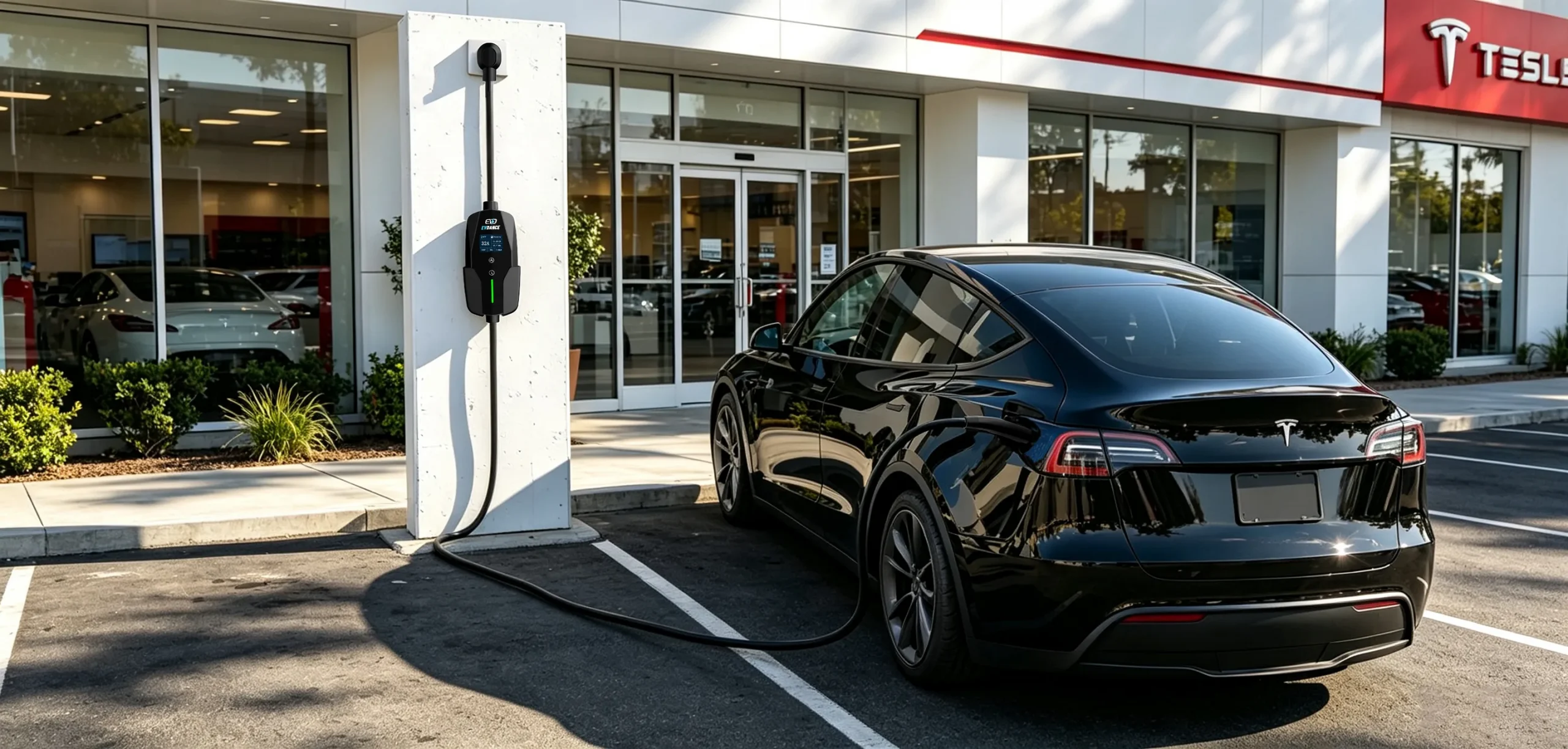
Set the two EVDANCE classes side by side and the job logic shows itself. The EV-AC03201T is an AC station: two Type 2 connectors sharing up to 43 kW (22 kW per connector), RFID access, OCPP 1.6J session records, IP54. It serves two cars at once at AC pace — the right shape for display cars holding a presentable charge and service cars charging through a workshop stay. The EV-RHDC30K-L is a single-connector DC unit of 22 kW (OCPP 1.6J, IP54): it feeds the battery directly, so a car with a modest AC rating can still take a fast top-up — the prep and handover job. It sits below the U.S. DOT DC fast band of 50–350 kW: compact DC for one car at a time, not corridor hardware. Neither unit is “the best dealership charger”: each wins the row of the table it was built for, and the comparison runs per bay, not per building. The wider range is on our commercial EV charging page.

Questions to Put to the Supplier in Writing
- What does each connector deliver when every connector on the station is running?
- Which connectors does the unit carry, and how are unfitted brands handled — adapter, or a different bay?
- How are sessions recorded, and can reports split by department — sales, service, customer?
- If customers pay, what is the payment route and whose platform provides it? A screen is a display, not a payment terminal.
- The warranty term, the service route when a unit fails, and what the quote excludes.
Frequently Asked Questions
Is a higher kW number always better for a dealership?
No. The car sets the pace: a charger rated above the car’s acceptance adds nothing, and a shared station total is divided between cars. Match the rating to the job’s dwell — hours in service, minutes in prep — rather than buying the largest number.
Can one charger model cover every department?
Physically, often yes; operationally, the jobs queue behind each other. Display, service and customer charging peak at different times on some sites and the same times on others — the install plan is where that is settled, and the comparison then runs per bay.
Do the chargers need to match the brands we sell?
The connectors do. A charger whose connector does not fit the cars on your lot turns every session into an adapter conversation. Confirm connector fit for the brands sold — and the exception route for traded-in cars of other brands — before comparing anything else.
Related Reading
- EV Charging for Car Dealerships: What to Install and Why
- RFID and User Management for Shared EV Chargers
- How Do Commercial EV Charging Stations Work?
- What Is the Best RFID Card for EV Charging? How to Choose

