
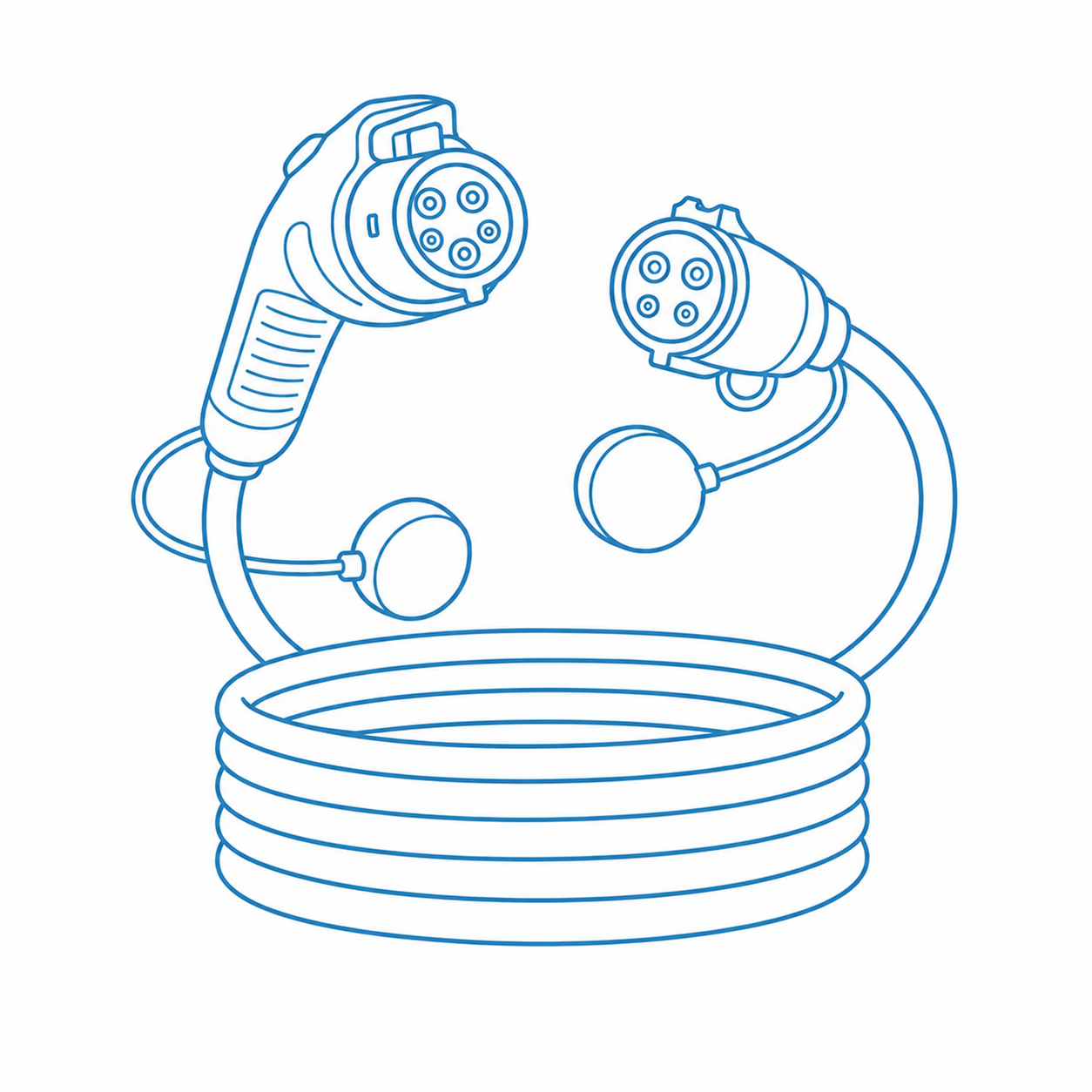
A charging cable lock is not a lock built into the cable. A cable is passive — copper, insulation, a connector at each end — and every lock under that name acts at one of its ends instead: the car’s inlet lock, a socket post’s lock, or an accessory around a connector. Which of the three a page means decides what you are getting.
Key Takeaways
- A charging cable carries no lock of its own; the locks live at its ends or in accessories around its connectors.
- The car-side inlet lock and the station socket lock are session locks owned by the car and the post.
- An add-on lock protects one connector point against an opportunist — not the cable run, and never against cutting.
- No EVDANCE listing states a connector or socket lock; confirm in writing if a project needs one.
Three Things Called a Cable Lock
The same two words are used for three different mechanisms. They differ in who owns the lock, where it acts, and what it leaves unprotected:
| Lock | Where it acts | What it stops | What it does not do |
|---|---|---|---|
| Car-side inlet lock | Inside the car’s charge port, holding the cable’s connector during the session | The connector being pulled out at the car end — a session interrupted, or the cable taken with it | It says nothing about the station end, and it releases by the car’s logic, not yours |
| Station socket lock | Inside a socket-outlet post, holding your cable’s plug for the session’s duration | Your cable being pulled from the post or walked away with mid-session | It exists only where the post provides it, and it lets go when the session ends |
| Add-on lock | Added around a connector or around the cable’s parking place — a padlock through the release catch on some connector handles, or a lockable holster or outlet box at home | The opportunist, at that one point | It protects a connector, not the cable run between the ends |
The first two are session locks: they engage while energy flows and release at a proper end. The third is an accessory family, and the one a shopping search usually means. None is a property of the cable itself — a plain cable listed “with lock” is describing one of these neighbours.

What No Cable Lock Does
Every lock above guards against unplugging. Keep the limits in view:
- No lock stops a cut cable. Cables are cut for the copper inside them, and a cut defeats every lock on this page at once. Our guide to how charging cables are stolen and protected covers the wider prevention picture — position, lighting and access control — that locks are only one layer of.
- No lock holds after the session. Both end locks release by design when charging ends; a cable taken home is protected by being moved, not by a lock.
- A tethered cable needs no cable lock. Its charger end is fixed by construction, and the car end is the car’s lock again.
What EVDANCE Listings State
Stated plainly: no EVDANCE charger or cable listing states a connector or socket lock. The EV-ACT3204PE 22 kW wallbox comes with a Type 2 cable or as a socket version (IP66, RFID and app); on the socket version the cable is the driver’s own, and whether the post locks it in session is a written-confirmation item for the exact model. A loose cable like the EV-ACS3210E 32 A Type 2 portable charger’s relies on the car’s inlet lock, like every cable of its kind. If a lock matters to your site, raise it through our contact page before purchase.
Frequently Asked Questions
Does a cable lock stop my cable being stolen?
It stops the unplug-and-walk kind during a session, at the end it covers. It does nothing against cutting, and nothing once the session has ended and the locks have released. Treat it as one layer, not as security for the cable.
Is the lock in my car’s charge port part of the cable?
No. The inlet lock and its locking pin belong to the car; the cable only carries the connector it holds. Its behaviour — when it locks, when it releases, any setting the car offers — is in the car’s manual.
A cable is advertised as “with lock”. What should I ask?
Which end, and whose mechanism. If the answer is a catch a padlock can pass through on the handle, that is the add-on accessory class. If the answer points at the car or the post, the lock belongs to them, and the cable is an ordinary cable.
Related Reading
- Can EV Charging Cables Be Stolen? How to Lock and Protect Yours
- Why Won’t My EV Charger Disconnect? Stuck Connector Fixes
- Tethered vs Socketed Wallbox Chargers: Which Should You Install?
- Which EV Charging Cable Do I Need?

