
Carry a charging cable as a travel routine, not as cargo: decide which cable travels, keep it secured in its bag in the boot or frunk, put it back before anything else when a session ends, and dry it properly once home. Each failure of a carried cable — left behind, soaked in a sealed bag, buried under luggage — has a habit against it.
Key Takeaways
- Give the cable a fixed home: a dedicated travel lead, or the single lead living in the car.
- It rides bagged and secured in the boot or frunk — never loose in the cabin.
- At the destination, the cable goes back first and a walk-around check closes the session.
- A wet cable rides home unsealed and dries before its bag closes; no EVDANCE listing states a case included.
Decide Which Cable Travels
The routine starts with an ownership decision:
| Setup | How it works | The risk it removes |
|---|---|---|
| Two cables | A home lead stays at home on its hook or holster; a second lead lives in the car permanently as the travel cable | The home session and the trip never compete for the same cable |
| One cable | The single lead’s fixed home is the car, not the garage | The classic failure — driving to a socket post with the cable still hanging at home |
Either works. What fails is a cable with no fixed home: it migrates to wherever the last session ended. Our guide to which EV charging cable you need covers choosing the lead itself.
While You Drive
On the move, the cable is cargo with two open ends:
- Bag it, and let the bag be its seat. The cable rides in its own bag or case, so the coil stays a coil and the connectors stay capped and clean. Confirm what a given charger comes with rather than assuming a case is in the box.
- Boot or frunk, never loose in the cabin. A charging cable is a heavy coil; loose in the cabin it slides, and under braking it travels. In the boot or frunk, secured so it cannot wander, it is out of the passenger space entirely.
- On top, not underneath. The bag rides above or beside the load, not under suitcases — weeks of weight on a folded cable is how kinks are made.
The parked half is short: cap both connectors, loop loosely along the cable’s natural curve, and glance at sheath and pins as you coil.
At the Destination, and the Wet Cable
At a strange post the routine runs in reverse — the return half matters more:
- Cable back first. When the session ends, the cable goes back into its bag and its seat before anything else is loaded around it. Cables are left behind in the loading shuffle, not during charging.
- The walk-around check. A last look at the post and the ground beside the car — ten seconds that catch the cable, the cap and anything else scattered.
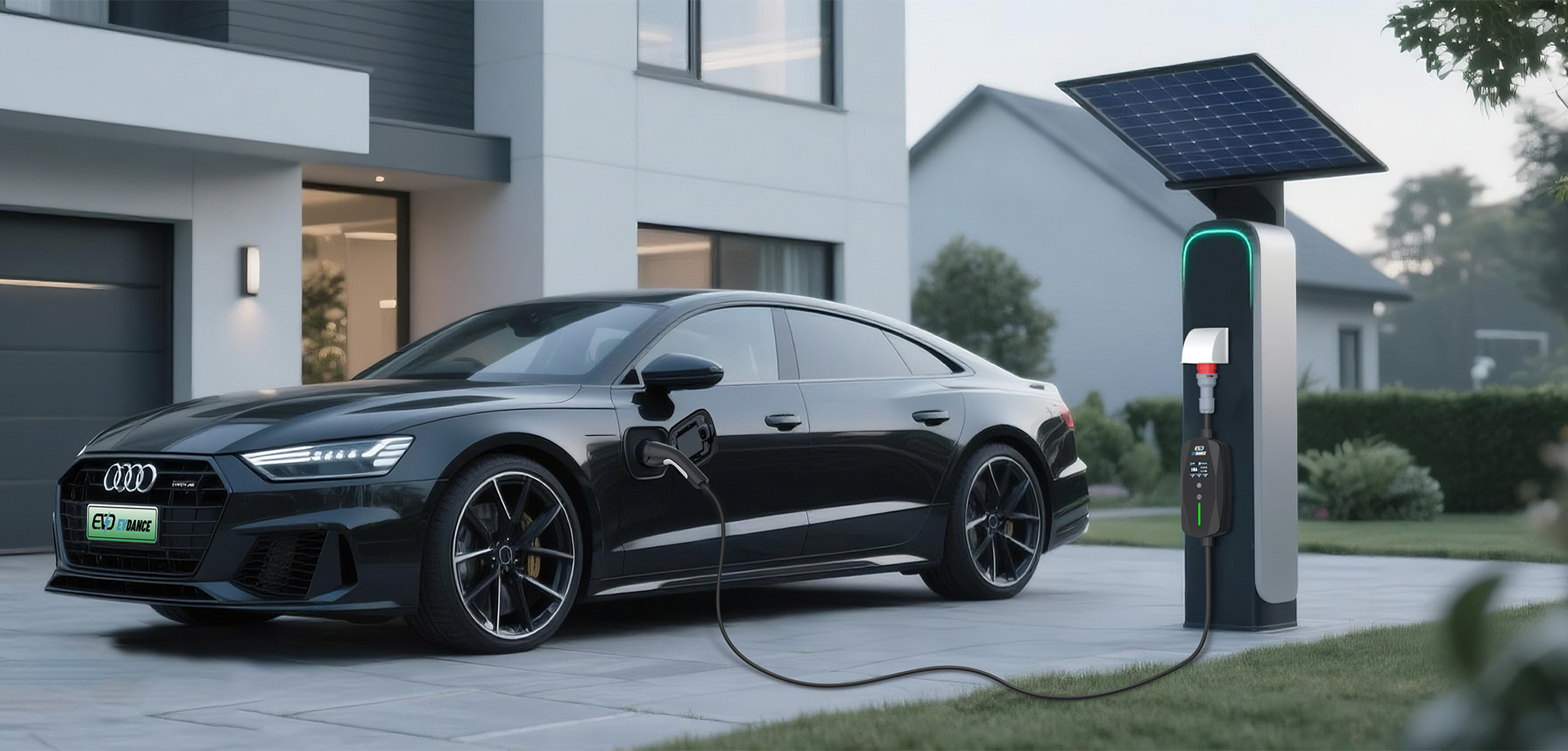
- A wet cable rides home unsealed. Rain on the cable is normal use — the run is a sealed tube, as our guide to leaving a charging cable outside sets out. But a wet cable sealed into a bag stays wet all the way home: mid-trip, let it ride in its bag left open, or on a boot liner, and dry the connectors at home before the bag is closed.
The Cables That Live This Life
The cables carried this way are loose leads and portable chargers. The EV-ACS3210E 32 A Type 2 portable charger (single-phase about 7 kW, IP66) is built for this pattern of use. One honesty note: a case is an accessory, and no EVDANCE listing states a case included with any model — confirm it separately at purchase, through our contact page if it matters. The contrast is the tethered EV-ACT5006T (up to 48 A, 25 ft cable, IP65/IP66): its cable never travels at all — park the cable with the charger, and carry only a travel lead.
Frequently Asked Questions
Frunk or boot — which is better for the cable?
Whichever gives the bag a fixed seat where it cannot slide. The frunk keeps the cable separate from luggage entirely; the boot works if the bag is secured rather than loose.
Can I keep the cable in the car all year?
Yes — the travel cable’s home is the car. Keep it dried before the bag closes, capped at both ends and out from under heavy loads, and look it over before a long trip.
I keep nearly leaving the cable at public posts. What actually helps?
Order, not memory: cable into its bag and its seat first, before anything else is loaded, then the walk-around check. The first item packed is the one that is not forgotten.
Related Reading
- Can You Leave an EV Charging Cable Outside?
- Which EV Charging Cable Do I Need?
- Do EV Charging Stations Have Cables?
- How Long Do EV Charging Cables Last, and Can They Be Repaired?

