
Rental companies charge most of their EVs on site, between hires. Rows of AC chargers at the depot do the bulk of the work, overnight or over a few hours. A few DC units handle fast turnarounds — a car back low, out again the same day. The charge level at handover is set by each company’s own rental policy, not by a shared industry rule.
Key Takeaways
- Most rental charging happens on site, between hires, by AC points working through the dwell.
- DC units are the exception tool for the same-day rehire, not the default.
- The handover level is each company’s own policy, in its rental agreement — there is no shared standard.
- On the road, the renter uses the same public networks as any other driver.
Charging Is One Step in the Turnaround
A rental car earns nothing while it waits. Between hires it passes through one chain: return, cleaning, inspection, charging, ready check. Charging is the step whose length varies most, with how the car came back and how soon it leaves. A car returned nearly full needs only a check; a car returned low with a booking in two hours drives the schedule.
| Situation at the depot | Usual on-site answer | Why |
|---|---|---|
| Returned low, next hire tomorrow | An AC point overnight | A modest rate fills the car inside the long dwell |
| Returned low, next hire in a few hours | The DC unit | Only a fast session fits the window |
| Returned nearly full | Top-up or ready check only | Most returns need energy for the next booking, not a refill |
| Car still out on rent | The renter charges on the road | The renter uses public networks, under the agreement’s terms |
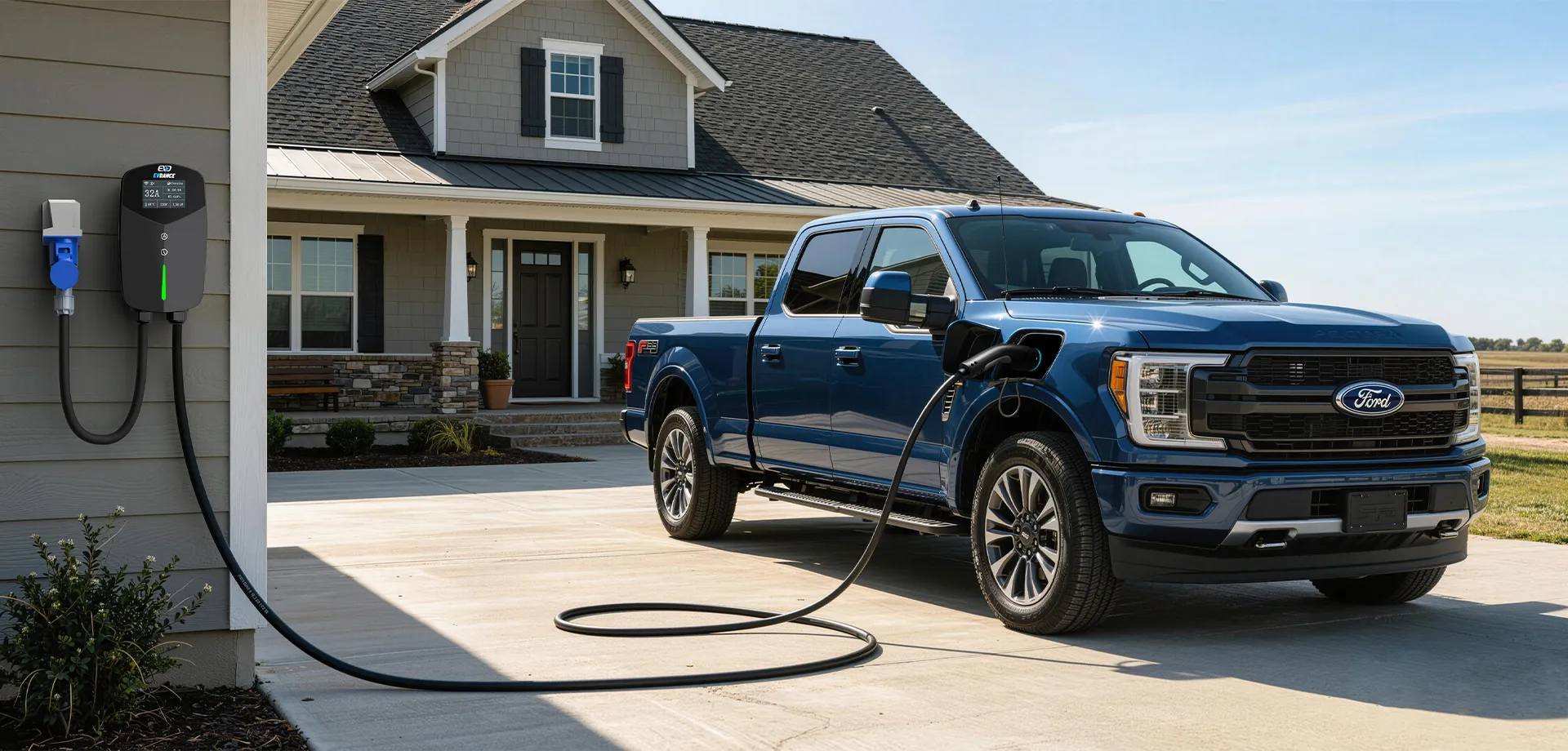
The On-Site Pattern: Many AC Points, Few DC
The depot layout follows the dwell. Because most returns sit for hours, the workhorse is AC: the U.S. DOT puts Level 2 at 7–19 kW, enough to refill a typical return overnight. Operators fit many AC points rather than a few powerful ones — the bottleneck is cars waiting for a plug, not for speed. The site supply is shared across them all, so the installation is designed around simultaneous sessions: the same discipline our fleet depot charging guide applies to vans.
DC sits alongside as the exception tool: a compact DC unit covers the late return and the same-day rehire, and stays idle much of the time by design. Access control and session records matter more here than at a private depot: the operator must know which session belonged to which vehicle.
The Handover Level Is a Policy Document
How full a rental EV is when you collect it is decided by the company’s own policy, stated in its rental terms. Companies set the level differently, and this article states no company’s actual level. The depot’s job is narrower: hit the level the policy promises, inside the window the next booking allows, and record it. If you are renting, the level to expect is in the agreement you signed.
The Renter’s Side of the Same System
Once the car leaves, the renter meets the same public charging system as any other driver: the networks, their apps and payment methods, and the car’s own connector. That is why counters push renters to set up charging accounts before driving away: an account created at the kerb is where authorisation failures happen. How those networks work is covered in our explainer on how commercial EV charging stations work.
Hardware That Fits the Rental Pattern

The EV-AC03201T fits the AC row: two Type 2 connectors sharing up to 43 kW (22 kW per connector), OCPP 1.6J, RFID and IP54 in one floor-standing station — two returns at once, with card access and session records. For the fast-turnaround slot, the EV-RHDC30K-L is a compact DC charger of 22 kW with OCPP 1.6J and IP54 — below corridor DC class, sized for a depot window. Our commercial EV charging page sets out the range.
Frequently Asked Questions
Do rental companies charge every EV to 100% between hires?
Not necessarily. The target is the level the company’s policy promises for handover — many returns need only a top-up to reach it. The promise is in the rental agreement and differs by company.
Who pays for charging while the car is out on rent?
The renter, under the agreement’s terms — public charging is bought with the renter’s own accounts. Returning the car at a lower charge is also governed by that document.
Why not fit only DC fast chargers?
Because most returns are not in a hurry. DC hardware costs far more per point than AC, and DC units would sit idle while cars dwell anyway. Operators match the tool to the window: AC for the dwell, DC for the exception.
Related Reading
- Fleet Depot Charging: How to Size AC Chargers for Vans and Light Commercial Vehicles
- How Do Commercial EV Charging Stations Work?
- What Is the Best Commercial EV Charging Station? How to Choose
- How to Plan a Workplace EV Charging Program

