
The division in a fleet charger calculation is easy. Counts go wrong earlier, in the inputs: fleets plan from battery sizes, scheduled dwell and charger ratings instead of route energy, real dwell and accepted rates. Audit four inputs first — daily energy, dwell window, accepted rate, simultaneity — and the arithmetic nearly does itself.
Key Takeaways
- Charger counts fail in the inputs, not the arithmetic: audit energy, dwell, accepted rate and simultaneity.
- Daily energy comes from route records; battery capacity is the tank, not the trip.
- The energy floor and the simultaneity floor are different numbers — the operation feels the larger one.
- Close with two checks: energy covered, last vehicle finished before departure.
Input 1: Daily Energy From Records
A battery’s capacity is the size of the tank, not the size of the trip. What a charger must replace each night is the energy the route used — already in the fleet’s records: telematics, dispatch logs, or fuel records. Plan for the heaviest regular route day, not the average; name seasonal peaks separately. Sum the vehicles: that total, in kilowatt-hours per night, is the demand every later step serves.
Input 2: The Real Dwell Window
Dwell is not the gap between first return and last departure. Vehicles arrive and leave across a spread; the honest window is the overlap most share. If the whole fleet returns within one hour, every vehicle expects to start at once: simultaneity, not total energy, sets the floor. Audit a normal week’s return and departure times before using any window.

Input 3: The Rate the Vehicle Accepts
A session runs at the lower of the charger’s rating and the vehicle’s onboard limit. The U.S. DOT puts Level 2 at 7–19 kW, but a vehicle that accepts less will draw less, for longer. Count points, not boxes: a dual-connector station is two points on one total, split when both are plugged in. Use the accepted rate and the shared total, or the window output per point is fiction.
| Input | Where it hides | The error a lazy input causes |
|---|---|---|
| Daily energy per vehicle | Telematics, dispatch and fuel records | Battery size overstates some vehicles, understates hard-worked ones |
| Dwell window | Actual return and departure times | Depot hours flatter the window; late vehicles miss their charge |
| Accepted rate | The vehicle’s onboard specification | The charger’s nameplate overstates every session it feeds |
| Simultaneity | The return pattern across one hour | An energy-only count fails on the first busy evening |
Input 4: Who Rotates
Sharing points lowers the count only if someone is on site to move vehicles, or some vehicles can skip a night. Audit the staffing, not the intention — an unstaffed depot at 1 a.m. has no rotation. Exception vehicles (late back, early out) may not fit AC at any count — a DC question.
The Calculation, in Three Steps
- Step 1. Total the audited nightly energy.
- Step 2. Divide by one point’s window output (accepted rate × audited window): the energy floor.
- Step 3. Raise it to the simultaneity floor — every must-charge vehicle starting on return — and take the larger.
Invented example only: 25 vehicles at 30 kWh is a 750 kWh night; at an accepted 7 kW over a 9-hour window, one point gives about 63 kWh, so the energy floor is 12 points. If all 25 return within the hour and nobody rotates, the simultaneity floor is 25 — the number the operation feels. Two checks close it: energy (points × rate × window ≥ the nightly total) and window (the last vehicle in finishes before departure). Growth and a down unit are a margin you decide deliberately — headroom in the infrastructure, not a percentage rule. The same audit, applied to power per vehicle, is in our fleet depot charging guide.
Hardware the Worksheet Lands On
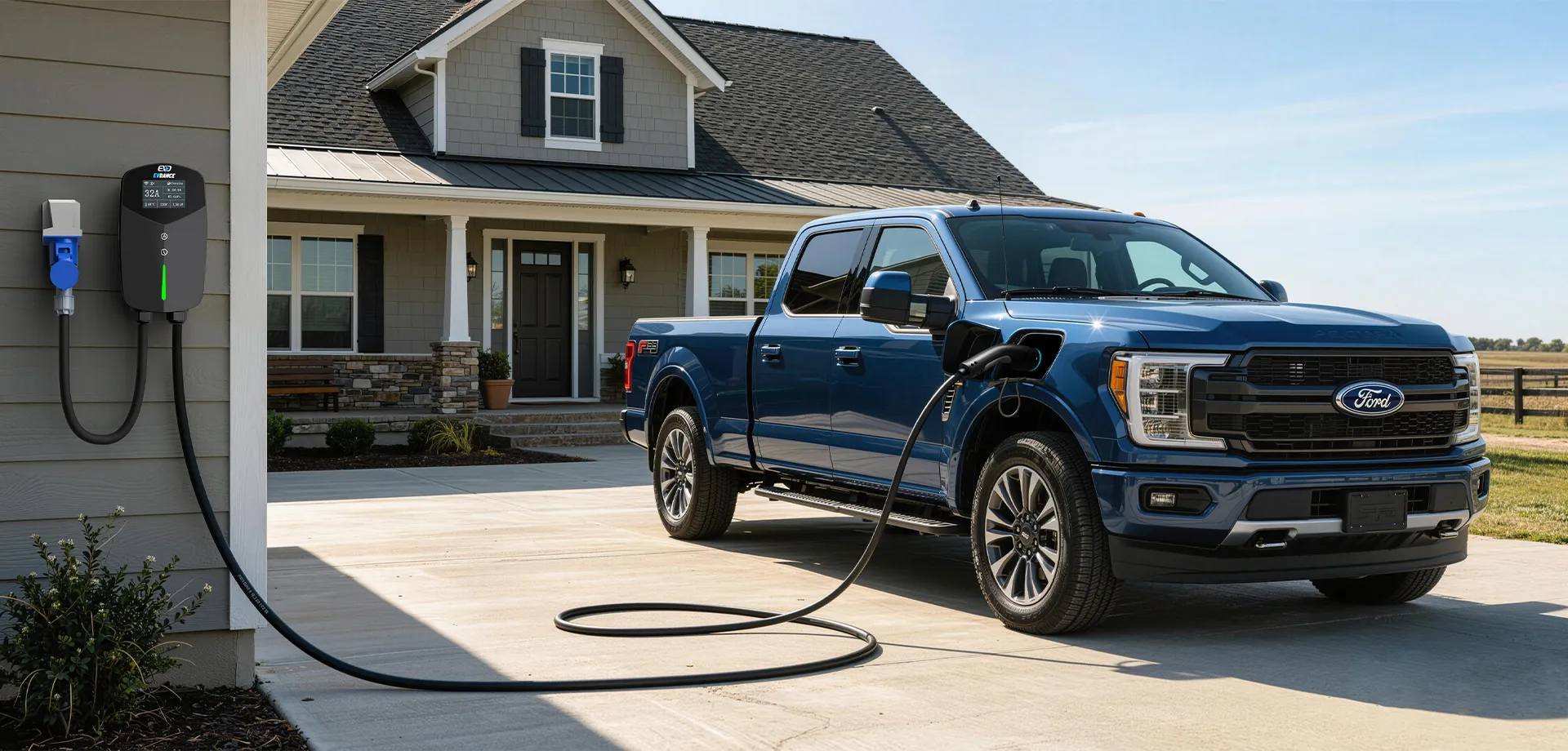
The EV-AC03201T puts two points in one station — two Type 2 connectors sharing up to 43 kW (22 kW per connector), OCPP 1.6J, RFID, IP54. The EV-ACT3204PE 22 kW wallbox is the single-bay point. Either way, the count comes from your audited inputs — as our workplace charging program guide does for staff fleets.
Frequently Asked Questions
Why not simply fit one charger per vehicle?
Sometimes it is the honest answer — an unstaffed depot where every vehicle must leave full often lands there. The audit shows whether you are buying that certainty deliberately or paying for unneeded points.
Does a bigger battery mean I need more chargers?
No — the count follows daily energy and the window, not capacity. A bigger battery on the same route changes only how many nights a vehicle could skip.
When does the answer stop being AC points?
When the window check fails, a vehicle whose dwell cannot replace its route energy at AC rates is a DC case, sized from its turnaround. More AC points cannot fix a window problem.
Related Reading
- Fleet Depot Charging: How to Size AC Chargers for Vans and Light Commercial Vehicles
- How to Plan a Workplace EV Charging Program
- How Do Commercial EV Charging Stations Work?
- What Is the Best Commercial EV Charging Station? How to Choose

