
Three-phase charging is AC charging that draws power through three live conductors instead of one. It raises the home charging ceiling from about 7.4 kW on a single-phase supply to about 11 kW or 22 kW, provided the supply, the charger and the car all support it. The catch is that many homes do not have a three-phase supply at all, so the useful question is not only what it is, but whether your property has it.
Key Takeaways
- Three-phase charging uses three live conductors and enables about 11 kW or 22 kW AC charging at home.
- Check the meter, the main switch, or your supplier’s record to learn your supply type.
- The car’s onboard charger is the ceiling, whatever the wallbox rating says.
- Confirm the supply with a licensed electrician before ordering three-phase equipment.
How three-phase charging works
A single-phase supply delivers power on one live conductor. A three-phase supply delivers three alternating currents, evenly spaced, so the charger can draw from all three at once. The car connector is the same: in Europe the Type 2 plug carries both single-phase and three-phase power, using more of its pins for three-phase. Charger ratings follow from the current on each phase:
| Supply | Typical charger rating | What it suits |
|---|---|---|
| Single-phase, 230 V / 32 A | About 7.4 kW | Overnight charging for most drivers |
| Three-phase, 16 A per phase | About 11 kW | Faster top-ups, larger batteries |
| Three-phase, 32 A per phase | About 22 kW | Short daytime sessions, cars that accept 22 kW AC |
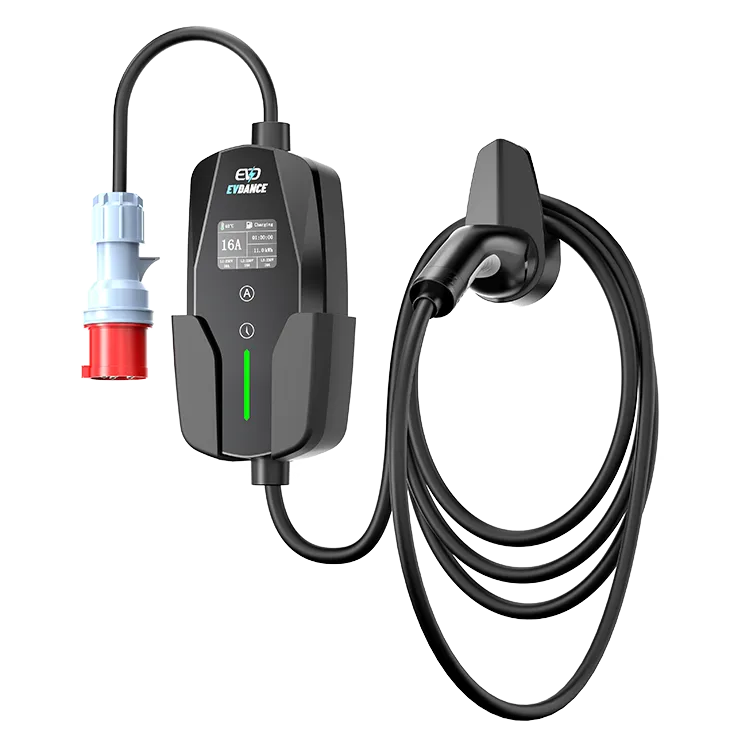
Portable three-phase chargers usually connect through a CEE industrial plug, as explained in our guide to choosing 16 A or 32 A CEE plugs. Wallboxes are wired into the supply by an installer instead.
How to check whether your home has three-phase power
You do not need test equipment. Work through these checks:
- Read the meter. Three-phase meters are usually labelled as such, or display readings for three phases.
- Look at the main switch. Three linked main switches, or three large service fuses where the supply enters, point to a three-phase supply. One main fuse usually means single-phase.
- Ask your supplier. Your electricity supplier or network operator holds the supply record for your address and can confirm it.
- Ask an electrician. Have a licensed electrician confirm the supply type before you order a charger or book an installation.
Regional patterns differ. Three-phase supplies are common in much of continental Europe and in Australian commercial buildings, while most houses in the United States use split-phase 240 V, which is not three-phase. Parts of the UK have three-phase at the street but only one phase connected to the house.
What three-phase charging does not change
The car’s onboard charger sets the AC limit. A car that accepts 11 kW AC will charge at 11 kW even on a 22 kW wallbox, and a single-phase car gains nothing from a three-phase supply. DC fast charging is a separate system that bypasses the onboard charger; the U.S. Department of Transportation lists typical DC fast charging at 50–350 kW, against 7–19 kW for Level 2 AC. Our single-phase vs three-phase comparison works through the speed differences in detail.

Three-phase chargers from EVDANCE
For a portable option, the ACS1605PE is an 11 kW three-phase portable charger with a CEE 5-pin plug, Type 2 connector and IP66 rating. For a fixed installation, the EV-ACT3204PE is a 22 kW three-phase wallbox with a tethered Type 2 cable, RFID and app control. Both ratings assume a three-phase supply; on single-phase, expect reduced power.
Frequently Asked Questions
Does an 11 kW charger need three-phase power?
Almost always, yes. Home chargers rated 11 kW are normally three-phase units drawing 16 A per phase. Connected to a single-phase supply, the same unit typically delivers only about 3.7 kW.
Is a 22 kW charger always three-phase?
Yes. AC home charging at 22 kW means three-phase at 32 A per phase. There is no single-phase 22 kW home charger, because a single-phase circuit would need an impractically high current.
Can I have three-phase power added to my home?
Often, yes, but it is a job for your network operator, with its own quote and timescale. Ask for the cost before committing; many drivers find that single-phase 7.4 kW charging covers overnight needs without the upgrade.
Related Reading
- Single-Phase vs Three-Phase EV Charging: 7 kW, 11 kW and 22 kW Explained
- CEE Plugs Explained: Choosing 16 A or 32 A for a Three-Phase Portable EV Charger
- Portable EV Charger Types Explained: 10 A, 16 A, 32 A and Three-Phase Models
- 11 kW vs 22 kW Wallbox: Which Should Distributors Stock for Europe?

