
No single company or government writes them all. EV charging standards come from a small set of standards bodies and industry groups: SAE International and the IEC write most of the plug and communication documents, safety standards come from organisations such as UL and are tested by recognised laboratories, and installation rules sit in codes such as the National Electrical Code. Knowing who writes what explains why charger specifications look the way they do.
Key Takeaways
- Charging standards are written by bodies such as SAE, the IEC and ISO — not by governments and not by any single car company.
- Plugs, communication, safety and installation are separate layers, each with its own standards organisation.
- A standard binds when a code, a certification or a programme like NEVI adopts it.
- The marks and standard names on a charger’s spec sheet are the quickest way to check which documents it was built to.
The Bodies Behind the Standards, at a Glance
| Body | What it produces | EV charging examples |
|---|---|---|
| SAE International | Engineering standards, rooted in North America | The J1772 connector; J3400, the standardised form of NACS |
| IEC | International electrotechnical standards | IEC 61851 (charging system and modes); IEC 62196 (plugs and inlets) |
| ISO | International standards across industries | ISO 15118, the car-to-charger communication behind Plug and Charge |
| CHAdeMO Association | The CHAdeMO specification, maintained by its member companies | CHAdeMO DC charging |
| CharIN | Industry association promoting the Combined Charging System | CCS interoperability work, including megawatt charging |
| National standards bodies | Country-level standards | China’s GB/T charging standards |
| UL | Safety standards | The safety documents that listed chargers are tested against |
| NFPA | Codes and standards for fire and electrical safety | NFPA 70, the National Electrical Code installers follow |
The pattern is a division of labour. One group defines the shape of the plug, another defines how the car and charger talk, a third defines what “safe” means in a test lab, and a fourth writes the rules for wiring it into a building. A single charger usually has to satisfy all four layers at once.
Standards Are Not Laws — Until a Rule Adopts Them
A standard by itself is a published specification, not a statute. It gains force when something with authority points at it: an electrical code that electricians must follow, a certification that a product must hold to be sold, or a funding programme with conditions. The US NEVI rules are a worked example — they require CCS1 connectors on DC fast-charging ports and J1772 on Level 2 ports, and set a minimum of 150 kW per DC port with average annual uptime above 97%. In each case, a regulation named standards written by SAE and the IEC.
Safety works the same way. In the US, chargers are tested by Nationally Recognized Testing Laboratories under OSHA’s programme, working to safety standards such as UL’s. Our explainer on how NRTL certification works walks through what the UL and ETL marks actually certify.
Why This Matters When You Buy a Charger
Almost every name on a charger specification sheet traces back to one of these bodies. The connector name comes from a plug standard — our piece on Mode 2 and Mode 3 charging shows how IEC 61851 frames everyday charging. Networked chargers quote OCPP, the operator protocol. And when a proprietary connector becomes an open standard — as happened when NACS was standardised as SAE J3400 — it is one of these bodies doing the standardising. Buying equipment built and listed to the recognised standards is what makes cars, chargers and adapters work together.
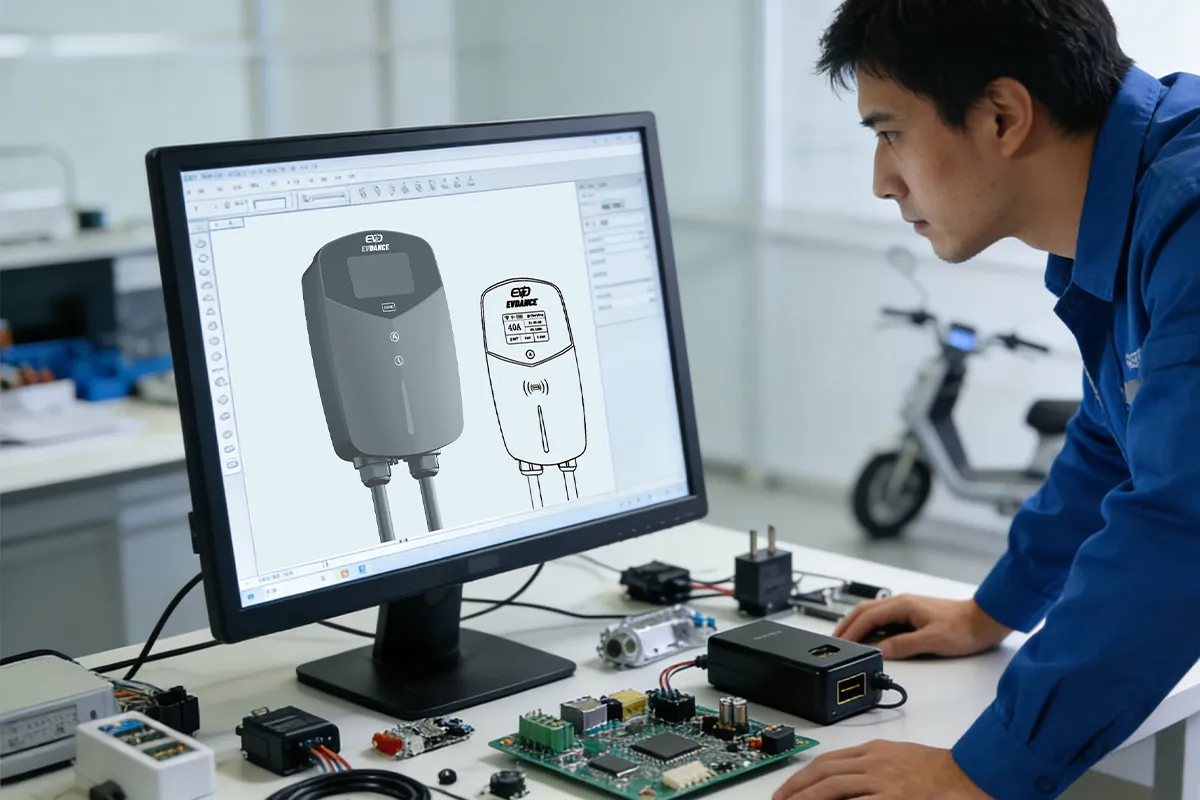
EVDANCE has manufactured chargers in Shenzhen since 2011 and exports to more than 30 countries, so its range is built market by market against these documents. The EV-ACT5006T 48 A wall charger carries ETL, FCC and CE marks, and the EV-ACT3204E wallbox carries CE — those marks are how a buyer can see the standards work without reading the standards themselves.
Frequently Asked Questions
Who invented the Type 2 plug?
The connector is defined internationally in IEC 62196, the IEC standard covering EV charging plugs and vehicle inlets. Whatever its design history, the document that makes Type 2 equipment from different makers fit together is the IEC’s.
Is NACS an official standard now?
Yes. NACS began as one manufacturer’s connector and was then published by SAE International as J3400, which is what makes it a standard other companies can build and certify against.
Can a company just write its own charging standard?
It can publish its own specification, and several did in the early years. The market has steadily moved to the shared documents, because interoperability, safety listing and public funding programmes all reward building to the recognised standards — which is also why adapters exist for the exceptions.
Related Reading
- UL and ETL Listing for EV Chargers: How NRTL Certification Works
- OCPP Explained: What Charge Point Operators Need From EV Charger Hardware
- Mode 2 vs Mode 3 Charging: What IEC 61851 Means for Portable EV Chargers
- Is the Tesla Charger NACS? NACS, J3400 and Adapters Explained

