
Cable management on a public charger is a specification decision, not an installation-day improvisation. Before a project opens, its documents settle three things per charger position: how the connector parks between sessions, how slack is controlled, and how a damaged cable is replaced. Because listings rarely include management hardware — no EVDANCE listing states a retractor or a holster — each answer is a written confirmation from the supplier, filed with the project documents.
Key Takeaways
- Cable management is specified, not improvised: parking, slack control and replacement are settled per charger position.
- No EVDANCE listing states a retractor or holster — management hardware is a written confirmation per model.
- Cable length is a stated specification line where it exists, and a question to close where it does not.
- The replacement route belongs in the operations file before the site opens.

The Questions the Specification Must Close
Five questions cover the cable’s whole life at a public site — each cheap on paper, expensive to discover after opening.
| Spec question | Why public sites feel it | The written answer to file |
|---|---|---|
| Is a holster or dock supplied with this model? | A connector with no parking place ends sessions on the ground, in grit and standing water | The supplier’s statement for the exact model: supplied, optional, or not offered |
| What cable length is stated for this model? | Too little strains at the far bay; too much lies in the drive path | The length from the model’s own listing; where none is stated, a written figure before positions are fixed |
| Does this position need a retractor or overhead support? | Long cables across wide bays get driven over and tripped over | The project’s hardware decision, with fit confirmed by the supplier in writing |
| How is a damaged cable replaced? | A cut or crushed cable takes its bay out of service until the assembly is swapped | The replacement route: the exact-model assembly, through the manufacturer’s service channel, named in the operations file |
| Who inspects cable condition, and how often? | The cable is the most handled part of the station and wears first | An inspection line in the site’s maintenance schedule, with an owner and interval |
The Hardware, in Categories
The specification chooses from a short list of site-side hardware. None of it is electrical or changes the charger’s certification; it changes how the cable ages.
- Holsters and docks. A fixed parking place for the connector, off the ground, facing down or capped so water and grit stay out of the contacts.
- Retractors and reels. Spring or counterweight systems that take up slack and pull the cable back beside the unit, sized to the cable they carry; the working position stays unwound.
- Overhead supports and booms. For bays with no wall or post to hold the parking point, or where the cable must cross no traffic at height.
- Hooks and loops. The baseline: the cable hangs in wide loops beside the unit, where the stated length is close to the run the bay needs.
Which category fits is a layout question: the survey that fixes charger positions also fixes where each cable parks — see our site selection guide — and sizing starts from our cable length guide.
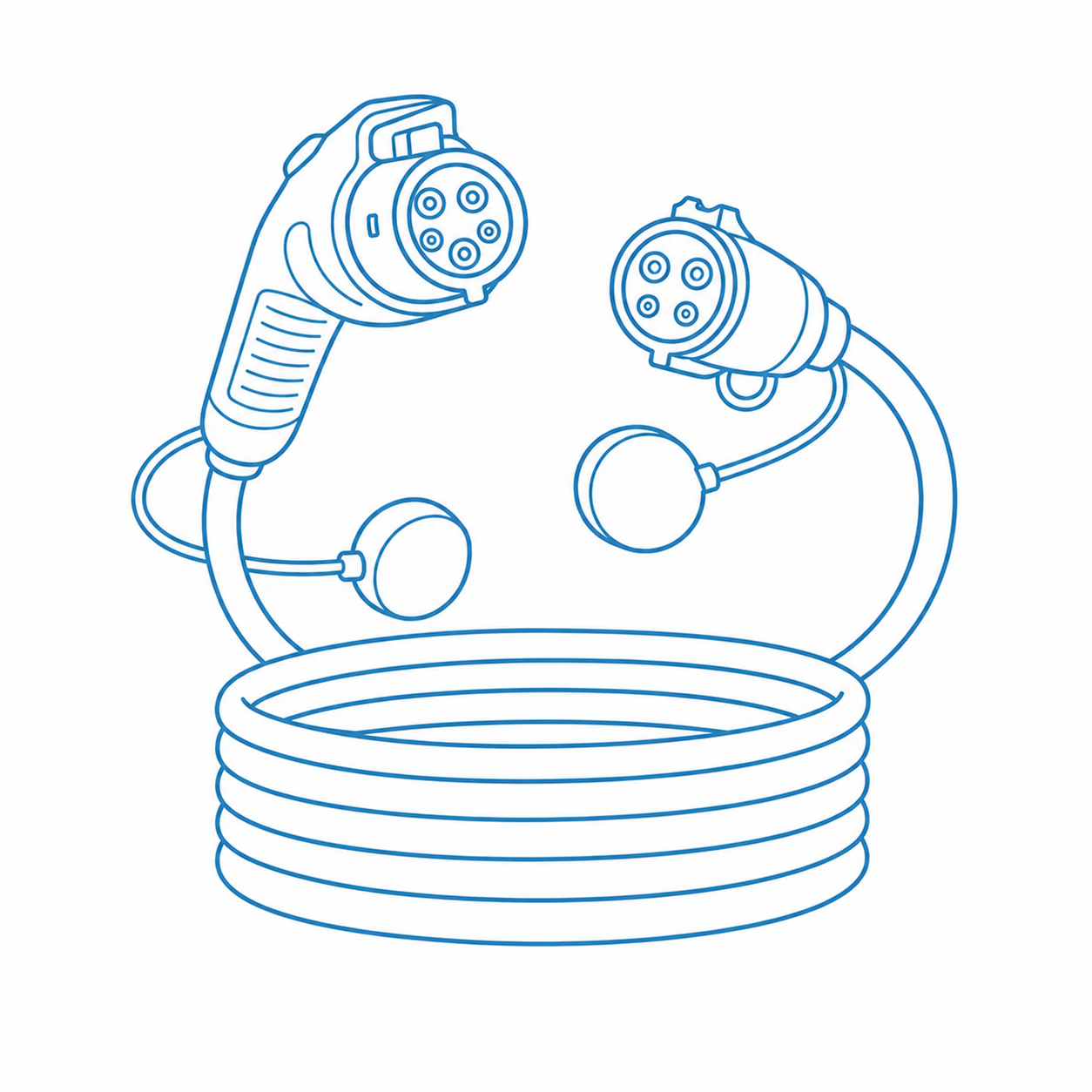
What the EVDANCE Listings State — and What They Leave to the Spec
The listings state cable facts as specification lines: the EV-ACT5006T carries a 25 ft cable, the EV-AC04001U 25 ft; the EV-ACS3210E states 7.5 m and the ACS1605PE 7.6 m. Two listings state no length at all: the EV-ACS3210T and the EV-AC03201T. The AC03201T’s listing states no retractor or add-on holster either, so on a project using that station, reach, docking and slack control are items to close with the supplier in writing — not assumptions to draw. Project teams can work through a model’s cable file via our commercial EV charging page or contact us.
Frequently Asked Questions
Does the EV-AC03201T come with cable retractors?
None is stated in its listing. If your site needs slack control beyond the station’s own docking, retractors and holsters are site accessories the project specifies and sources — confirmed with the supplier in writing before the order.
How long should a public charger’s cable be?
Only as long as the bay geometry needs. Lengths are stated per model — 25 ft on the EV-ACT5006T and EV-AC04001U, 7.5 m on the EV-ACS3210E — and where a listing states none, the figure is a written confirmation, not a guess.
Who replaces a damaged tethered cable?
The manufacturer’s service route, with the exact-model assembly — a route the specification files before the site opens, so a damaged cable becomes a service order, not a research project. How cables age is covered in our guide to how long EV charging cables last.
Related Reading
- EV Charger Cable Length Guide: 5 m, 7.5 m or Longer?
- How Long Do EV Charging Cables Last, and Can They Be Repaired?
- Do EV Charging Stations Have Cables?
- Where to Install an EV Charging Station: Site Selection Guide

