
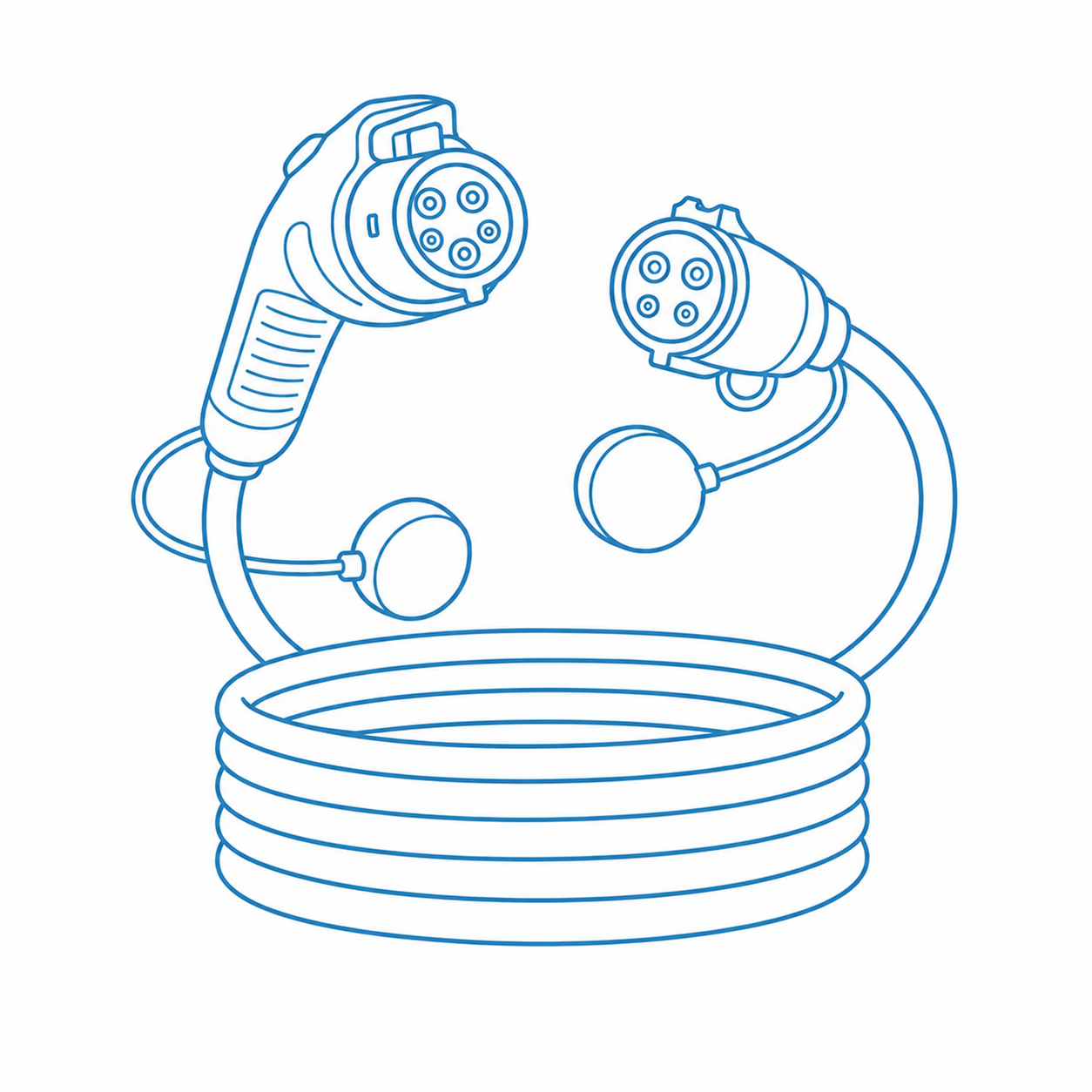
No. Swapping a 5 m charging cable for a 7.6 m one on the same charger does not change your charging time in any way you could measure. Charging speed is set by the charger’s power rating and by how much power the car can accept; the cable supplied with the unit is sized to carry its rated current over its full length, so a full charge takes the same time on the short cable and the long one.
Key Takeaways
- A longer charging cable does not slow home charging; time is set by charger power and the car.
- Cable conductors are sized for the rated current, so extra metres cost a negligible fraction of voltage.
- The length that matters is the fixed wiring run from the panel — an electrician sizes that wire for distance.
- Pick cable length for reach and handling, never for speed — and never add an extension cord.
What Actually Sets Charging Time
Charging time is energy divided by power. A charger rated at 7.4 kW delivers about 7.4 kWh per hour, so a 40 kWh top-up takes a little over five hours — on any cable length that charger is sold with. U.S. DOT figures show the ranges that matter:
| Charging level | Typical power | Range added per hour |
|---|---|---|
| Level 1 | About 1 kW | 2–5 miles |
| Level 2 | 7–19 kW | 10–20 miles |
| DC fast charging | 50–350 kW | 180–240 miles |
The car’s onboard charger can lower the figure; the cable is not part of the calculation. If your charging is slower than expected, our troubleshooting guide to why an electric car charges slowly at home works through the real causes.
Why a Few Extra Metres Do Not Slow You Down
Every cable resists current slightly, and resistance grows with length. The scale is what settles it. Conductors in a charging cable are sized for the unit’s rated current, so over the two or three metres between a short and a long version, the voltage lost is a tiny fraction of one percent, and the charger and car regulate around losses of that size. Compare like with like, on the same 7.4 kW charger adding 40 kWh:
| Cable length | Charging time for 40 kWh | What actually changes |
|---|---|---|
| 5 m (about 16 ft) | About 5.4 hours | Lightest, easiest to coil |
| 7.6 m (about 25 ft) | About 5.4 hours | More reach, a little heavier |
| 10 m (about 33 ft) | About 5.4 hours | Heaviest; reaches a second parking spot |
Any real-world difference is seconds, buried under normal temperature and charging-curve variation.
The Length That Does Matter: The Wiring Run
A different length question genuinely affects charging, and it is easy to confuse the two. The fixed wiring between your electrical panel and the charger — across a house, or out to a detached garage or barn — can run to tens of metres. On very long runs, voltage drop becomes a real design point, and the electrician answers it by sizing the wire for the distance, as our guides to what size wire an EV charger needs and how an EV charger is wired explain. That is about the installation, not the cable you uncoil each night.
An extension cord is never the shortcut: household leads are not rated for hours of continuous EV current, as our extension cord safety advisory sets out. If the cable will not reach, buy reach — a longer-cable charger or a better-placed outlet.

So Choose Cable Length for Reach
Since speed is off the table, choose on fit: measure from the charger to the farthest parking position, allow slack so the cable is not under tension, and allow for handling — longer cables weigh more. Our EV charger cable length guide covers choosing between 5 m, 7.5 m and longer in full.
EVDANCE sells the same charger in both lengths for this reason: the EV-ACS4005T 40A portable charger delivers 9.6 kW on a 25 ft or a 28 ft cable, and the EV-ACT5006T wall charger pairs up to 48 A with a 25 ft cable — identical charging time, different driveways.
Frequently Asked Questions
Does a 10 m cable charge slower than a 5 m cable?
No measurable difference at home charging power. Both are sized for the charger’s rated current, and the extra loss over a few metres is a tiny fraction of one percent.
Why does my charging cable feel warm?
A cable working at high current for hours can feel mildly warm, which is normal. A cable, plug, or outlet that is hot, discoloured, or damaged is not — stop using it and have it inspected.
Can I add an extension lead to get more reach?
No. Extension leads are not designed for continuous EV charging loads. Buy a charger with a longer cable, or have an electrician move or add an outlet.
Related Reading
- EV Charger Cable Length Guide: 5 m, 7.5 m or Longer?
- Why Is My Electric Car Charging Slowly at Home?
- What Size Wire Do You Need for an EV Charger?
- How Is an EV Charger Wired? A Plain-English Overview

