
Yes — for the vehicles whose nights are long enough. A minibus or small bus that sits at the depot overnight can take on real energy from a 22 kW AC charger: at a sustained 22 kW, roughly 20 kWh an hour reaches the battery after losses. What AC cannot do is turn a large bus around quickly between routes — that is DC work. The EV-ACS3205PE is the portable way to put that 22 kW wherever a 32 A CEE socket exists.
Key Takeaways
- At a sustained 22 kW, about 20 kWh an hour reaches the battery — an eight-hour dwell adds roughly 160 kWh.
- Minibuses and smaller buses with long overnight dwells are the honest fit; route turnarounds belong to DC.
- The vehicle’s own AC acceptance caps the session, whatever the charger can offer.
- A portable unit moves between bays; the 32 A CEE socket is the only fixed investment per bay.
The Arithmetic, Honestly Labelled
Everything in the table is arithmetic, not a promise. It assumes the vehicle accepts the full 22 kW for the whole window, with about 10% allowed for losses. The vehicle’s own AC rating is the ceiling — check it in the vehicle documentation — and charging slows as a battery nears full, so a big fill’s last part takes longer than the straight line.
| Dwell window | Energy into the battery, at about 20 kWh per hour |
|---|---|
| 4 hours | About 80 kWh |
| 6 hours | About 120 kWh |
| 8 hours | About 160 kWh |
| 10 hours | About 200 kWh |
Compare the right-hand column with the energy your vehicles actually use each day — your own fleet logs hold that number, and it, not the charger’s rating, decides the verdict. Our guide to sizing AC chargers for fleet depots works the same nightly-energy method for vans and light commercial vehicles.
Where AC Fits a Bus Operation
- Minibuses and shuttle vehicles on fixed daily routes, parked at base for a full night — their daily energy is what the table covers.
- Smaller buses whose day fits the overnight window — if the day’s use is under what eight hours adds, AC alone carries the schedule.
- Depots where vehicles park in different bays on different nights: one portable unit moves to the vehicle that needs it, and the 32 A CEE socket is the only fixed point.
The portable form matters here: a depot rarely needs a charger bolted to every bay on day one — it needs full-rate AC at the bays that matter, and the freedom to move the unit as the pattern settles.
Where It Does Not Fit
A full-size bus that must return to service in an hour or two cannot be refilled at AC rates — the energy is not there. The same applies to mid-route top-ups measured in minutes. That work belongs to DC charging: U.S. DOT frames DC fast charging at 50–350 kW, an order of magnitude above any AC post.
EVDANCE’s own compact DC unit, the EV-RHDC30K-L, delivers 22 kW DC — a useful depot support charger, and still not a route-turnaround machine. Choose the class by the dwell: long night, AC; short turnaround, DC.
The EV-ACS3205PE in This Role
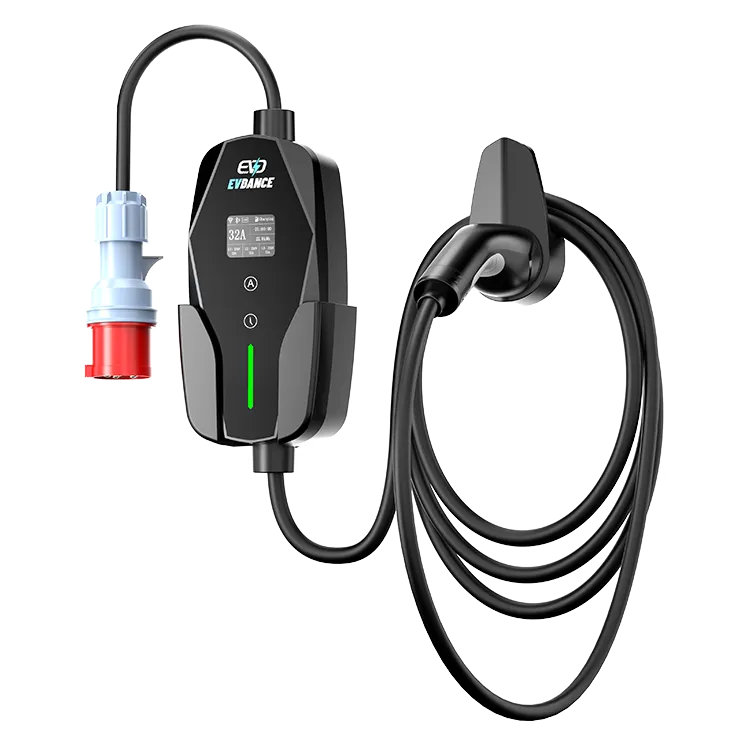
The EV-ACS3205PE is a 22 kW three-phase portable charger: 32 A at 380–400 V, Type 2 connector, CEE five-pin plug, a 1.77-inch display, and an IP66 housing for yard and depot conditions. It needs a 32 A five-pin CEE socket on a three-phase supply — our CEE plugs explainer covers telling the right socket from a smaller one. No installation project: the socket is fitted once, the charger moves.

EVDANCE is a Shenzhen manufacturer founded in 2011, exporting to more than 30 countries, and the unit carries its 3-year standard warranty.
Frequently Asked Questions
Can a portable AC charger fully charge an electric bus overnight?
It depends on the vehicle’s nightly need against its dwell. At about 20 kWh stored per hour, an eight-hour dwell adds roughly 160 kWh. If the vehicle’s day uses more than that, AC alone is not the plan — and its own AC acceptance may cap the rate below 22 kW anyway. Check both numbers before ordering.
Why not use DC fast charging for every bus?
Cost and role. DOE-cited figures put DC fast charging equipment at about $38,000–$90,000 plus $20,000–$60,000 installation, against a portable AC unit on an existing socket. DC earns that money where turnaround time is the constraint; on a vehicle parked all night, it buys speed the schedule never uses.
What must the bus have for this charger to work?
A Type 2 inlet and an onboard charger that accepts three-phase AC at the full 22 kW. Both are vehicle-spec items — confirm them against the vehicle’s documentation, because a bus that accepts less simply charges at its own rate.
Related Reading
- Fleet Depot Charging: How to Size AC Chargers for Vans and Light Commercial Vehicles
- CEE Plugs Explained: Choosing 16A or 32A for a Three-Phase Portable EV Charger
- How Do Commercial EV Charging Stations Work?
- Commercial EV Charger Maintenance Checklist

