
Workplace charging should scale with the number of EV drivers, not the headcount, and long parking times mean modest AC power serves most staff. A 10-person office may need one or two chargers; a 50-person site several shared wallboxes or a dual-connector station with RFID; a 200-person site a managed system with load balancing, OCPP and a few faster units. EVDANCE’s wallboxes, AC stations and compact DC charger cover each size.
Key Takeaways
- Size workplace charging by EV drivers, not headcount.
- AC charging covers all-day parking.
- Larger sites need RFID, OCPP and load management.
- Install ducts and capacity for growth from day one.
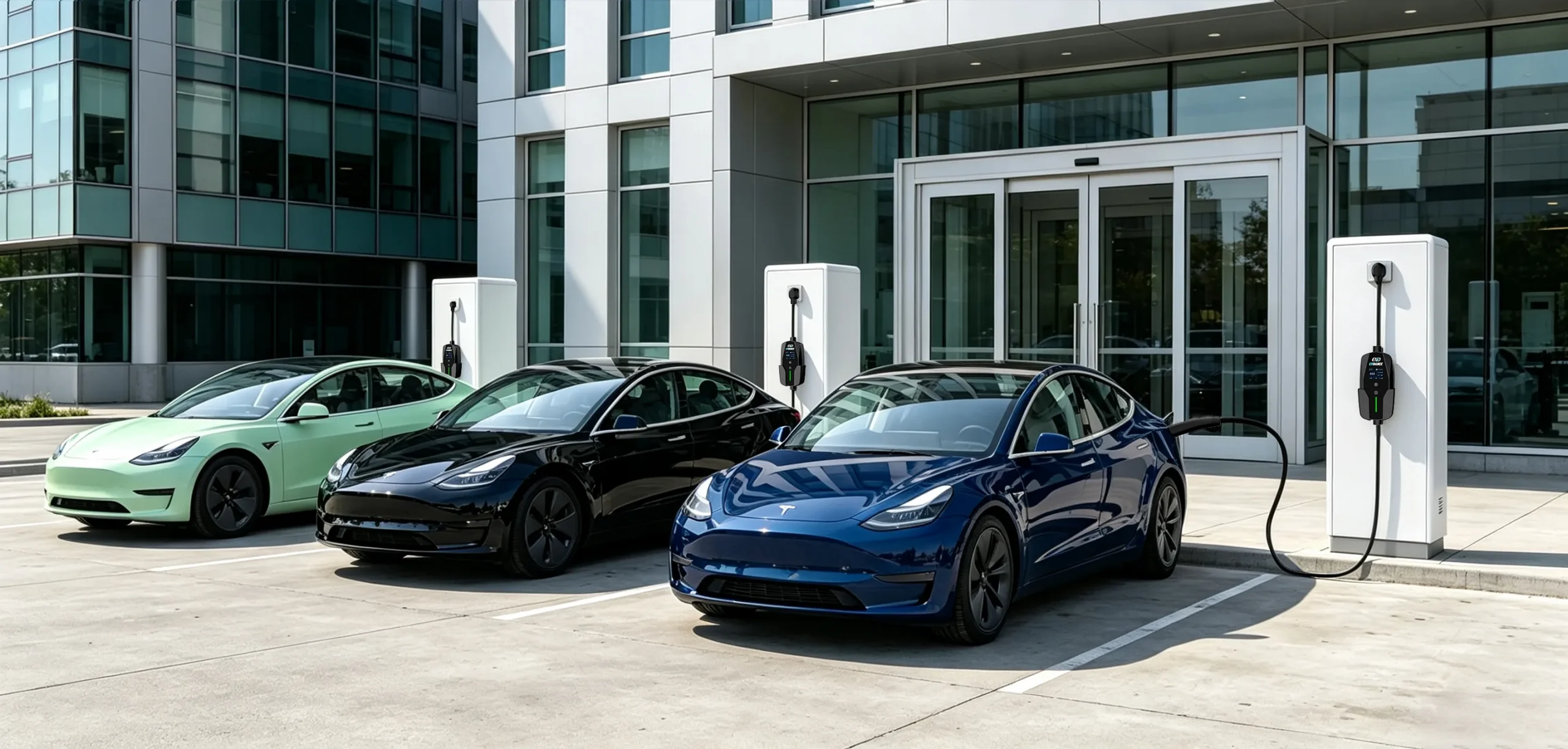
Sample Setups by Company Size
| Company size | Typical starting setup | EVDANCE options | Management |
|---|---|---|---|
| 10 employees | 1 to 2 chargers | EV-ACT5006T (North America) or EV-ACT3204E (Europe) | Simple rota, app control |
| 50 employees | 4 to 8 bays | EV-ACT3204E wallboxes or EV-AC03201T dual-connector stations | RFID cards, monthly reports |
| 200 employees | 15 to 30 bays plus visitor bays | EV-AC03201T stations, wallboxes, one EV-RHDC30K-L | OCPP platform, load management, pricing rules |
These are starting points. Survey staff to find out how many drive EVs now and how many plan to switch, then design for growth.
Why AC Is Usually Enough
Staff park for six to nine hours. At 7 to 11 kW, a car gains far more than a typical commute uses in that time. Load management lets many bays share a limited supply. Read how to plan a workplace program and whether load balancing affects speed.
Policy Questions for Every Size
- Is charging free, subsidised or charged per kWh?
- How long can a car stay after charging finishes?
- Are visitors allowed to charge?
- Who manages RFID cards and faults?
- How is any taxable benefit handled? Ask a tax adviser.

Scaling Without Waste
Install ducts and electrical capacity for future bays at the start, even if you only fit a few chargers. Adding chargers later is then quick and cheap. Use session data to decide when to expand. Read load calculation basics.
In the United States, check incentives before you buy. The IRS lists Section 30C credit amounts for business charging property placed in service from January 1, 2023 to June 30, 2026: 6% of cost, or 30% if wage and apprenticeship requirements are met, up to $100,000 per item, subject to location rules. Confirm the current status with the IRS and a tax adviser as of your installation date; state and utility programmes are listed in separate databases.
Where a DC Unit Helps
Larger sites with pool cars, visitors or shift workers who need a quick top-up benefit from one compact DC unit. It also helps staff whose cars have small onboard AC chargers.
EVDANCE supports workplaces with factory-direct supply and a 3-year standard warranty. See EVDANCE commercial charging.
Frequently Asked Questions
How many chargers does a small office need?
One or two, depending on how many staff drive EVs. Plan capacity for growth.
Should workplace charging be free?
It is the employer’s choice. Free, subsidised and per-kWh models are all common.
Is DC charging needed at work?
Rarely for staff parking all day. One DC unit can help visitors, pool cars and shift workers.
Related Reading
- How to Plan a Workplace EV Charging Program
- Does Load Balancing Increase EV Charging Speed?
- Adding EV Chargers to a Building: Load Calculation Basics
- What Is the Best EV Charger for a Small Business? How to Choose

