
A datasheet is a claim, not a measurement. Read for sourcing, its red flags are rarely wrong numbers — they are missing conditions: an “up to” power figure, a current with no statement of whether it is continuous, an IP rating with no note of what was tested, one sheet quietly covering several models. Every flag has the same remedy: a written question, asked before you request a quote, with the answer filed against the exact model code.
Key Takeaways
- A datasheet is a claim document: read it for missing conditions, not just for numbers.
- Six flags: “up to” power, unstated duty, no test conditions, unscoped IP ratings, bare protection lists, variant sharing.
- Each flag converts into one written question, answered against the exact model code.
- File the answers with your specification so quotes and inspections test the same figures.
Screening a Supplier, Not Studying a Product
Our buyer’s guide to reading an EV charger datasheet explains what each line means. This article covers the earlier moment: the datasheet is the first technical document a supplier sends, and at screening you are deciding who earns an enquiry at all. Certificates and test reports are verified separately, against the issuing body. Here the subject is narrower: the claims printed on the sheet itself.

The Red Flags, Claim by Claim
| What the sheet says | What it can hide | What to ask, in writing |
|---|---|---|
| Headline power with “up to” | A range maximum, or a figure reached at a voltage your market does not use | Which exact model does this sheet cover, and what is its power stated as voltage × current? |
| A maximum current, with no duty stated | Charging runs for hours; a peak figure is not a continuous rating | Is this current continuous, at what ambient temperature, and with what derating? |
| Ratings with no test conditions | Output depends on temperature and mounting; a bare number cannot be compared across suppliers | Under what conditions was this measured, and where is that recorded? |
| An IP rating with no scope | IP65 or IP66 may describe the enclosure only, or the connector as well, mated or unmated | What exactly was tested, and which document states the result? |
| Protection features as a bare list | A feature named with no standard or test behind it is marketing, not specification | Which standard or test covers each listed protection? |
| One datasheet for many variants | Variants sharing a sheet can differ in rating, connector and certification | Does this revision cover the exact model code I will order? |
The current question matters more than it looks. Under the U.S. National Electrical Code, EV charging is a continuous load, sized at 125% of charger current — a 32 A charger sits on a 40 A breaker. A sheet that will not say whether its current is continuous leaves the most basic operating question open.
Turn Each Flag Into a Filed Answer
- Ask for the revision that names your model. Anything whose revision does not name your model code is a brochure.
- Ask for ratings with their conditions. Current, power and temperature belong in one sentence; another bare number leaves the flag up.
- Run the arithmetic. Power should equal voltage × current, times the phases — the worked check is in our datasheet guide.
- Test the sample against the sheet. The sample should match the paper claims line by line; our guide to testing a charger sample before a bulk order shows how.
- File the answers with your specification. Then the quote, the contract and the inspection all test the same numbers.
Putting a Datasheet to EVDANCE
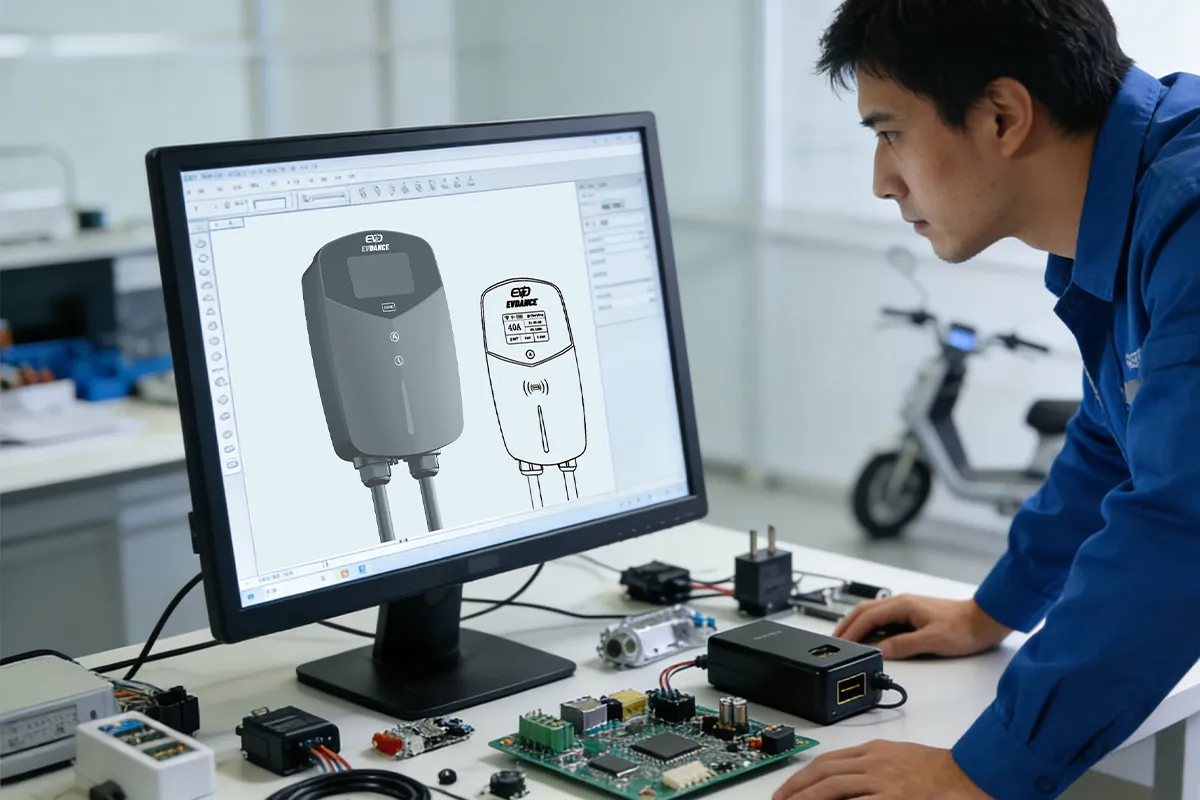
EVDANCE is a Shenzhen EV charger manufacturer founded in 2011, exporting to more than 30 countries, with private label from 100 units and a 3-year standard warranty. Our product pages state figures per model — the EV-ACS4005T (9.6 kW, NEMA 14-50P, adjustable 16/24/32/40 A, IP66), the EV-ACS3210E (32 A Type 2 portable, single-phase about 7 kW, IP66). Run the six questions above on our sheets too, via the contact page or the resellers and distributors program.
Frequently Asked Questions
Is an “up to” figure always misleading?
No — it can be an honest maximum for a range or an adjustable unit. It becomes a flag when the sheet does not say which model reaches it, at which voltage.
Should one red flag disqualify a supplier?
No — a flag is a question, not a verdict; honest factories write loose sheets too. The warning pattern is answers that stay vague, or change between datasheet, quote and sample.
What is the single most useful question to ask?
“Does this datasheet revision cover the exact model code I will order, with its ratings measured under stated conditions?” A clean written answer usually settles the other five as well.
Related Reading
- How to Read an EV Charger Datasheet: A Buyer’s Guide
- How to Test an EV Charger Sample Before Placing a Bulk Order
- How to Choose a Portable EV Charger Supplier: A B2B Checklist for Importers
- EV Charger Factory Audit Checklist for Importers

