
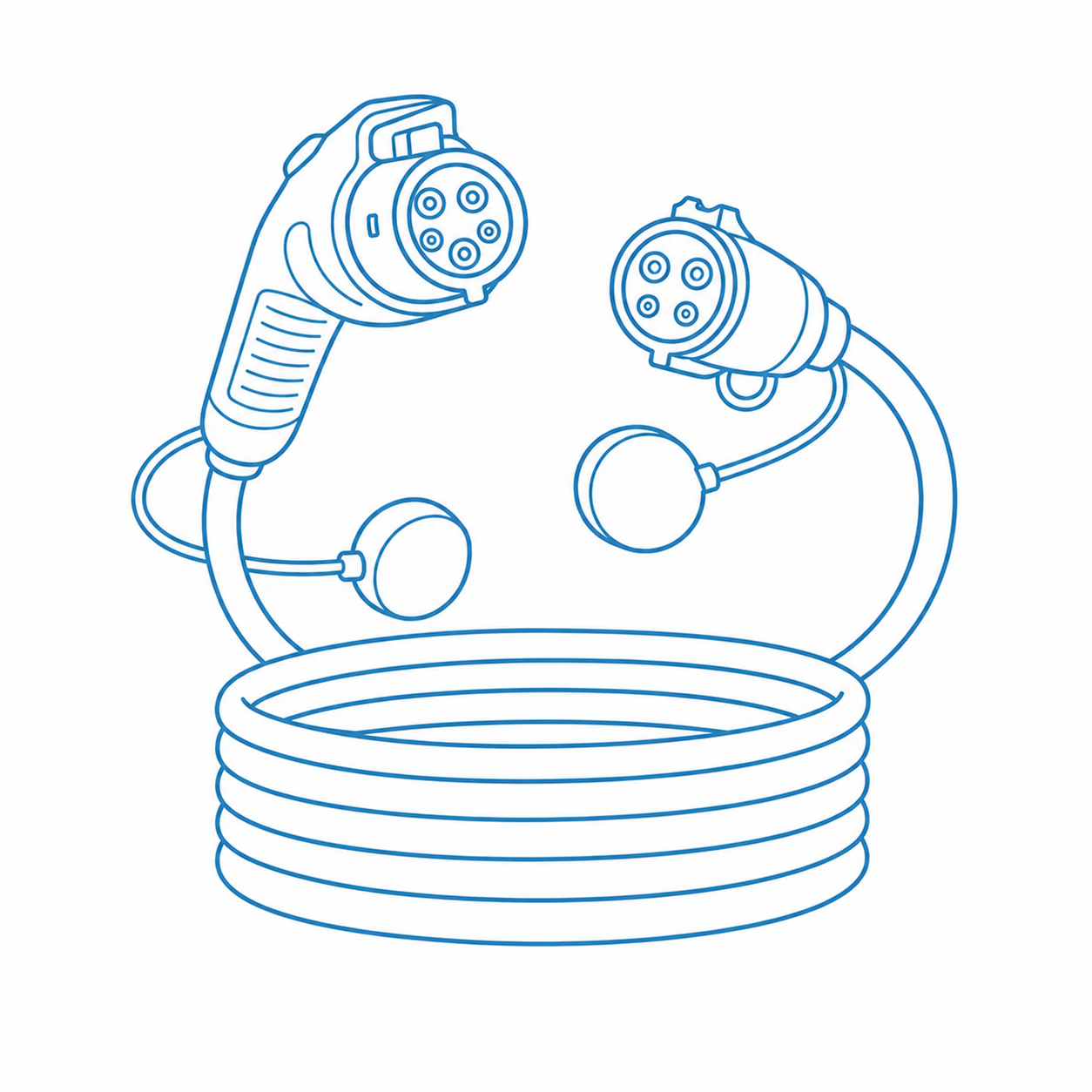
A fast charging cable is not an accessory you buy separately. It is the cable permanently attached to a DC fast charger, built to carry 50–350 kW into the car. It is short on purpose: every extra metre adds heat to shed, copper to lift and cost to the station, and none of it makes charging faster.
Key Takeaways
- A fast charging cable is the tethered cable built into a DC charger, not an accessory you buy.
- It is short because length adds heat, copper weight and replacement cost.
- The highest-power cables are liquid-cooled, and a shorter cooling loop is a simpler one.
- Park so the cable reaches without stretching; reposition the car rather than forcing the connector.

What a Fast Charging Cable Is
The cable belongs to the station, not to you. It is tethered to the charger, ends in a CCS1 or CHAdeMO connector, and is rated as one assembly with the unit it hangs from. That is why public stations provide the cable at DC speeds. Home charging is the opposite: the cable is yours, and generous lengths are normal because the power is far lower.
| DC fast charging cable | Home charging cable | |
|---|---|---|
| Typical power | 50–350 kW (U.S. DOT) | About 1 kW Level 1; 7–19 kW Level 2 (U.S. DOT) |
| Whose cable it is | The station operator’s, fixed to the unit | Yours, bought with or for your charger |
| Cooling | Thick conductors; liquid cooling on the highest-power units | Air-cooled conductor size alone |
| Length | Just enough to reach a car parked at the post | Commonly 25 ft or so, chosen for your driveway |
| Replaced by | The operator, as a rated assembly | You, or the charger maker under warranty |
Heat Is the First Reason It Stays Short
Moving high current through a conductor makes heat, and the longer the run, the more heat the cable has to shed. DC designers already fight this with thick copper; at the highest power levels they run liquid coolant through the cable and connector as well. A longer cable means a longer cooling loop and more places for the cooling to fall behind on a hot day. Keeping the cable short keeps the thermal problem small. The warmth in a working cable is normal within limits, as our guide to whether EV charging cables get hot explains.
Weight and Cost Rise With Every Metre
Copper is heavy and expensive, and a DC cable carries a lot of it. Each added metre makes the cable harder to lift, harder to coil back onto its holster, and more likely to spend its life on the ground being driven over. A short cable also presents less to steal, less to damage and less to replace when a connector wears out. A cable one person can handle easily, that docks cleanly and stays off the tarmac, is the one that keeps working.
What Short Cables Mean for You
- Park for the port, not the post. Stop so your charge port is on the same side as the cable and within easy reach. A stretched cable pulls sideways on the connector and can end the session.
- Reposition instead of forcing it. If the cable will not reach comfortably, move the car. Forcing a heavy connector in at an angle damages latches and pins.
- Expect variety. Cable position and parking direction differ by site, which is part of how fast a DC fast charger is in practice.
- At home, the logic flips. Level 2 power is low enough that length is a convenience choice, not a thermal one — our cable length guide covers choosing 5 m, 7.5 m or more for a driveway.
Chargers Sized to Their Job
Power is a dial, and cable bulk follows it. The EVDANCE EV-RHDC30K-L compact DC fast charger delivers 22 kW DC for depots, workplaces and retail sites, with a cable sized for that class — far friendlier to handle than a corridor unit’s. Sites that do not need 350 kW do not have to hand drivers a 350 kW cable. Our commercial charging solutions map charger classes to site types.
Frequently Asked Questions
Can I buy a longer fast charging cable for public chargers?
No. The cable is part of the station’s rated assembly. Only the operator can replace it, with a cable specified for that unit. You cannot extend or swap it yourself.
Does a shorter cable charge my car faster?
No. The car’s maximum rate, the station’s output and the battery’s state of charge set the speed. Shortness is about heat, weight and handling — the cable just has to be good enough not to limit the station.
Why is my home charging cable so much longer?
Because it carries a fraction of the power. At Level 2 rates of 7–19 kW, a longer cable stays cool, light and affordable, so length is chosen for your parking layout, not dictated by heat.
Related Reading
- How Fast Is a DC Fast Charger?
- Do EV Charging Stations Have Cables?
- Do EV Charging Cables Get Hot?
- EV Charger Cable Length Guide: 5 m, 7.5 m or Longer?

