
For a European dealership, a portable Type 2 charger covers two jobs fixed points handle badly: demos that charge where cars stand, and loaners that go home with buyers. The EV-ACS3210E adjusts between 10 A and 32 A, so one unit charges a demonstrator on site, then runs gently on a buyer’s unknown home socket. Nothing is installed at either end — it is an appliance the dealership lends.
Key Takeaways
- A portable Type 2 unit covers the two jobs fixed points handle badly: demos where cars stand, loaners that go home with buyers.
- In Europe the handover question is the socket, not the connector — the buyer’s supply is the unknown.
- Set loaners low at handover — 10–13 A for an unknown supply — and write it on the card.
- Run the pool like any loan asset: logged loans, signed terms, inspection at both ends.

Demo Charging: The Car Charges Where It Stands
Demo and test-drive cars do not park in one bay. They sit wherever the next customer will see them, and come back from test drives needing charge. An installed point serves its own bay; a portable serves whichever car needs it. The installed side — what to fit for customers and the workshop — is covered in our guide to EV charging for car dealerships; the portable is the flexible layer in front of it.
Two things make it work as demo equipment. The connector is Type 2 — the inlet these cars carry, as our comparison of Type 2, J1772 and NACS explains — no adapter conversation before a demo. And the current adjusts: on site, the setting is matched once to a socket the dealership’s electrician has confirmed for continuous charging.
The Loaner Job: Bridging the Buyer’s Wait
The loaner case is the gap between delivery day and the buyer’s own home installation: the car arrives this week; the wallbox comes later. A portable bridges it — the buyer charges at home from day one, and the unit returns when the loan ends.
Europe changes the handover checks. The connector question mostly disappears — the buyer’s car has a Type 2 inlet and the plug fits. What replaces it is the socket question:
| Check at handover | Works when | Does not work when |
|---|---|---|
| The car’s inlet | Type 2 — the connector fits directly | The car needs a maker-supplied adapter: confirm the buyer has it before lending |
| The home socket | A sound socket within the 7.5 m cable’s reach of the parking spot, the setting matched to it before handover | No usable socket near where the car parks — no portable fixes that |
| The current setting | Set at handover to the buyer’s socket class — 10 A to 13 A if the supply is unknown — and shown to the buyer in the app | Left at 32 A “for speed”: the top setting belongs on circuits built for it, not an unvisited home |
Running the Pool
The dealership side is a small logistics routine, set by the dealer, not the charger maker:
- Log every loan. Serial number, buyer, car, out date, due-back date — a portable is easy to lend and easy to lose track of.
- Hand over a one-page card. Which socket, which setting, how to read the session in the app, who to call if anything looks or smells wrong.
- Set the terms before handover. Deposit, damage and late-return terms are the dealership’s own paperwork, signed before the unit leaves.
- Inspect on return. Cable, connector face and plug pins, every time — damage found by your check is a workshop item; found by the next buyer, a complaint.
The Charger Behind the Pool
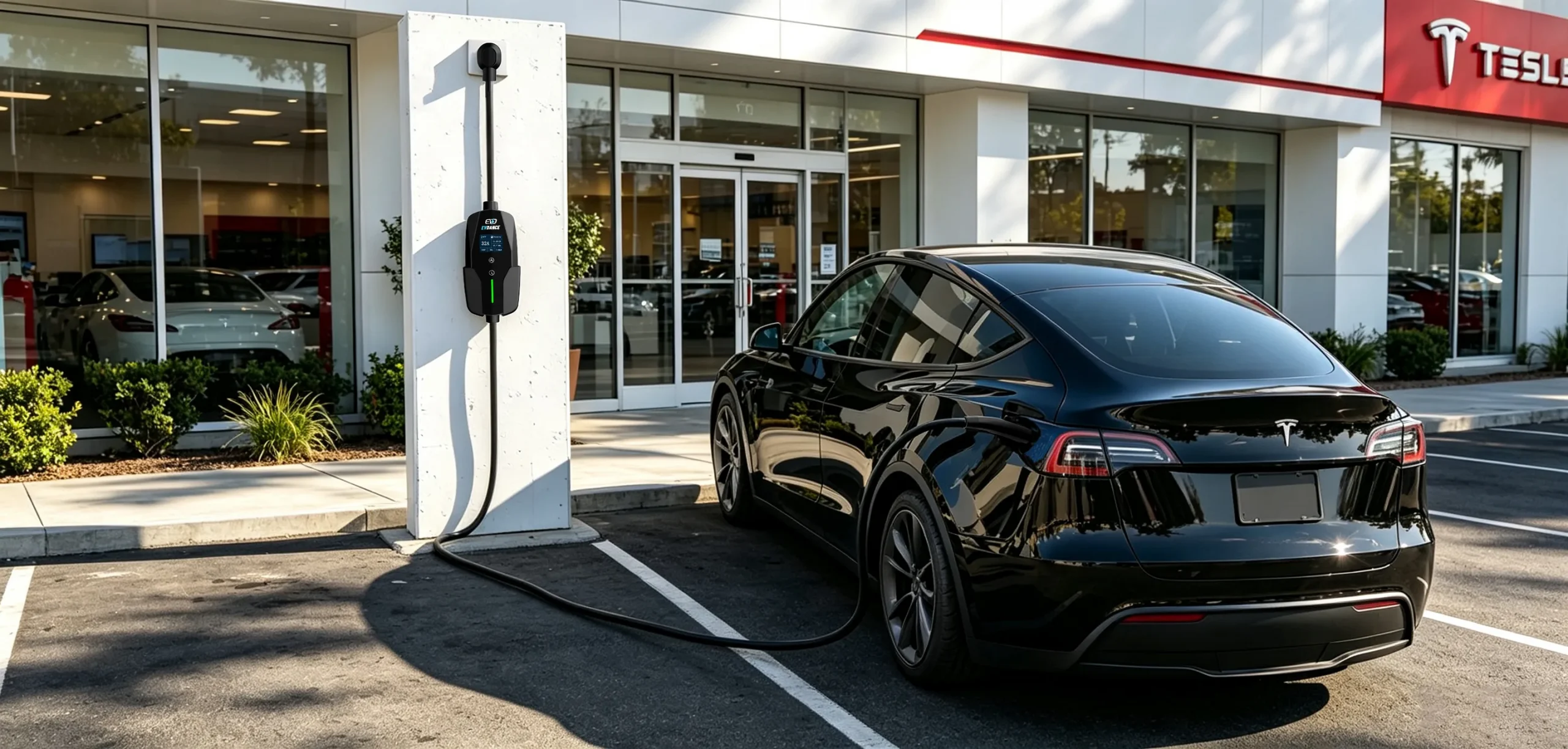
The EV-ACS3210E is a 32 A Type 2 portable charger: single-phase, about 7 kW at its top setting, adjustable from 10 to 32 A, with app control and energy monitoring, OCPP-readiness, an IP66 enclosure and a 7.5 m cable. EVDANCE is a Shenzhen manufacturer founded in 2011 with a 3-year standard warranty. Dealerships buying several units order through the reseller and distributor program.
Frequently Asked Questions
Can one portable cover both demo and loaner work?
Yes. The jobs differ in place, not in the charger. What changes is the setting — matched to the dealership’s confirmed socket for demos, set low for a buyer’s unknown home.
What setting should a loaner go out at?
The class of the buyer’s home socket. If that is unknown at handover, the household settings — 10 A to 13 A — until the supply is confirmed. A slower first night beats a tripped fuse.
Does the dealership need to install anything to use one?
The portable itself installs nothing. The demo socket must suit hours of continuous charging — the site’s electrician confirms it once.
Related Reading
- EV Charging for Car Dealerships: What to Install and Why
- Type 2 vs J1772 vs NACS: Which EV Charger Connector Does Your Market Need?
- What Is a 7kW Portable EV Charger? Speed, Range, and Compatibility Explained
- Do Portable EV Chargers Work? How Speed Depends on the Outlet

