
Private, shared or public is a decision about who may start a session, and on the EV-ACT3204E it is made with the two gates the listing states: RFID cards at the charger and access settings in the app. Private keeps it for your own household, shared opens it to a named group whose cards you control, and public leaves it open to any driver. One boundary matters: public on this unit means open access, not paid charging — no payment or billing platform is stated for this model.
Key Takeaways
- Private, shared and public are access postures on the same wallbox, set by its RFID card list and app access settings.
- Shared mode is the one that makes sessions attributable — the card list is the policy, and it needs an owner.
- Public on this unit means open and free, not paid: no payment or billing platform is stated for the model.
- Monetised public charging belongs to OCPP 1.6J platform hardware, not to an access-controlled wallbox.

The Three Modes, Side by Side
The hardware does not change between modes. What changes is the rule for starting a session.
| Mode | Who can start a session | How this wallbox runs it | Where it fits |
|---|---|---|---|
| Private | Your household only | Access restricted to your own cards and app users, or simply left as your home charger behind your own frontage | A house, a private garage, a single-tenant unit |
| Shared | A named group: staff, residents, members | A card list you issue and prune, with access settings managed in the app; each session is tied to a card | A workplace car park, an apartment building, a club or depot |
| Public | Any driver who can reach the charger | The charger is left open — no card gate. Sessions are anonymous and the electricity is the site owner’s cost | A site that deliberately offers free charging as an amenity |
How card lists and app control combine is covered in our overview of RFID and user management for shared chargers. The workplace and apartment cases differ in detail, but the choice underneath is these same three options.
What “Public” Does Not Mean on This Wallbox
Public charging usually implies more than an open socket: drivers expect to pay, and the operator expects a record and a tariff. That layer is a platform function. The EV-ACT3204E’s listing states RFID and app control; it does not state driver payment, per-session billing or a public-charging back office, so none of that should be promised to a site owner on the strength of this model.
If paid public operation is the actual requirement, the step up in the same range is the EV-AC03201T dual-connector station, which lists OCPP 1.6J with RFID — the protocol layer that charging platforms run on, explained in our OCPP explainer. Offering charging to the public can also bring local obligations for the operator — a question for your installer or adviser, not something a wallbox specification settles.
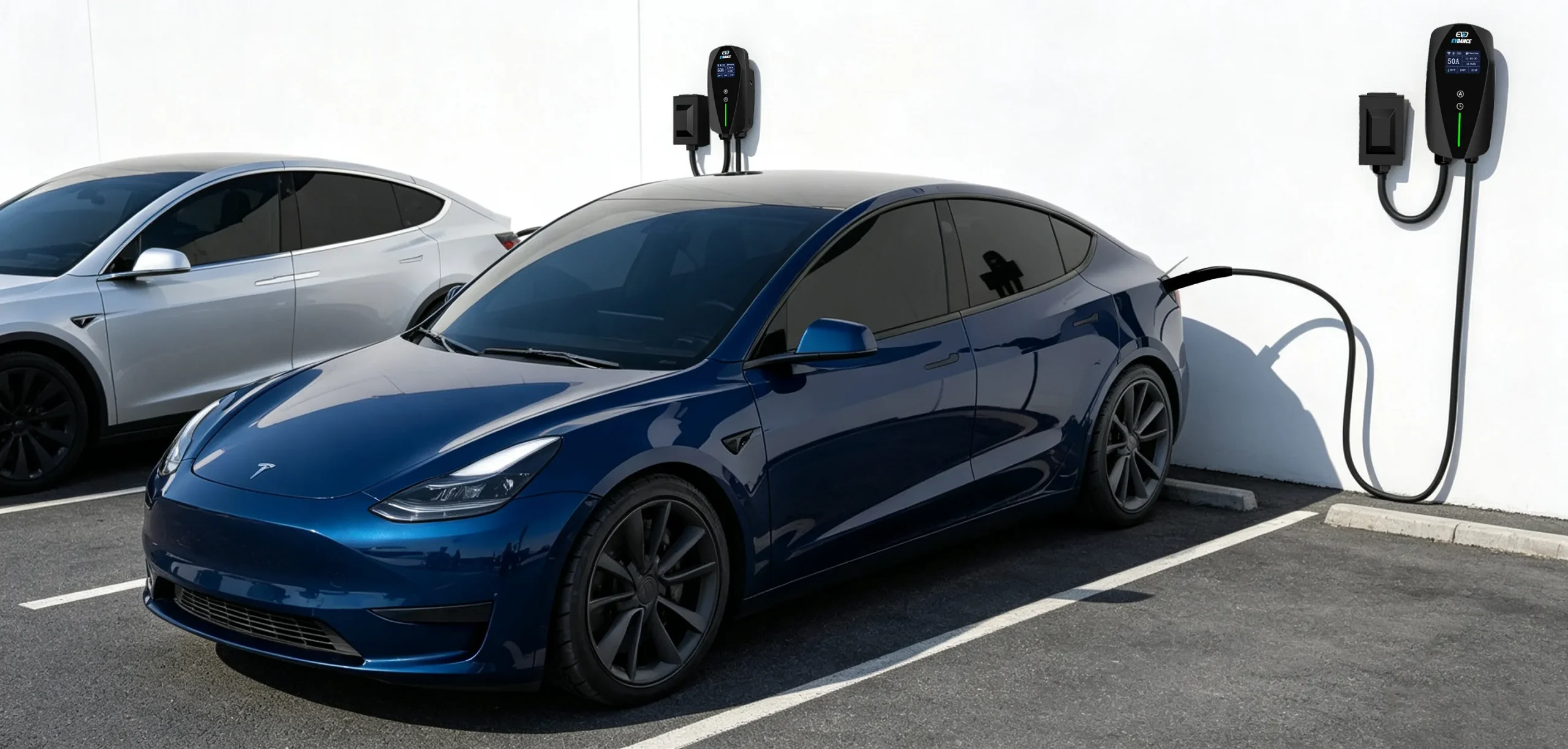
Choosing: Three Questions
- Can strangers physically reach the charger? If yes, private mode only works with the gate actually on — an unrestricted charger on a reachable wall is public in practice.
- Do you need to know who charged? If sessions must be attributable — for fairness, a rota or internal cost splitting — you need shared mode and a maintained card list.
- Do you need to be paid by drivers? If yes, this model is the wrong layer: choose platform hardware with payment stated, rather than bolting expectations onto an access-controlled wallbox.
The EV-ACT3204PE itself is a 22 kW three-phase wallbox — 32 A per phase at 380–400 V — tethered Type 2 cable, hardwired, RFID and app control, IP66 housing, CE mark, 3-year standard warranty. The mode is configuration, not a different product: the same unit can serve a household this year and a shared car park later, as long as expectations match the listing.
Frequently Asked Questions
Can I switch modes later, or is it fixed at installation?
The mode lives in the access configuration — the card list and the app access settings — not in the wiring. Moving from private to shared is mainly the admin work of issuing cards and setting access; the manual has the exact settings.
Can drivers pay by card at this charger in public mode?
No payment function is stated for this model, so do not plan on it. Public mode here means the charging is open and free to the driver, with the site owner carrying the electricity cost. Paid public charging needs platform hardware whose listing states it.
Our car park serves both staff and visitors. Which mode?
Shared, with visitors settled as policy: a guest card at reception keeps visitor sessions under the same record as staff. Leaving a post open makes those sessions anonymous — legitimate, but choose it deliberately.
Related Reading
- RFID and User Management for Shared EV Chargers
- Apartment and Condo EV Charging: Solutions for Shared Parking
- How to Plan a Workplace EV Charging Program

