
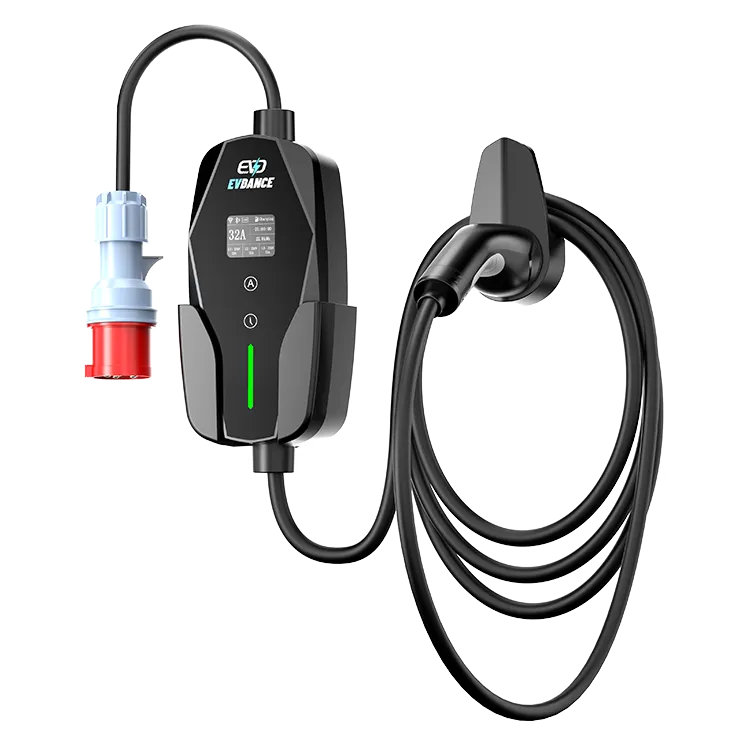
For a site with an end date, the portable-versus-fixed choice is a question about where the fixed work sits. Fixed charge points put that work — and much of the cost — into ground the operator will hand back. The EV-ACS3205PE puts the fixed work into a single socket: fit a 32 A CEE outlet where cars park, and the charger stays an asset that unplugs, moves and leaves with you. Both routes deliver up to 22 kW of three-phase AC.
Key Takeaways
- On a temporary site, fixed points spend much of their cost on ground that will be handed back; the portable spends it on one socket.
- The EV-ACS3205PE delivers the same 22 kW three-phase class as a fixed point — the difference is logistics, not power.
- Control on the portable is physical: no app, RFID or payment is claimed, so custody and a rota do the managing.
- Long-running sites and paid, managed public charging still belong to fixed points and stations.
What Fixed Points Ask of a Temporary Site
A fixed charge point is a small construction project: survey, supply run, groundworks, installation and commissioning before the first session. On a temporary site that sequence runs twice — once to open, and once in reverse at the close, if the landowner’s terms require removal and reinstatement. For scale only: DOE-cited US figures put a public Level 2 point at about $3,500 of equipment plus $2,500 of installation per connector. Those are US numbers, not a European quote — but they show the shape: a large share of a fixed point’s cost is spent on the site, not the charger. Our breakdown of commercial charging installation costs separates the two halves.
What the Portable Asks Instead
The portable inverts the list. The only fixed work is the socket — a 32 A five-pin CEE outlet on a three-phase supply, fitted by an electrician where cars will charge. After that, everything is logistics: the unit travels between serving points and sites, and into storage when the season ends. Two honest limits come with the shape. Control is physical, not digital: this model’s specification includes no app, RFID or payment layer, so who charges is managed by custody and a rota. And it works one car at a time — a busy site needs a queue, or more than one unit. Its IP66 enclosure suits outdoor work, and between uses it is stored.
| Factor | Portable EV-ACS3205PE | Fixed charge points |
|---|---|---|
| Time to the first session | As fast as a matching socket can be fitted | After survey, works and commissioning |
| Left behind at close | A socket | The installation spend stays with the site |
| Serving several locations | One unit, many sockets | One point, one place |
| Access control | None on the unit — custody and a rota | Card, app and platform classes exist |
| If the need turns permanent | The demand record sizes the fixed design | Already installed |

When Fixed Still Wins on a Temporary Site
“Temporary” covers a season and it covers five years, and the longer the site runs, the more the fixed case recovers. Fixed points are also the answer where the requirement is management rather than power: paid public access, session records per user, or several cars charging at once, sold as a service. That is station ground — a fixed dual-connector station such as the EV-AC03201T, with OCPP 1.6J and RFID, is the step up. The portable’s case is the shorter, simpler end: real 22 kW charging, at known points, for a need that will end.
The Charger in Brief
The EV-ACS3205PE is a 22 kW three-phase portable: 32 A per phase at 380–400 V, CEE five-pin plug, Type 2 to the car, a 1.77-inch display and an IP66 enclosure. For a temporary site it asks for one fitted socket — the whole argument. The cost side of the comparison is worked through in our guide to what affects EV charger installation cost.
Frequently Asked Questions
Is a portable charger a cut-down substitute for a fixed point?
No. This unit is in the same 22 kW three-phase class as a fixed wallbox — the car’s onboard charger sets the pace on either. The difference is where the fixed work and the money sit, not the power.
What fixed work does the portable still need?
One thing: the matching 32 A five-pin CEE socket on a three-phase supply, fitted by an electrician where cars will park. Our guide to CEE plugs, 16 A vs 32 A, explains the socket classes. Everything else is unplug and carry.
Can a site start portable and go fixed later?
Yes, and it is often the sensible order. Run the portable for a season, count the sessions and the cars, and let that record size any fixed installation that follows.
Related Reading
- How Much Does It Cost to Install a Commercial EV Charging Station?
- What Affects EV Charger Installation Cost? 8 Factors to Check
- Portable EV Charger Buying Guide 2026: Specs, Costs, and When to Choose One Over a Wallbox

