
There is no default split. Who pays for the chargers, the electrical upgrade, the electricity and the repairs is whatever the lease and service-charge documents say — and most leases were written before charging existed. Settle each item in writing before anything is installed.
Key Takeaways
- No default split exists: responsibility for office charging is set by the lease documents, item by item.
- The supply upgrade matters most — it stays with the building, so price and assign it first.
- Electricity recovery needs a per-user record; access control is a paperwork decision too.
- Settle ownership, maintenance and reinstatement in writing before installation, with your own advisers.

The Responsibility Table: Settle Each Line in the Lease
Each item can sit with a different party. Use the table as the agenda; the answers belong in the lease or a written side agreement, not an email thread.
| Item | The landlord-side question | The tenant-side question | Where it gets written down |
|---|---|---|---|
| Electrical capacity and any supply upgrade | Does the supply carry the load, and is an upgrade a building asset the landlord funds? | Will the tenant’s fit-out pay for capacity it leaves behind? | Works schedule + electrician’s assessment |
| Chargers: purchase and ownership | Does the landlord buy and keep the units? | Does the tenant buy units it owns — and may it remove them? | Lease amendment naming the owner |
| Installation and approvals | Which contractors may work on the building’s system, under whose insurance? | Who contracts the installer, and who holds the records? | Fit-out or licence-to-alter documents |
| Electricity cost and recovery | Recovered via the service charge, a submeter, or not at all? | What will drivers be charged, and on what record? | Service-charge schedule or charging agreement |
| Access and day-to-day running | Who administers users — building management or the tenant? | Can visitors and other tenants’ staff be admitted? | Building rules + charger administration |
| Maintenance, faults and damage | Who holds the service arrangement for shared units? | Who reports a fault, and who pays for damage? | Service agreement and lease repair clauses |
| End of lease | Must the bays be reinstated, at whose cost? | May the tenant remove its chargers? What happens to the wiring? | Reinstatement clause, agreed first |
Why the Supply Line Is the Hardest One
Chargers are cheap next to capacity. EV charging is a continuous load under the National Electrical Code, so breakers are sized at 125% of the charger current — a 40 A charger needs a 50 A breaker, a 48 A charger a 60 A breaker. A row of them can still exceed an older building’s spare capacity; a licensed electrician’s assessment settles what it can carry. For scale only, U.S. DOE figures put public Level 2 at about $3,500 of equipment plus $2,500 of installation per connector, before any supply upgrade — and the upgrade matters most, because it stays with the building whoever pays for it. The wider programme questions sit in our guide to planning a workplace charging program.
Recovering the Electricity Cost Without Inventing a Rule
Three recovery shapes recur: energy in the service charge, energy measured per user and billed back, or charging offered free. Which are open depends on the building’s metering and local rules on reselling electricity; confirm them for your building rather than copying another site’s arrangement. What does not vary is the record: per-user recovery needs session records tied to a driver — the RFID explainer and shared-parking guide in Related Reading cover both.
Hardware for Shared Office Parking
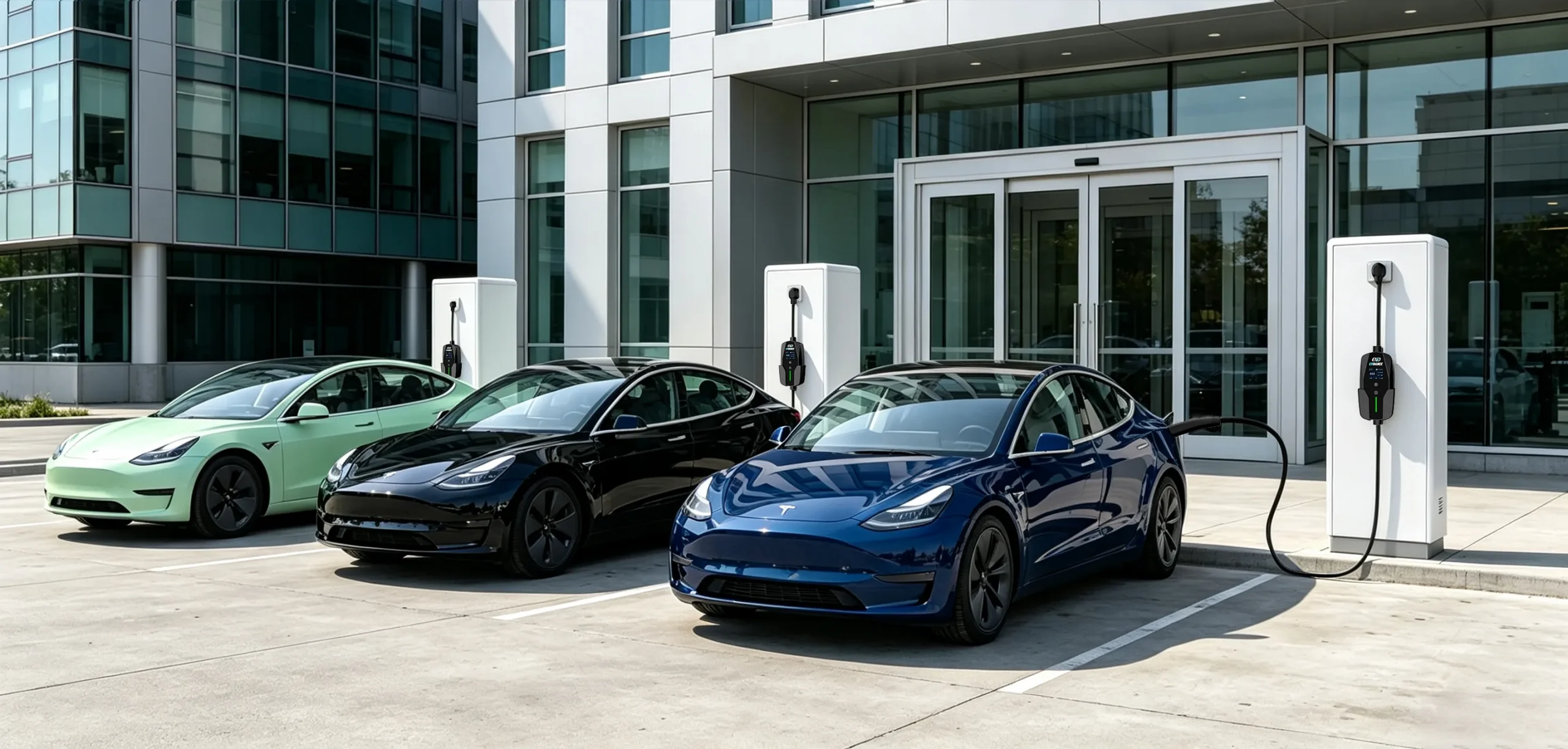
For a shared car park, the EV-AC03201T dual-connector AC station serves two bays from one unit — two Type 2 connectors sharing up to 43 kW (22 kW per connector), OCPP 1.6J, RFID access, IP54, recording users per session. For single bays, the EV-ACT3204PE 22 kW three-phase wallbox (tethered Type 2 cable, RFID and app, IP66, CE) gives the same per-user record. Neither unit is a payment terminal: if drivers are billed, billing runs on the operator platform the building appoints. EVDANCE is a Shenzhen manufacturer founded in 2011 with a 3-year standard warranty. Projects start through our commercial charging team or contact us.
Frequently Asked Questions
Who normally pays for office EV chargers — the landlord or the tenant?
There is no normal answer that survives contact with a real lease. Buildings split the lines differently: capacity and wiring often follow the building; hardware and running costs follow whoever asked for the charging. What protects both sides is the split written down.
Can a tenant install its own chargers in a landlord’s car park?
Only with the landlord’s written consent, on the building’s terms — the work touches the supply, the insurance and other tenants’ parking. A tenant who installs first usually ends up removing the units.
What happens to the chargers when the tenant leaves?
Whatever the reinstatement clause says. Agree it at the start: whether tenant-owned units are removed, whether landlord-owned units stay, and who pays. It is the cheapest line to settle early, the most expensive at exit.
Related Reading
- How to Plan a Workplace EV Charging Program
- RFID and User Management for Shared EV Chargers
- Apartment and Condo EV Charging: Solutions for Shared Parking

