
A developer specifies apartment charging in clauses, not wishes: how many bays and in what phases, what the building’s supply can carry, which connector and power each bay gets, how residents are admitted and billed, what parking rights the chargers sit on, and what must be provable at handover. Each clause pairs a decision with the evidence that closes it — the load study, the platform terms, the sale or lease document. Written this way, the specification survives the sales launch, the build and the first residents.
Key Takeaways
- Specify apartment charging as clauses: bays and phasing, capacity, connector and power, access, billing, parking rights, expansion, handover.
- Capacity rests on the project’s own load study — charging is a continuous load, sized at 125% under the NEC.
- Parking rights and billing promises live in legal and platform documents; the charger file cannot carry them.
- Spec only what the exact model’s file states; everything else is a written question to the supplier.
The Clauses a Developer Writes
| Clause | What to write | The evidence or decision it rests on |
|---|---|---|
| Bays and phasing | The count per phase, and the trigger that releases the next phase | The project’s own demand evidence — expected EV ownership, the car park count |
| Supply capacity | The capacity the chargers may draw now, and at full build-out | A load study by the project’s licensed electrician; charging is a continuous load, sized at 125% of charger current under the NEC |
| Connector and power per bay | The connector set for the market’s car parc, and the AC class per bay — U.S. DOT figures put Level 2 at 7–19 kW | Datasheets for the exact models specified |
| Access and administration | How a resident is admitted, removed and recorded — RFID or app, as the model states | The administration arrangement named in the building’s management documents |
| Billing model | Free, folded into service charges, or billed per session or per kWh by the appointed platform | The platform terms; per-kWh resident billing is a jurisdiction confirmation, obtained in writing before it is promised |
| Parking rights | Whether charging bays are assigned, shared or bookable, and what a buyer or tenant is actually promised | The sale, lease and parking documents — drafted with the project’s own legal advisers |
| Expansion provision | Spare capacity, cable routes and spaces reserved for later phases | The electrical drawings showing the provision — a drawing, not a promise |
| Handover pack | Certificates, declarations, manuals and warranty text naming the exact models installed | The documentation pack delivered at completion |
What the Specification Must Not Borrow
A product family’s top figures are not the specified unit’s rating; the datasheet for the exact model is. A dual-connector station’s stated ability to allocate power applies between its own two connectors — site-wide load management across a car park is a separate project decision, and the spec must not write one as the other. A station screen is a display, not a payment terminal or a meter; if the billing clause promises a price, the platform terms are the evidence. Anything a model’s file does not state becomes a written question to the supplier. The resident’s side of the same car park is covered in our guide to apartment and condo charging in shared parking.

EVDANCE Hardware Written Into an Apartment Spec
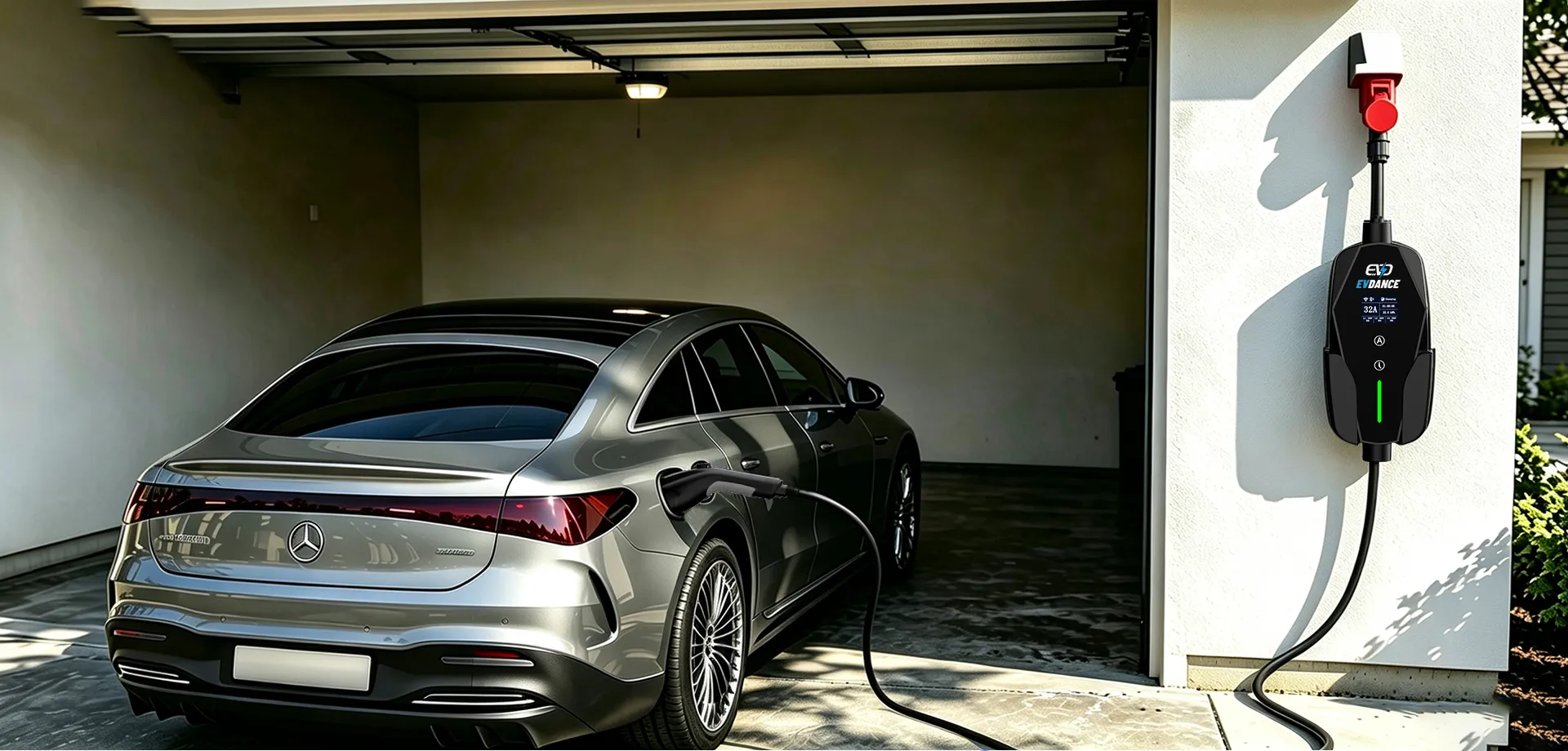
For a wall-mounted point per bay, the EV-ACT3204PE enters the spec as: 22 kW three-phase wallbox, tethered Type 2 cable — the clause names which — RFID and app access, IP66, CE. For a shared pair of bays, the EV-AC03201T enters as: floor-standing dual-connector AC station, two Type 2 connectors sharing up to 43 kW (22 kW per connector), OCPP 1.6J, RFID, IP54, sessions recorded per user. Neither entry claims billing: resident payment runs on the platform the building appoints. EVDANCE is a Shenzhen manufacturer founded in 2011, with a 3-year standard warranty. Developer enquiries go through our residential charging page or contact us, naming the project and the phase count.
Frequently Asked Questions
Who writes the apartment charging specification?
The developer’s design team writes it, the project’s licensed electrician owns the capacity figures, and the parking-rights wording belongs in the project’s legal documents, drafted with its own advisers. No single party can write all three parts credibly.
Assigned or shared bays — which should the spec choose?
The project’s sales model decides. Assigned bays simplify access and administration; shared bays spread fewer units across more residents and need booking or access rules. The choice changes the unit count, so it is written as a decision, not left as a default.
Can residents be billed per kWh?
It depends on the jurisdiction’s metering and resale position, which varies. Treat per-kWh billing as a written confirmation to obtain before the billing model is promised to buyers or tenants.
Related Reading
- Apartment and Condo EV Charging: Solutions for Shared Parking
- How to Charge an EV When You Live in an Apartment
- RFID and User Management for Shared EV Chargers
- Adding EV Chargers to a Building: Load Calculation Basics

